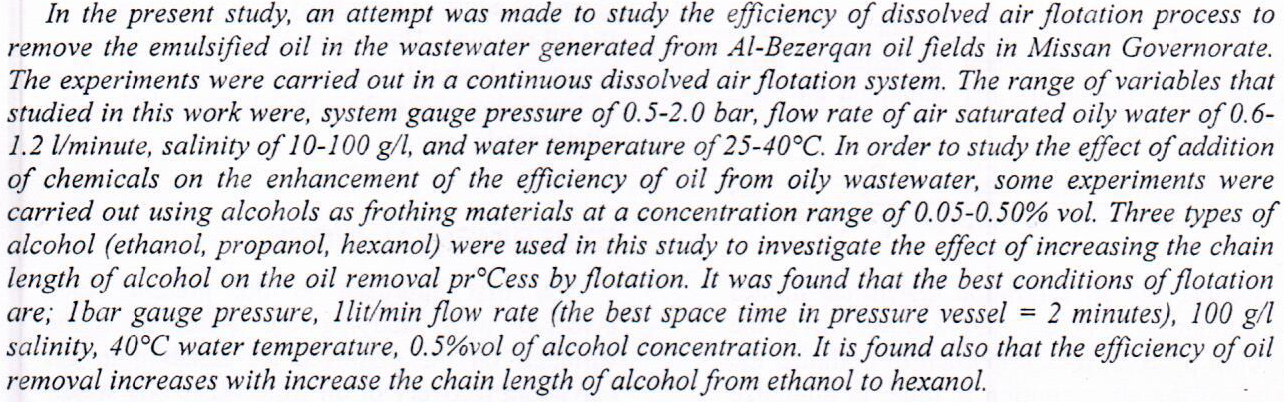
Oil Removal from Wastewater of Al-Bezerqan Crude Oil Fields by Air Flotation

IA Ali, FK Emran, DF Salloom, Annals of the Romanian Society for Cell Biology, 2021
The present study was performed to detect the molecular and the phylogenetic identification of species that belonging to the genus of Moniezia Blanchard, 1891 which affected intestines of sheep in Al-Diwaniyah city, Iraq; fifty intestine samples were sought for the infestation of Moniezia spp. from the city slaughterhouse from 1 October to 30 November 2017, this tapeworm was found to infest the intestines of 13 sheep.
For morphological identify the genus of this tapeworm, eggs from one gravid proglottid of the thirteen worms were examined, polymerase chain reaction (PCR) and the PCR-product-based sequencing were applied on 4 Moniezia tapeworms targeti
... Show More (7)
(7)
 (3)
(3)


This study is aimed to Green-synthesize and characterize Al NPs from Clove (Syzygium aromaticum
L.) buds plant extract and to investigate their effect on isolated and characterized Salmonella enterica growth.
S. aromaticum buds aqueous extract was prepared from local market clove, then mixed with Aluminum nitrate
Al(NO3)3. 9 H2O, 99.9% in ¼ ratio for green-synthesizing of Al NPs. Color change was a primary confirmation
of Al NPs biosynthesis. The biosynthesized nanoparticles were identified and characterized by AFM, SEM,
EDX and UV–Visible spectrophotometer. AFM data recorded 122nm particles size and the surface roughness
RMs) of the pure S. aromaticum buds aqueous extract recorded 17.5nm particles s
(4)
(2)
Electrochemical decolorization of direct black textile dye was studied in the presence of sodiumhydroxide (NaCl). Electrochemical cell occupy about 1 liter of working electrolyte supplied with graphiteelectrodes for both anode and cathode was constructed for this purpose. Decolorization percent, treatment time, power consumption, and pH were studied as a function of the applied voltage and salt concentration. Results show that decolorization increase with increasing salt concentration and applied voltage. Best decolorization of 86% can be achieved after 17 min at 7 volt and 5 g/l salt concentration. Further decolorization can be achieved but this will be accompanied with a sharp increase in power consumption. No significant decrease
... Show More
(2)
The contamination of soil with the wastes of oil industry products that are complex mixtures of hydrocarbons increased recently due to the large development of oil industries in Iraq. This study deals with the remediation of low permeability contaminated clayey soil by using the enhanced electrokinetic technique (EK). The contaminated soil samples obtained from Thi-Qar oil refinery plant in Al-Nassyriah city, where the byproducts of refinery plant are disposed into that site. The byproduct contaminant treated as total petroleum hydrocarbons (TPH) to avoid dealing and complexity of treating the individual minerals and compounds consisting the contaminant. The initial concentrations of TPH were (702.7, 1168, 1235) ppm in the contaminated s
... Show MoreShatt Al-Arab River in Al Basrah, Iraq, has recently recorded massive levels of TDS values (Total Dissolved Solids) in the water as a result of reduced fresh water discharge from sources, causing the river to become salinized due to salt wedge intrusion. Therefore, a block dam in the south reach is required to salt intrusion prevention. The main objective of this research is to simulate the hydraulic impact of a suggested barrage in Ras Al Besha on the Shatt Al-Arab River. The HEC-RAS (5.0.7) model was used to develop a one-dimensional unsteady model to gaining an understanding of the proposed barrage's influence on river behaviour. The daily discharges of the Tigris River provided as the upstream boundary conditions, wh
... Show More
(2)
Began the process of re-engineering processes in the private sector as a way to assist organizations in re-thinking how to run the business in order to improve production processes and reduce operational cost, to get to compete on a global level. That was a major restructuring by further evolution in the use of technology to support innovative operations.
Entered the technology in all areas of life and different regulations, This led to use as a change in all aspects The companies achieved success and progress today through the use of resources so as to ensure the wishes of the customers and their needs, and the requirements of the market primarily, Which is reflected on the basis of building strate
... Show More
(1)
Background: During acrylic resin processing, the mold must be separated from the surface of the gypsum to prevent liquid resin from penetrating into the gypsum, and water from the gypsum seeping into the acrylic resin. For many years, tin foil was the most acceptable separating medium, and because it's difficult to apply, a tin-foil substitute is used. In this study, olive oil is used as an alternative to tin foil separating medium for first time, and evaluating its effect as a separating medium on some mechanical properties such as (indentation hardness and transverse strength) of acrylic resins denture base comparing it with those processed using tin-foil and tin foil substitute such as (cold mold seal) separating medium. Materials and M
... Show MoreThe 17 α-ethinylestradiol (EE2) adsorption from aqueous solution was examined using a novel adsorbent made from rice husk powder coated with CuO nanoparticles (CRH). Advanced analyses of FTIR, XRD, SEM, and EDSwere used to identify the classification parameters of a CRH-like surface morphology, configuration, and functional groups. The rice husk was coated with CuO nanoparticles, allowing it to create large surface area materials with significantly improved textural qualities with regard to functional use and adsorption performance, according to a detailed characterization of the synthesized materials. The adsorption process was applied successfully with elimination effectiveness of 100% which can be kept up to 61.3%. The parameters of ads
... Show More
(16)
(14)

In addition to its basic communicative function, language can be used to imply information that is not actually stated, i.e. addressers do not always state exactly (or directly) what they mean. Such instances fall within the domain of pragmatics in that they have to do with how addressers use language to communicate in a particular situation by implication rather than by direct statement. The researcher attempts to demonstrate that the beauty and the multiple layers of meaning in poetry can be better explored if the addressee looks at the lines from a pragmatic perspective in search for implied meaning. There are many devices that can convey implied meaning in poetry, among which are 'rhetorical', 'figurative' or 'literary' devices. But
... Show More