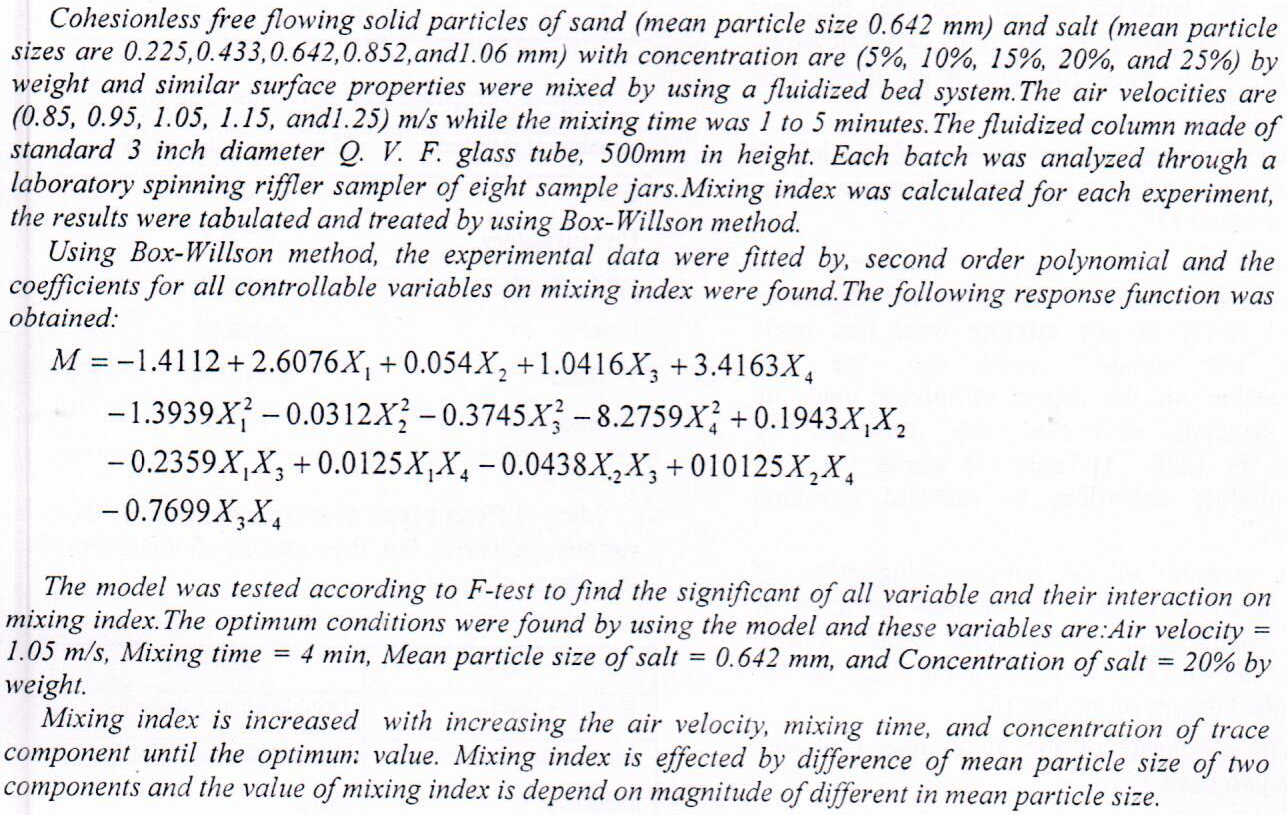
Performance of Mixing Granules Solid Materials by Fluidization

Turbidity is a visual property of water that expresses the amount of suspended substances in the water. Its presence in quantities more significant than the permissible limit makes the water undrinkable and reduces the effectiveness of disinfectants in treating pathogens. On this basis, turbidity is used as a basic indicator for measuring water quality. This study aims to evaluate the removal efficiency of AL- Muthanna WTP. Water turbidity was used as a basic parameter in the evaluation, using performance improvement evaluation and data from previous years (2016 to 2020). The average raw water turbidity was 26.7 NTU, with a minimum of 14 NTU, with a maximum of 48 NTU. Water turbidity value for 95% of settling daily readi
... Show More (9)
(9)
 (6)
(6)


This study explores the role of nanomaterials in the performance of asphalt binders and mixtures. Two commonly available nanomaterials, i.e., nanosilica (NS) and nanoalumina (NA), were used at contents of 0%, 2%, 4%, 6%, and 8% by weight of asphalt binder. A set of experiments was carried out at the binder level to investigate properties such as penetration, softening point, aging-related mass loss, nanomaterial dispersion (storage stability), and workability (rotational viscosity). In addition, the suitability of NS and NS was also assessed through the testing of nanomodified asphalt mixtures, which focused on Marshall properties, the resilient modulus, moisture susceptibility, permanent deformation, and fatigue resistance. The findings in
... Show More
(3)
(3)

To evaluate and improve the efficiency of photovoltaic solar modules connected with linear pipes for water supply, a three-dimensional numerical simulation is created and simulated via commercial software (Ansys-Fluent). The optimization utilizes the principles of the 1st and 2nd laws of thermodynamics by employing the Response Surface Method (RSM). Various design parameters, including the coolant inlet velocity, tube diameter, panel dimensions, and solar radiation intensity, are systematically varied to investigate their impacts on energetic and exergitic efficiencies and destroyed exergy. The relationship between the design parameters and the system responses is validated through the development of a predictive model. Both single and mult
... Show More
(31)
(38)
Malaysia has been supported by one of the high-speed fiber internet connections called TM UniFi. TM UniFi is very familiar to be used as a medium to apply Small Office Home Office (SOHO) concept due to the COVID-19 pandemic. Most of the communication vendors offer varieties of network services to fulfill customers' needs and satisfaction during the pandemic. Quality of Services is queried by most users by the fact of increased on users from time to time. Therefore, it is crucial to know the network performance contrary to the number of devices connected to the TM UniFi network. The main objective of this research is to analyze TM UniFi performance with the impact of multiple device connections or users' services. The study was conducted
... Show More
(2)
(4)
(3)
This research utilized natural asphalt (NA) deposits from sulfur springs in western Iraq. Laboratory tests were conducted to evaluate the performance of an asphalt mixture incorporating NA and verify its suitability for local pavement applications. To achieve this, a combination of two types of NA, namely soft SNA and hard HNA, was blended to create a binder known as Type HSNA. The resulting HSNA exhibited a penetration grade that adhered to Iraqi specifications. Various percentages of NA (20%, 40%, 60%, and 80%) were added to petroleum asphalt. The findings revealed enhanced physical properties of HSNA, which also satisfied the requirements outlined in the Iraqi specifications for asphalt cement. Consequently, HSNA can serve as an
... Show More
(17)
(8)
The durability of asphalt pavement is associated with the properties and performance of the binder. This work-study intended to understand the impact of blending Styrene-Butadiene-Styrene (SBS) to conventional asphalt concrete mixtures and calculating the Optimum Asphalt Content (OAC) for conventional mixture also; compare the performance between SBS modified with the conventional mixture. Two different kinds of asphalt penetration grades, A.C. (40-50) and A.C. (60-70), were improved with 2.5 and 3.5% SBS polymer, respectively. Marshall properties were determined in this work. Optimum Asphalt Content (OAC) was 4.93 and 5.1% by weight of mixture for A.C. (40-50) and (60-70), respectively. Marshall properties results show an increasem
... Show More
(18)
(11)
Sensitive information of any multimedia must be encrypted before transmission. The dual chaotic algorithm is a good option to encrypt sensitive information by using different parameters and different initial conditions for two chaotic maps. A dual chaotic framework creates a complex chaotic trajectory to prevent the illegal use of information from eavesdroppers. Limited precisions of a single chaotic map cause a degradation in the dynamical behavior of the communication system. To overcome this degradation issue in, a novel form of dual chaos map algorithm is analyzed. To maintain the stability of the dynamical system, the Lyapunov Exponent (LE) is determined for the single and dual maps. In this paper, the LE of the single and dual maps
... Show More
(5)
(1)
(15)
(11)
This research utilized natural asphalt (NA) deposits from sulfur springs in western Iraq. Laboratory tests were conducted to evaluate the performance of an asphalt mixture incorporating NA and verify its suitability for local pavement applications. To achieve this, a combination of two types of NA, namely soft SNA and hard HNA, was blended to create a binder known as Type HSNA. The resulting HSNA exhibited a penetration grade that adhered to Iraqi specifications. Various percentages of NA (20%, 40%, 60%, and 80%) were added to petroleum asphalt. The findings revealed enhanced physical properties of HSNA, which also satisfied the requirements outlined in the Iraqi specifications for asphalt cement.
Consequently, HS
... Show More
(17)
(8)