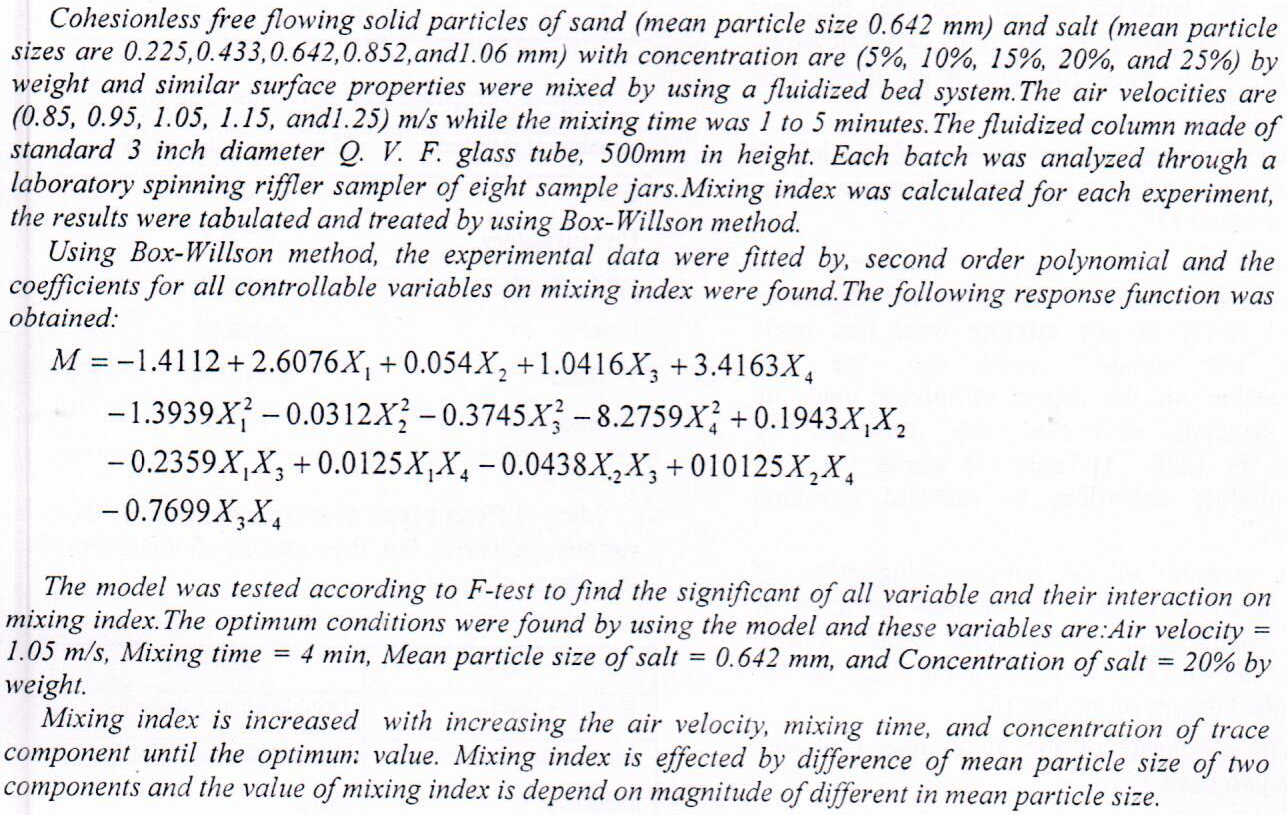
Performance of Mixing Granules Solid Materials by Fluidization

Background: Salivary biomarkers, a non-invasive alternative method to serum and tissue based biomarkers and it is consider as an effective modality for early diagnosis. Salivary microRNA 21, a nucleotide biomarker, was reported to increase in patients with oral squamous cell carcinoma. This study was conducted to measure the fold change of microRNA 21 in stimulated saliva and to study its association with smoking and occurrence of oral squamous cell carcinoma. Materials and methods: A 20 patients with oral squamous cell carcinoma who used to be smokers was included in addition to 40 control subjects (20 smokers and 20 non- smokers health looking subjects). Stimulated saliva was collected under standardized condition. Salivary microRNA 21 wa
... Show More (2)
(2)

A series of experiments were conducted for the first time in Iraq to evaluate the efficiency of five plant leaves extracts (Ibicella lutea, Nerium oleander, Clerodendron inerme, Allium cepa and Eucalyptus spp.) in treating the common carp (Cyprinus carpio) infected with monogenetic trematodes of genera Dactylogyrus. Five different concentrations of such extracts were used to bathe fishes for 5,10,15,20 and 25 minutes. A concentration of 15% A. cepa for 25 minutes of bath exposure was affective in trematode eradication. Extracts of both Eucalyptus and N. oleander at a concentration of 10% each were also affective for ten minutes exposure. Extracts of C. inerme had no any effect on such parasites. On the otherhand, extracts of 1. hitea caused
... Show MoreIn the present research the flame retardancy to buildings and industrial foundations which are manufacturing from advanced polymeric composite material was increased by coating it with surface layer included flame retardant material. A(3mm) thick antimony tetroxide was used as a coated layer to retard and prevent the flame spread to the coating surface of polyester resin (SIROPOL 8340-PI) reinforced with hybrid fibers as a woven roving (°45-°0) consist of carbon and kevlar (49) fibers, and exposed it to direct flame generated from gas torch at temperature of (2000ºC), at different exposed distance (10,15,20mm)and study the rang of resistance for this layer and its ability to protec
... Show MoreThis study was aime to investigate the effect of addition different concentration of celery leaves to white soft cheese ,Treated cheese between 2018-2019, ,The finely Celery (Apium graveolens) leaves were adding to crude white cheese after texturizing in three leveles included (A,B,C) in addition of control antimicrobial activity of celery treated cheese against total account bacteria and coliform bacteria was estimated during (0, 5, 10, 15, 20) days. The results were shown that the higher concentration of celery in treated cheese, had a lower concentration of protein, lipid and ash content ( 16.81,15.13 and 4.30% respectively, but it had a higher moisture content 59.50%.also the total bacteria counts were decreasing significantly (0.05 P)w
... Show More (11)
(11)
 (15)
(8)
(15)
(8)

Background: Bone defect healing is a multidimensional procedure with an overlapping timeline that involves the regeneration of bone tissue. Due to bone's ability to regenerate, the vast majority of bone abnormalities can be restored intuitively under the right physiological conditions. The goal of this study is to examine the immunohistochemistry of bone sialoprotein in order to determine the effect of local application of bone sialoprotein on the healing of a rat tibia generated bone defect. Materials and Methods: In this experiment, 48 albino male rats weighing 300-400 grams and aged 6-8 months will be employed under controlled temperature, drinking, and food consumption settings. The animals will be subjected to a surgical procedure o
... Show More
(1)
(1)
Films of pure Poly (methyl methacrylate) (PMMA) doped by potassium iodide (KI) salt with percentages (1%) at different thickness prepared by casting method at room temperature. In order to study the effect of increasing thickness on optical properties, transmission and absorption spectra have been record for five different thicknesses(80,140,210,250,320)µm. The study has been extended to include the changes in the band gap energies, refractive index, extinction coefficient and absorption coefficient with thickness.
The corrosion of carbon steel in single phase (water with 0.1N NaCl ) and two immiscible phases (kerosene-water) using turbulently agitated system is investigated. The experiments are carried out for Reynolds number (Re) range of 38000 to 95000 corresponding to rotational velocities from 600 to 1400 rpm using circular disk turbine agitator at 40 0C. In two-phase system test runs are carried out in aqueous phase (water) concentrations of 1 % vol., 5 % vol., 8% vol., and 16% vol. mixed with kerosene at various Re. The effect of Reynolds number (Re), percent of dispersed phase, dispersed drops diameter, and number of drops per unit volume on the corrosion rate is investigated and discussed. Test runs are carried out using two types of
... Show More
(4)
(1)
(5)
(3)