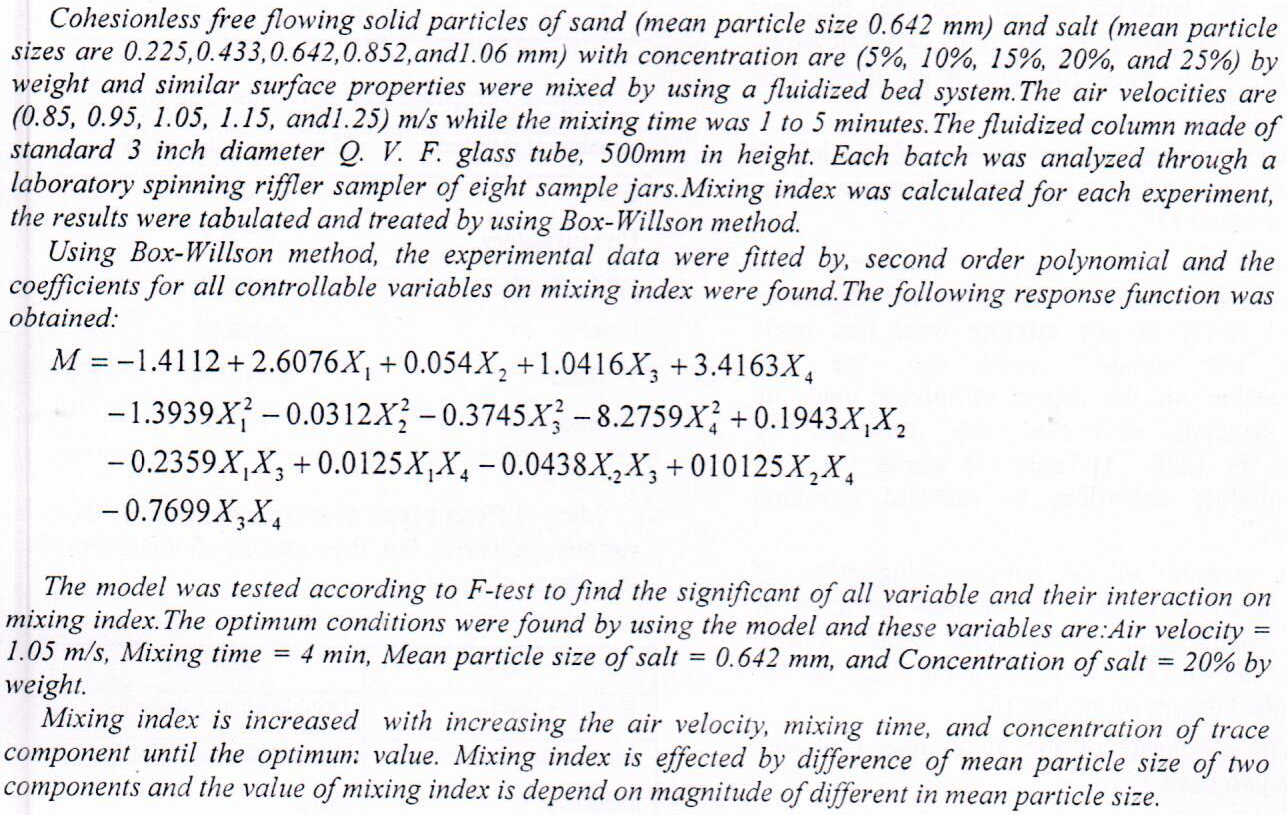
Performance of Mixing Granules Solid Materials by Fluidization



This contribution evaluates the influence of Cr doping on the ground state properties of SrTiO3 Perovskite using GGA-PBE approximation. Results of the simulated model infer agreement with the previously published literature. The modification of electronic structure and optical properties due to Cr3+ doping levels in SrTiO3 has been investigated. Structural parameters infer that Cr3+ doping alters the electronic structures of SrTiO3 by shifting the conduction band through lower energies for the Sr and Ti sites. Substituting Ti site by Cr3+ results the energy gap in being eliminated revealing a new electrical case of conducting material for the system. Furthermore, it has been noticed that Cr doping either at Sr or Ti positions could effectiv
... Show MoreFind goal to detect educational and technical staffing of style fiction in book reading school materials so determine the current research on the specific book reading in fourth grade of primary for the academic year 2014 issued by the Ministry of Education / Republic Iraq stories. Come in the importance of research to draw attention to the best of these stories and strengthened, and the negative deny it and claim his deportation in order to protect the thought of the learner, and the study may contribute to the development of some frameworks to write a story appropriate for elementary school. This McCann within the first chapter The second chapter included the theoretical framework has been contained on two main sections included the co
... Show More
Functionally graded materials (FGMs), with ceramic –ceramic constituents are fabricated using powder technology techniques. In this work three different sets of FGMs samples were designed in to 3 layers, 5 layers and 7 layers. The ceramic constituents were represented by hard ferrite (Barium ferrite) and soft ferrite (lithium ferrite). All samples sintered at constant temperature at 1100oC for 2 hrs. and characterized by FESEM. Some physical properties were measured for fabricated FGMs include apparent density, bulk density, porosity, shrinkage and hardness. The results indicated that the density increase with the increase the number of layer. Lateral shrinkage is one of the important parameter f
... Show More (1)
(1)
This research aims to improve the radiation shielding properties of polymer-based materials by mixing PVC with locally available building materials. Specifically, two key parameters of fast neutron attenuation (removal cross-section and half-value layer) were studied for composite materials comprising PVC reinforced with common building materials (cement, sand, gypsum and marble) in different proportions (10%, 30% and 50% by weight). To assess their effectiveness as protection against fast neutrons, the macroscopic neutron cross-section was calculated for each composite. Results show that neutron cross-section values are significantly affected by the reinforcement ratios, and that the composite material PVC + 50% gypsum is an effect
... Show More (3)
(1)
(4)
(4)
(3)
(1)
(4)
(4)

Iraqi siliceous rocks were chosen to be used as raw materials in this study which is concern with the linear shrinkage and their related parameters. They are porcelinite from Safra area (western desert) and Kaolin Duekla, their powders were mixed in certain percentage, to shape compacts and sintered. The study followed with thermal and chemical treatments, which are calcination and acid washing. The effects on final compact properties such as linear shrinkage were studied. Linear shrinkage was calculated for sintered compacts to study the effects of calcination processes, chemical washing, weight percentage, sintering processes, loading moment were studied on this property where the compacts for groups is insulating materials.
Linear
Refractories are mineral and chemical-, based, materials with excellent heat resistance, making them ideal for use in the construction of ovens, furnace walls industries. According to this our research is concerned to study the effect of addition of (4% CaO) and (5% graphite) on the silica brick properties. Different amounts of CaO and Graphite were included in the white sand (raw ingredients) of silica bricks as a binder to prepare the composition then the composition were sintered using Different sintering temperatures ranging from (1000–1400)𝛐C under static air. Density, thermal conductivity, porosity, and water absorption Compression there was power tested after sintering. XRD analysis was used to identify raw materials’
... Show More
