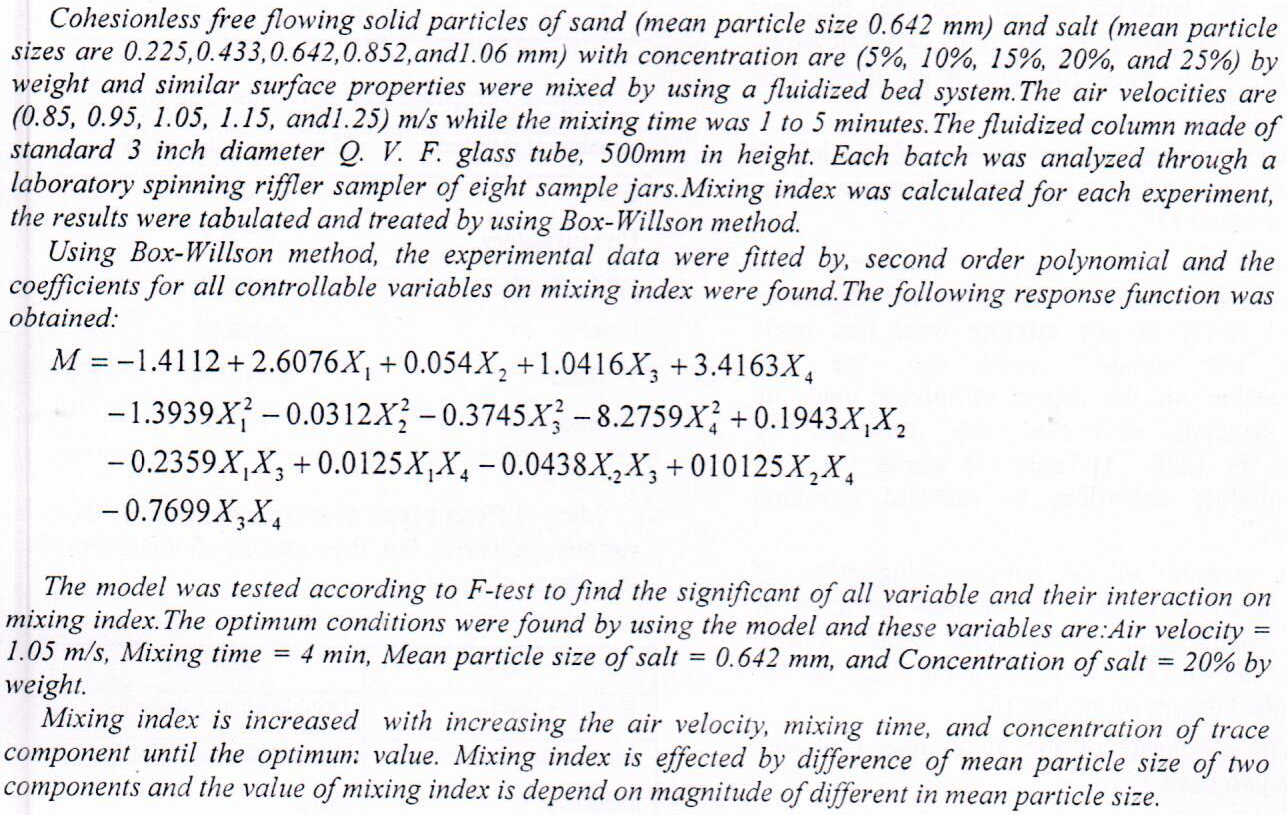
Performance of Mixing Granules Solid Materials by Fluidization

Objectives To tailor composites of polyethylene–hydroxyapatite to function as a new intracanal post for the restoration of endodontically treated teeth (ETT). Methods Silanated hydroxyapatite (HA) and zirconium dioxide (ZrO2) filled low-density polyethylene (LDPE) composites were fabricated by a melt extrusion process and characterised using infrared spectroscopy (FTIR), differential scanning calorimetry (DSC) and dynamic mechanical analysis (DMA). The flexural strength and modulus were determined in dry state and post ageing in simulated body fluid and fractured surfaces analysed by SEM. The water uptake and radiographic appearance of the experimental composites were also measured and compared with a commercially known endodontic fibre
... Show More (3)
(3)
 (1)
(2)
(1)
(2)


 (3)
(3)
Many nations are seeing an increase in water pollution from dairy and cheese production due to the high organic and fat content in their waste products and the high temperature of their waste products, which elevates the water temperature and causes loss to ecosystem components. Reusing industrial wastewater that has been treated to guarantee no harm has been done to the environment is being hampered by a lack of water. This study compares the presence and absence of mixing in the anaerobic biological treatment of liquid waste for the cheese industry. To decrease heat exchange with the external environment, cube-shaped anaerobic reactors with dimensions of (30 x 30 x 30) cm and thick glass (10 mm) were utilized in this investigation
... Show More
(1)
(1)
A numerical method (F.E.)was derived for incompressible viscoelastic materials, the aging and
environmental phenomena especially the temperature effect was considered in this method. A
treatment of incompressibility was made for all permissible values of poisons ratio. A
mechanical model represents the incompressible viscoelastic materials and so the properties can
be derived using the Laplace transformations technique .A comparison was made with the other
methods interested with viscoelastic materials by applying the method on a cylinder of viscoelastic material surrounding by a steel casing and subjected to a constant internal pressure, as well as a comparison with another viscoelastic method and for Asphalt Concrete pro
The aim of this research is to study the surface alteration characteristics and surface morphology of the superhydrophobic/hydrophobic nanocomposite coatings prepared by an electrospinning method to coat various materials such as glass and metal. This is considered as a low cost method of fabrication for polymer solutions of Polystyrene (PS), Polymethylmethacrylate (PMMA) and Silicone Rubber (RTV). Si were prepared in various wt% of composition for each solutions. Contact angle measurement, surface tension, viscosity, roughness tests were calculated for all specimens. SEM showed the morphology of the surfaces after coated. PS and PMMA showed superhydrophobic properties for metal substrate, while Si showed hydroph
... Show More
(28)
(12)
(12)
(10)
Most of the recent works related to the construction industry in Iraq are focused on investigating the validity of local raw materials as alternatives to the imported materials necessary for some practical applications, especially in thermal and sound insulation. This investigation includes the use of limestone dust as partial substitution of cement in combination with foam agent and silica fume to produce sustainable Lightweight Foam Concrete (LWFC). This study consists of two stages. In the first stage, trial mixes were performed to find the optimum dosage of foam agent. Limestone dust was used as a partial replacement for cement. Chemical analysis and fineness showed great similarity with cement. Many concrete mixes were prepared
... Show More
(26)