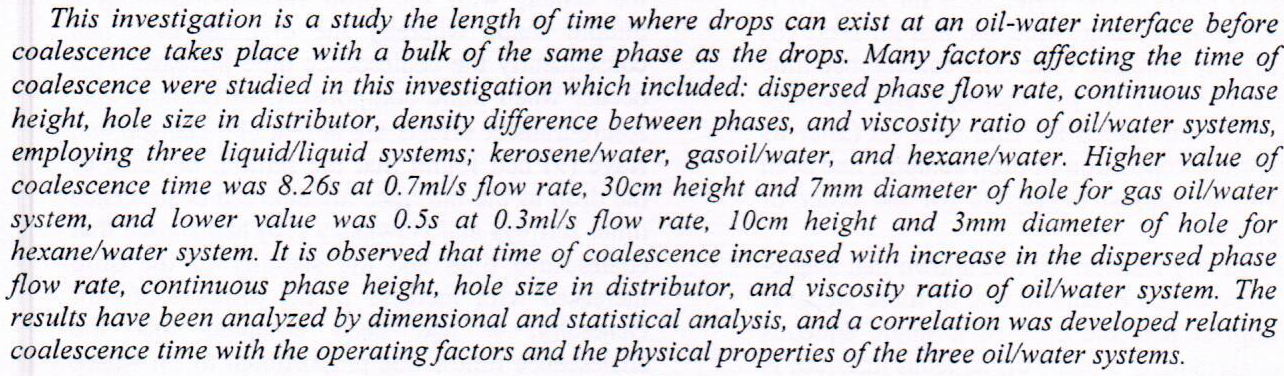
Drop Interface Coalescence in Liquid-Liquid System

Developments are carried out to enhance the performance of vertical axis wind turbines (VAWT). This paper studies the performance of the ducted wind turbine with convergent duct (DAWT). Basically, the duct technique is utilized to provide the desired wind velocity facing the turbine. Methodology was developed to estimate the decisive performance parameter and to present the effect of the convergent duct with different inlet angles. The ducted wind turbine was analyzed and simulated using MATLAB software and numerically using ANSYS-Fluent 17.2. Result of both approaches were presented and showed good closeness for the two cases of covering angles 12 and 20 respectively. Results also showed that the convergent duct with an inlet angl
... Show More (1)
(1)

Pulsatile drug delivery systems are time-controlled dosage forms which are designed to release the active pharmaceutical ingredient after a predetermined lag time to synchronize the disease circadian rhythm. A migraine shows circadian rhythm with a marked increase in attacks between 6 a.m. and 8 a.m.
Sumatriptan is a selective agonist at serotonin (5-Hydroxy tryptamine1 (5-HT1))receptors, is an effective treatment for acute migraine attacks.
The aim of this work is to prepare time-controlled press-coated tablet with a lag time of 5.45 hrs.
Six formulas of fast dissolving core tablets and three formulas of press-coated tablets were prepared by using direct compression method using different variables to prepa
... Show More (7)
(1)
(7)
(1)

This paper presents an improved technique on Ant Colony Optimization (ACO) algorithm. The procedure is applied on Single Machine with Infinite Bus (SMIB) system with power system stabilizer (PSS) at three different loading regimes. The simulations are made by using MATLAB software. The results show that by using Improved Ant Colony Optimization (IACO) the system will give better performance with less number of iterations as it compared with a previous modification on ACO. In addition, the probability of selecting the arc depends on the best ant performance and the evaporation rate.
In this study, the optimum conditions for COD removal from petroleum refinery wastewater by using a combined electrocoagulation- electro-oxidation system were attained by Taguchi method. An orthogonal array experimental design (L18) which is of four controllable parameters including NaCl concentration, C.D. (current density), PH, and time (time of electrolysis) was employed. Chemical oxygen demand (COD) removal percentage was considered as the quality characteristics to be enhanced. Also, the value of turbidity and TDS (total dissolved solid) were estimated. The optimum levels of the studied parameters were determined precisely by implementing S/N analysis and analysis of variance (ANOVA). The optimum conditions were found to be NaCl = 2.5
... Show More
(7)
(1)

The performance of a solar assisted desiccant cooling system for a meeting-hall located in the College of Engineering/University of Baghdad was evaluated theoretically. The system was composed of four components; a solar air heater, a desiccant dehumidifier, a heat exchanger and an evaporative cooler. A computer simulation was developed by using MATLAB to assess the effect of various design and operating conditions on the performance of the system and its components. The actual weather data on recommended days were used to assess the load variation and the system performance during those days. The radiant time series method (RTS) was used to evaluate the hourly variation of the cooling load. Four operation modes were employed for perform
... Show More
(51)
(46)
Ball and Plate (B&P) system is a benchmark system in the control engineering field that has been used to verify many control methods. In this paper the design of a sliding mode . controller has been investigated and verified in real-time via implementation on a real ball and plate system hardware. The mathematical model has been derived and the necessary parameters have been measured. The sliding mode controller has been designed based on the obtained mathematical model. The resulting controller has been implemented using the Arduino Mega 2560 and a ball and plate system built completely from scratch. The Arduino has been programmed by the Arduino support target for Simulink. Three test signals has been used for verification purposes
... Show MoreMPEG-DASH is an adaptive bitrate streaming technology that divides video content into small HTTP-objects file segments with different bitrates. With live UHD video streaming latency is the most important problem. In this paper, creating a low-delay streaming system using HTTP 2.0. Based on the network condition the proposed system adaptively determine the bitrate of segments. The video is coded using a layered H.265/HEVC compression standard, then is tested to investigate the relationship between video quality and bitrate for various HEVC parameters and video motion at each layer/resolution. The system architecture includes encoder/decoder configurations and how to embedded the adaptive video streaming. The encoder includes compression besi
... Show MoreThis research aims primarily to highlight personal tax exemptions A comparative study with some Arab and European regulations. And by conducting both theoretical comparative analyses. Most important findings of the study is the need to grant personal and family exemptions that differ according to the civil status of the taxpayer (single or married). In other words, the exemption increases as the number of family members depend on its social sense. Also taking into account some incomes that require a certain effort and looking at the tax rates, it is unreasonable for wages to be subject to the same rates applied to commercial profits.
This paper deals with a Twin Rotor Aerodynamic System (TRAS). It is a Multi-Input Multi-Output (MIMO) system with high crosscoupling between its two channels. It proposes a hybrid design procedure that combines frequency response and root locus approaches. The proposed controller is designated as PID-Lead Compensator (PIDLC); the PID controller was designed in previous work using frequency response design specifications, while the lead compensator is proposed in this paper and is designed using the root locus method. A general explicit formula for angle computations in any of the four quadrants is also given. The lead compensator is designed by shifting the dominant closed-loop poles slightly to the left in the
... Show More
(1)