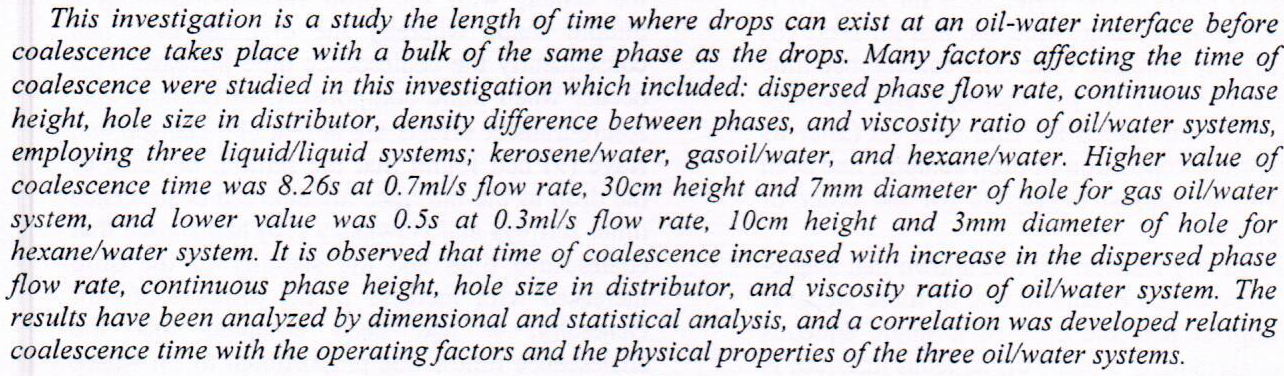
Drop Interface Coalescence in Liquid-Liquid System

The research synthesis variables of competitive advantage and the mechanism achieved by focusing on knowledge abilities and strategic of the administrative leadership, and governments and the developed countries took the racing frantically and my destiny to invest more money and resources to development of wealth and human knowledge is so choice investment winner always and who Aaikhyee never, because God Almighty give humans the abilities of all other creatures and that these abilities varying from person to person, there is the problem of search provoking questions about the essence of what it's about research and both sides theoretical and field, the objective of this research
... Show More (1)
(1)

 (21)
(21)
 (18)
(15)
(18)
(15)

The coronavirus-pandemic has a major impact on women's-mental and physical-health. Polycystic-ovary-syndrome (PCOS) has a high-predisposition to many cardiometabolic-risk factors that increase susceptibility to severe complications of COVID-19 and also exhibit an increased likelihood of subfertility. The study includes the extent of the effect of COVID-19-virus on renin-levels, glutathione-s-transferase-activity and other biochemical parameters in PCOS-women. The study included 120 samples of ladies that involved: 80 PCOS-patients, and 40 healthy-ladies. Both main groups were divided into subgroups based on COVID-19 infected or not. Blood-samples were collected from PCOS-patients in Kamal-Al-Samara Hospital, at the period between Decembe
... Show More
(14)
(9)
Orange peel was used as a plant-derived medium to prepare a ZnO–calcite mixed-phase nanostructured material, which was physicochemically characterized and evaluated for DPPH radical-scavenging, α-glucosidase inhibitory, and in vitro cytotoxic activities. XRD confirmed the coexistence of hexagonal wurtzite ZnO and crystalline calcite, with ZnO apparent crystallite sizes ranging from 9.2 to 28.3 nm (mean 16.4 ± 7.3 nm). FTIR identified Zn–O vibrations, carbonate-related bands, surface hydroxyl groups, and residual organic functionalities, while FESEM revealed irregular agglomerates composed of nanoscale grains. EDX showed Zn, O, C, and Ca as the principal elements, and the material exhibited a zeta potential of -14.86 ± 0.52 mV
... Show More
(20)
Darcy-Weisbach (D-W) is a typical resistance equation in pressured flow; however, some academics and engineers prefer Hazen-Williams (H-W) for assessing water distribution networks. The main difference is that the (D-W) friction factor changes with the Reynolds number, while the (H-W) coefficient is a constant value for a certain material. This study uses WaterGEMS CONNECT Edition update 1 to find an empirical relation between the (H-W) and (H-W) equations for two 400 mm and 500 mm pipe systems. The hydraulic model was done, and two scenarios were applied by changing the (H-W) coefficient to show the difference in results of head loss. The results showed a strong relationship between both equations with correlation coefficients of 0.999,
... Show More
(1)
(3)
In this investigation, deep eutectic solvent based on propionic acid and choline chloride was used to prepare polyaniline, polypyrrole, and poly(aniline-co-pyrrole) samples using chemical oxidation and polymerization. Quantum mechanical calculations were conducted using time-dependent density functional theory to determine the electronic, spectroscopic properties and structure of homopolymers and the copolymer which were compared with the respective experimental data. Furthermore, the synthesized materials were characterized using Fourier transform IR spectroscopy, scanning electron microscopy (SEM), UV-visible spectroscopy, and thermogravimetric analysis. IR and UV-visible spectra confirmed copolymerization, and SEM revealed that the copol
... Show More
(15)
(16)
Background. Endodontic infections caused by remaining biofilm following disinfection with chemical fluids encourage secondary bacterial infection; hence, employing laser pulses to activate the fluids is advised to improve microbial biofilm clearance. This study investigated the performance of Er,Cr:YSGG laser in photon-induced photoacoustic streaming (PIPS) agitation of 5.25% sodium hypochlorite (NaOCl) to enhance the removal of mature Enterococcus faecalis (E. faecalis) biofilms in complex root canal systems. Methods. The mesial roots of the lower first and second molars were separated and inoculated with E. faecalis bacteria for 30 days. The roots were irrigated with 5.25% NaOCl, some of them were agitated with passive ultrasonic
... Show More
(6)
(7)