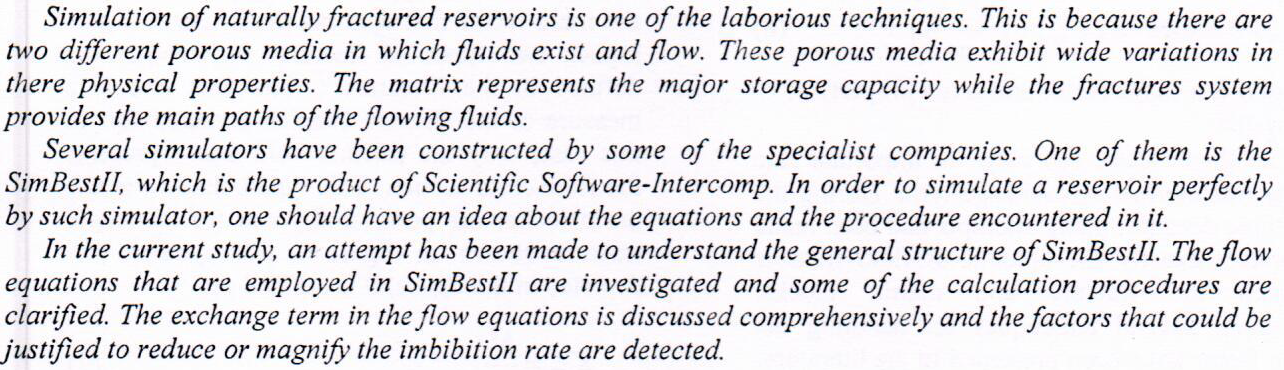
Simulation of naturally Fractured Reservoirs with SimBest ll

The study aimed to identify the social support and its relation with death anxiety for
olds who are listed at the Palestinian ministry of social affairs in the Jerusalem governorate,
the researcher uses the descriptive method and she bases her research on two types of
criterion: the social support and the criterion of death anxiety, these two criterion are applied
on a stratified random sample, amounted to (184) of the elderly.
The results show no statistical differences in the level of social support for olds who
are listed at the Palestinian ministry of social affairs according to the variables of sex.
Whereas there are statistical differences in the level of social support for those olds according
to the variab
We studied the relationship between DNA sequencing of interleukin-10 (IL-10) gene promoter for -1082 (A/G) and -592 (A/C) positions with the concentration of IL-10 in blood serum of Iraqi children with type 1 diabetes mellitus (T1D). Fifty blood serum samples collected from children with age ranged between 7-12 years. Thirty-five blood samples collected from patient children with T1D, and compared with 15 healthy children age matched as control sample. The results revealed decreasing in anti-inflammatory IL-10 concentration in T1D patient’s blood serum (0.068 Pg/ml) as compared with the control sample (0.111 Pg/ml). No significant differences were found in interleukin concentration between the studied samples when they analyzed with the M
... Show MoreThe ligand [Potassium (E)-(4-(((2-((1-(3-aminophenyl) ethylidene) amino)-4-oxo-1,4- dihydropteridin-6-yl) methyl) amino)benzoyl)-L-glutamate] was prepared from the condensation reaction of folic acid with (3-aminoacetophenone) through Schiff reaction to give a new Schiff base ligand [H2L]. The ligand [H2L] was characterized by elemental analysis CHN, atomic absorption (A.A), (FT-I.R.), (U.V.-Vis), TLC, E.S. mass (for spectroscopes), molar conductance, and melting point. The new Schiff base ligand [H2L], reacts with Mn(II), Co(II), Ni(II), Cu(II), Cr(III) and Cd(II) metal ions and (2-aminophenol), (metal : derivative ligand : 2-aminophenol) to give a series of new mixed complexes in the general formula:- K3[M2(HL)(HA)2], (where M=Mn(II) and
... Show MoreA (k,n)-arc is a set of k points of PG(2,q) for some n, but not n + 1 of them, are collinear. A (k,n)-arc is complete if it is not contained in a (k + 1,n)-arc. In this paper we construct complete (kn,n)-arcs in PG(2,5), n = 2,3,4,5, by geometric method, with the related blocking sets and projective codes.

Founding a System to secure deposits and protecting the depositors is considered one of the important and exchanged subjects out there in the banking system/field in Iraq at the current time, and the reason behind the exchange and spread of this subject is due to the financial crisis of which the banking sector is suffering from and the stumbling of many banks, those factors have had led to the insecurity of the depositors and their mistrust towards banks, thus, it is necessary to create a system to secure deposits in which depositors would be compensated for the losses caused by the banks' failures. in addition, it could be a countermeasure system which maintains the banking stability, protects the rights of depositors and gains
... Show More (1)
(1)
The [2-hydroxy -1,2-diphynel-ethanone oxime] was reacted with 1,2- dichloroethan to give the new ligand [H2L].this ligand was reacted with some metal ions (Co(II),Ni(II),Cu(II),Zn(II) and Cd(II) in methanol as a solvent to give a series of new (1:1)complexes of the general formula [ M(HL)]Cl ,( where : M= Co(II),Ni(II),Cu(II),Zn(II) and Cd(II)) are isolated All compounds have been characterized by spectroscopic methods [ I.R , U.V -Vis ] atomic absorption . Chloride content along with conductivity measurements. From the above data the proposed molecular structure for (Co, Cu, Ni, Zn and Cd) complexes adopting a tetrahedral structure.
synthesis and characterization of New schiff base Ligand Derived from 4-amino anti pyrine and it's complexes with some Metal lons and theirAntibacterial studies
This study depicts the removal of Manganese ions (Mn2+) from simulated wastewater by combined electrocoagulation/ electroflotation technologies. The effects of initial Mn concentration, current density (C.D.), electrolysis time, and different mesh numbers of stainless steel screen electrodes were investigated in a batch cell by adopting Taguchi experimental design to explore the optimum conditions for maximum removal efficiency of Mn. The results of multiple regression and signal to noise ratio (S/N) showed that the optimum conditions were Mn initial concentration of 100 ppm, C.D. of 4 mA/cm2, time of 120 min, and mesh no. of 30 (wire/inch). Also, the relative significance of each factor was attained by the analysis of variance (ANO
... Show More
(5)
The research aims to identify the effect of the training program that is based on integrating futuristic thinking skills with classroom interaction patterns on mathematics teachers in order to provide their students with creative solution skills. The research sample consisted of 31teachers (15 teachers for the experimental group and 16 for the control groups). The researcher developed a measure for the academic self-efficacy consisting of (39) items. Its validity, reliability, coefficient of difficulty and discriminatory power were estimated. To analyze the findings, the researcher adopted the Mann-Whitney (U) test and the effect size, and the findings were as follows: There is a statistically significant difference at the significance leve
... Show MoreThe [2-hydroxy-1, 2-diphynel-ethanone oxime] was reacted with 1, 2-dichloroethan to give the new ligand [H2L]. this ligand was reacted with some metal ions (Co (II), Ni (II), Cu (II), Zn (II) and Cd (II) in methanol as a solvent to give a series of new (1: 1) complexes of the general formula [M (HL)] Cl,(where: M= Co (II), Ni (II), Cu (II), Zn (II) and Cd (II)) are isolated All compounds have been characterized by spectroscopic methods [IR, UV-Vis] atomic absorption. Chloride content along with conductivity measurements. From the above data the proposed molecular structure for (Co, Cu, Ni, Zn and Cd) complexes adopting a tetrahedral structure