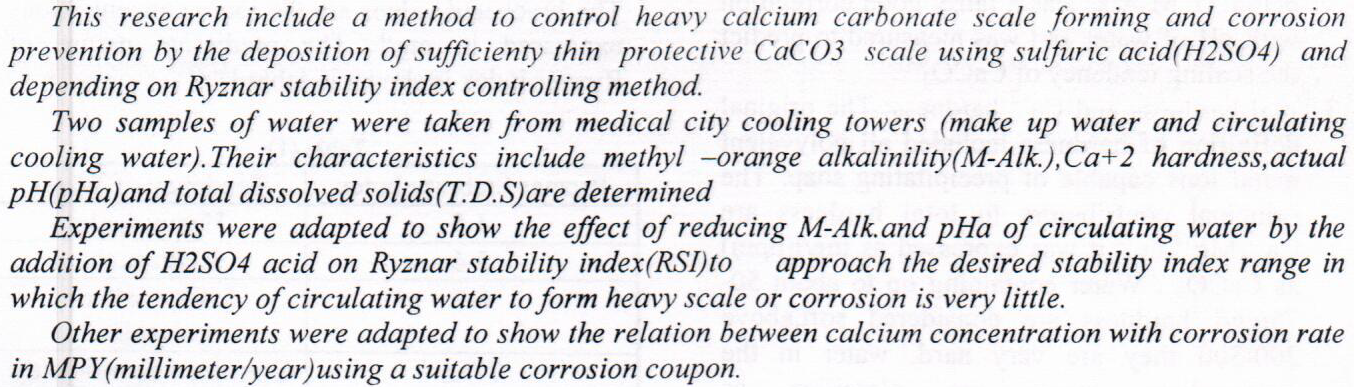
Control of Calcium Scale and Corrosion of Medical City Cooling Water System using Sulfuric Acid

This study investigates the corrosion inhibition performance of a newly synthesized quinazolinone derivative, AMQ, on mild steel in a hydrochloric acid medium. The inhibition efficiency was evaluated using potentiodynamic polarization at varying inhibitor concentrations (100–250 ppm) and temperatures (303– 333 K). The results showed that AMQ exhibited effective corrosion inhibition, with the highest efficiency of 74% observed at 250 ppm and 323 K. Density Functional Theory (DFT) calculations were conducted to study the electronic properties of AMQ and its adsorption behavior. The thermodynamic parameters, including activation energy, enthalpy, and Gibbs free energy, were calculated, indicating spontaneous adsorption of AMQ onto the meta
... Show More

The river water salinity is a major concern in many countries, and salinity can be expressed as total dissolved solids. So, the water salinity impact of the river is one of the major factors effects of water quality. Tigris river water salinity increase with streamline and time due to the decrease in the river flow and dam construction from neighboring countries. The major objective of this research to developed salinity model to study the change of salinity and its impact on the Al-Karkh, Sharq Dijla, Al-Karama, Al-Wathba, Al-Dora, and Al-Wihda water treatment plant along Tigris River in Baghdad city using artificial neural network model (ANN). The parameter used in a model built is (Turbidity, Ec, T.s, S.s, and TDS in)
... Show More (6)
(6)
 (3)
(2)
(47)
(41)
(3)
(2)
(47)
(41)
 (3)
(1)
(3)
(1)
Abstract
Stainless steel (AISI 304) has good electrical and thermal conductivities, good corrosion resistance at ambient temperature, apart from these it is cheap and abundantly available; but has good mechanical properties such as hardness. To improve the hardness and corrosion resistance of stainless steel its surface can be modified by developing nanocomposite coatings applied on its surface. The main objective of this paper is to study effect of electroco-deposition method on microhardness and corrosion resistance of stainless steel, and to analyze effect of nanoparticles (Al2O3, ZrO2 , and SiC) on properties of composite coatings. I
... Show MoreMedical image security is possible using digital watermarking techniques. Important information is included in a host medical image in order to provide integrity, consistency, and authentication in the healthcare information system. This paper introduces a proposed method for embedding invisible watermarking in the 3D medical image. The cover medical image used is DICOM which consists of a number of slices, each one representing a sense, firstly must separate the ROI (Region of Interest) and NROI (Not Region Of Interest) for each slice, the separation process performed by the particular person who selected by hand the ROI. The embedding process is based on a key generated from Arnold's chaotic map used as the position of a pixel in
... Show More
(3)
The aims of the lecture should be clearly defmed. These will help to define the teaching methods and the structure. If, for example, the purpose of the lecture is to introduce new knowledge and concepts, then a classic lecture structure might be most appropriate. On the other hand, if the purpose is to make the students aware of different approaches to a particular clinical problem, a problem oriented design in which alternative approaches are presented and discussed might be a more appropriate fonnat.
Lectures are still a common teaching methOd in both undergraduate and postgraduak medical education. Properly done, the lectwe is a creative and personal work by the teachll:l modeled upon his intellectual scaffolding. Few other fonns o

(1)