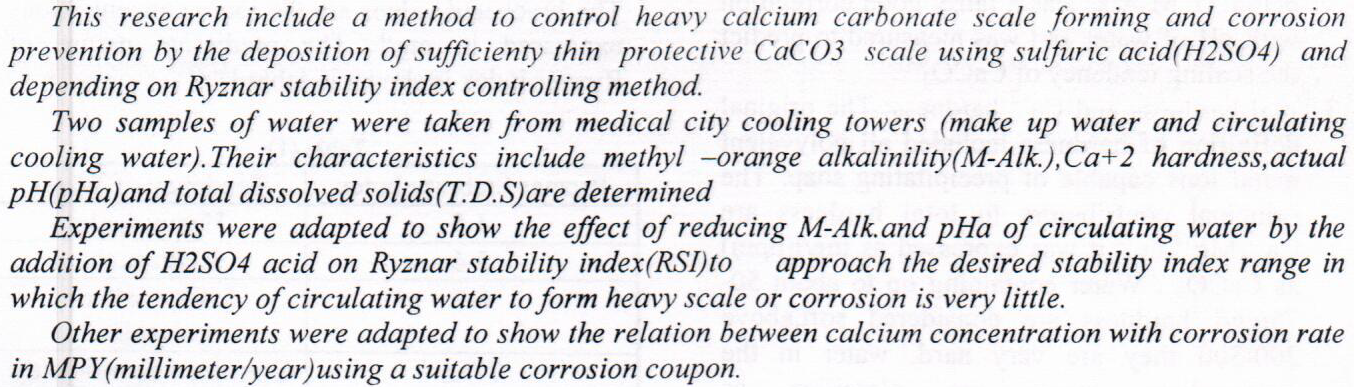
Control of Calcium Scale and Corrosion of Medical City Cooling Water System using Sulfuric Acid

In this work, the possibility of utilizing osmosis phenomenon to produce energy as a type of the renewable energy using Thin Film Composite Ultra Low Pressure membrane TFC-ULP was studied. Where by forward osmosis water passes through the membrane toward the concentrated brine solution, this will lead to raise the head of the high brine solution. This developed static head may be used to produce energy. The aim of the present work is to study the static head developed and the flux on the high brine water solution side when using forward and reverse osmosis membranes for an initial concentration range from 35-300 g/l for each type of membrane used at room temperature and pressure conditions, and finally calculating the maximum possible po
... Show More (5)
(5)


This study investigated a novel application of forward osmosis using different types of draw solutions for oilfield produced water treatment from the East Baghdad oilfield affiliated to the Midland Oil Company (Iraq). Magnesium chloride (MgCl2) and magnesium sulfate (MgSO4) were used as draw solutions in forward osmosis process to evaluate their effectiveness. Experiments were conducted in a laboratory scale forward osmosis system with cellulose triacetate hollow fiber membrane. In this work, sodium chloride solution was used as a feed solution with a concentration of 76 g/L (same concentration as the East Baghdad oilfield produced water) and the applied external pressure on the feed solution side was 2 bar. The impact of draw solution (DS)
... Show MoreWearable sensors are a revolutionary tool in agriculture because they collect accurate data on plant environmental conditions that affect plant growth in real-time. Moreover, this technology is crucial in increasing agricultural sustainability and productivity by improving irrigation strategies and water resource management. This review examines the role of wearable sensors in measuring plant water content, leaf and air humidity, stem flow, plant and air temperature, light, and soil moisture sensors. Wearable sensors are designed to monitor various plant physiological parameters in real-time. These data, obtained through wearable sensors, provide information on plant water use and physiology, making our agricultural choices more informed an
... Show More
 (4)
(4)
Experimental model was done for pile model of L / D = 25 installed into a laminar shear box contains different saturation soil densities (loose and dense sand) to evaluate the variation of pore water pressure before and after apply seismic loading. Two pore water pressure transducers placed at position near the middle and bottom of pile model to evaluate the pore water pressure during pullout tests. Seismic loading applied by uniaxial shaking table device, while the pullout tests were conducted through pullout device. The results of changing pore water pressure showed that the variation of pore water pressure near the bottom of pile is more than variation near the middle of pile in all tests. The variation of pore water
... Show More
A novel metal-organic framework (MOF) sorbent based on tannic acid/copper (TA/Cu) was synthesized and characterized for the application of the anticancer drug imatinib (IMA) from biological samples. The TA/Cu MOF was prepared via a facile coordination reaction and thoroughly characterized by SEM, XRD, and FTIR techniques. Critical parameters influencing the extraction efficiency of imatinib mesylate (IMAM), including pH, ionic strength, desorption solvent, and adsorption-desorption time were optimized. With acetonitrile as the desorption solvent, the method demonstrated a broad linear range of 0.55-300 μg L-1 under ideal conditions. Limits of detection and quantification were found to be 0.16 μg L-1 and 0.55 μg L-1, respectively.
... Show More
(4)

A novel metal-organic framework (MOF) sorbent based on tannic acid/copper (TA/Cu) was synthesized and characterized for the application of the anticancer drug imatinib (IMA) from biological samples. The TA/Cu MOF was prepared via a facile coordination reaction and thoroughly characterized by SEM, XRD, and FTIR techniques. Critical parameters influencing the extraction efficiency of imatinib mesylate (IMAM), including pH, ionic strength, desorption solvent, and adsorption-desorption time were optimized. With acetonitrile as the desorption solvent, the method demonstrated a broad linear range of 0.55-300 μg L-1 under ideal conditions. Limits of detection and quantification were found to be 0.16 μg L-1 and 0.55 μg L-1, respectively.
... Show More
(4)