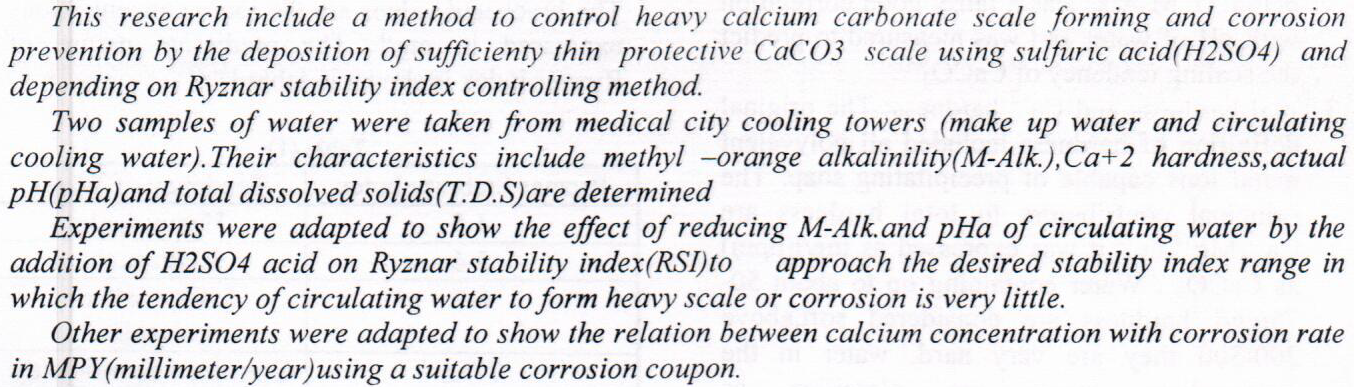
Control of Calcium Scale and Corrosion of Medical City Cooling Water System using Sulfuric Acid

In this study, dead and live anaerobic biomass was used in biosorption of Pb(II), Cr(III) and Cd(II) ions from a synthetic wastewater. The biosorption was investigated by batch adsorption experiments. It was found that, the biosorption capacities were significantly affected by biosorbent dosage. The process follows Langmuir isotherm (regression coefficient 0.995, 0.99 and 0.987 for Pb(II), Cr(III) and Cd(II) ions, respectively, onto dead anaerobic biomass) model with uniform distribution over the biomass surface. The experimental uptake capacity was 51.56, 29.2 and 28 mg/g for Pb(II), Cr(III) and Cd(II), respectively, onto dead anaerobic biomass, compared with 35, 13.6 and 11.8 mg/g for Pb(II), Cr(III) and Cd(II), respectively, onto live
... Show More (4)
(4)

The effect of substitution of Ni on Cu in (Bi0.8Pb0.2)2(Sr0.9Ba0.1)2 Ca2Cu3-x Nix O10+? for (x=0,0.1….1,2,3) superconductor system and sintering time has been investigated .The samples were prepared by solid-state reaction methods. The results show that the optimum sintering temperature is equal to 850 ºC, and the sintering time is equal to 140 h. The highest transition temperature (Tc) obtained for (Bi0.8Pb0.2)2(Sr0.9Ba0.1)2 Ca2Cu3-x NixO10+? composition was 113 with x=0.8 Phase analyses of the samples by X-ray diffraction (XRD) analysis showed an orthorhombic structure with a high Tc phases (2223) as a dominant phase and low Tc phase (2212) in addition to some impurity phases.
(1)
(1)
Software Defined Network (SDN) is a new technology that separate the control plane from the data plane. SDN provides a choice in automation and programmability faster than traditional network. It supports the Quality of Service (QoS) for video surveillance application. One of most significant issues in video surveillance is how to find the best path for routing the packets between the source (IP cameras) and destination (monitoring center). The video surveillance system requires fast transmission and reliable delivery and high QoS. To improve the QoS and to achieve the optimal path, the SDN architecture is used in this paper. In addition, different routing algorithms are used with different steps. First, we eva
... Show More (6)
(3)
(6)
(3)


This paper deals with a Twin Rotor Aerodynamic System (TRAS). It is a Multi-Input Multi-Output (MIMO) system with high crosscoupling between its two channels. It proposes a hybrid design procedure that combines frequency response and root locus approaches. The proposed controller is designated as PID-Lead Compensator (PIDLC); the PID controller was designed in previous work using frequency response design specifications, while the lead compensator is proposed in this paper and is designed using the root locus method. A general explicit formula for angle computations in any of the four quadrants is also given. The lead compensator is designed by shifting the dominant closed-loop poles slightly to the left in the
... Show More
(1)
(6)
(8)
The research dealt with the issue of strategic information systems and its impact on the global marketing channel. As the research aims to know the strategic information systems used in the cement company. Which support the senior management in supporting decisions taken in the process of global orientation and moving to foreign markets by choosing the marketing channel that will suit the company. Product and competition with it. With other companies' products. The problem of the study focused on how to move to global markets, and any marketing channel that can be followed to move the cement product globally, what are the strategic information systems used in the company and how will it contribute to supporting senior management dec
... Show More
This paper proposes a new structure for a Fractional Order Sliding Mode Controller (FOSMC) to control a Twin Rotor Aerodynamic System (TRAS). The new structure is composed by defining two 3-dimensional sliding mode surfaces for the TRAS model and introducing fractional order derivative integral in the state variables as well as in the control action. The parameters of the controller are determined so as to minimize the Integral of Time multiplied by Absolute Error (ITAE) performance index. Through comparison, this controller outperforms its integer counterpart in many specifications, such as reducing the delay time, rise time, percentage overshoot, settling time, time to reach the sliding surface, and amplitude of chattering in control inpu
... Show More This paper describes the application of consensus optimization for Wireless Sensor Network (WSN) system. Consensus algorithm is usually conducted within a certain number of iterations for a given graph topology. Nevertheless, the best Number of Iterations (NOI) to reach consensus is varied in accordance with any change in number of nodes or other parameters of . graph topology. As a result, a time consuming trial and error procedure will necessary be applied
to obtain best NOI. The implementation of an intellig ent optimization can effectively help to get the optimal NOI. The performance of the consensus algorithm has considerably been improved by the inclusion of Particle Swarm Optimization (PSO). As a case s
(29)