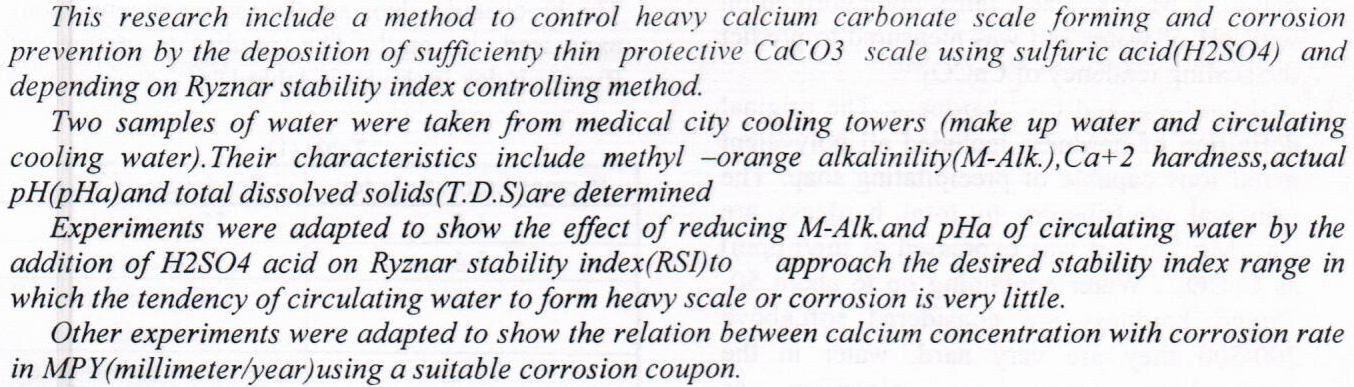
Control of Calcium Scale and Corrosion of Medical City Cooling Water System using Sulfuric Acid

 (11)

The study aims to indicate the role of strategic financial accounting in the service investors to take appropriate decisions in the future, Through what is provided by the strategic accounting, the future of information and data that enable the investor to make future investment decisions appropriate، If no longer traditional financial accounting putting meet all existing and prospective investors Requirements، That reliance on historical data and information already signed and neglected aspect of future, From this point it was to highlight the role of strategic financial accounting to contribute in this area.
In this research the specifications of Iraqi drinking bottled water brands are investigated throughout the comparison between local brands, Saudi Arabia and the World Health Organization (WHO) for bottled water standard specifications. These specifications were also compared to that of Iraqi Tap Water standards. To reveal variations in the specifications for Iraqi bottled water, and above mentioned standards some quality control tools are conducted for more than 33% of different bottled water brands (of different origins such as spring, purified,..etc) in Iraq by investigating the selected quality parameters registered on their marketing labels. Results employing Minitab software (ver. 16) to generate X bar,
... Show MoreAbstract. Froth flotation is a well-known solid-liquid separation technique. Hydrophobicity is the main driving force for such processes. Hydrophobic solids attach to air bubbles and rise up while hydrophilic or less hydrophobic species settle down. Froth can be produced with chemical frothers such as alcohols and polyglycols. However, the use of chemicals limits the use of this separation method in applications such as drinking water, food, and pharmaceutical industries. Therefore, developing a technique that produces froth without adding any chemicals would be useful to such industries. This work demonstrates that with suitable operating parameters a 27 cm froth height can be obtained in a 20 cm diameter column by using an air
... Show More
This research was aimed to study the efficiency of microfiltration membranes for the treatment of oily wastewater and the factors affecting the performance of the microfiltration membranes experimental work were includes operating the microfiltration process using polypropylene membrane (1 micron) and ceramic membrane (0.5 micron) constructed as candle; two methods of operation were examined: dead end and cross flow. The oil emulsion was prepared using two types of oils: vegetable oil and motor oil (classic oil 20W-50). The operating parameters studied are: feed oil concentration 50 – 800 mg/l, feed flow rate 10 – 40 l/h, and temperature 30 – 50 oC, for dead end and cross flow microfiltration.
It was found that water flux decrea
Abstract
The removal of water turbidity by using crumb rubber filter was investigated .The present study was conducted to evaluate the effect of variation of influent water turbidity (10, 25 and 50 NTU), media size (0.6and 1.14mm), filtration rate (25, 45 and 65 l/hr) and bed depth (30 and 60 cm) on the performance of mono crumb rubber filter in response to the effluent filtered water turbidity and head loss development, and compare it with that of conventional sand filter.Results revealed that 25 l/hr flow rate and 25 NTU influent turbidity were the best operating conditions. smaller media size and higher bed depth gave the best removal efficiency while higher media size and small bed depth gave lower head
... Show MoreTo investigate the antiplaque and antigingivitis efficacy in addition to evaluating side effects and subjects’ perceptions of three commercially available mouthwashes.
This study was a double‐blind, parallel, and short‐term trial. A total of 75 dental students with biofilm‐induced gingivitis were included in the final analysis of the current study. Clinical parameters (plaque index and bleeding on probing) and the staining effect were measured at baseline and after 7 days. In addition, a VAS‐based assessment questionnaire was completed by the participants.
 (30)
(27)


Turbidity is a visual property of water that expresses the amount of suspended substances in the water. Its presence in quantities more significant than the permissible limit makes the water undrinkable and reduces the effectiveness of disinfectants in treating pathogens. On this basis, turbidity is used as a basic indicator for measuring water quality. This study aims to evaluate the removal efficiency of AL- Muthanna WTP. Water turbidity was used as a basic parameter in the evaluation, using performance improvement evaluation and data from previous years (2016 to 2020). The average raw water turbidity was 26.7 NTU, with a minimum of 14 NTU, with a maximum of 48 NTU. Water turbidity value for 95% of settling daily reading data was
... Show More
(6)
(3)
(2)
Two samples of (Ag NPs-zeolite) nanocomposite thin films have been prepared by easy hydrothermal method for 4 hours and 8 hours inside the hydrothermal autoclave at temperatures of 100°C. The two samples were used in a photoelectrochemical cell as a photocatalyst inside a cell consisting of three electrodes: the working electrode photoanode (AgNPs-zeolite), platinum as a cathode electrode, and Ag/AgCl as a reference electrode, to study the performance of AgNPs-zeolite under dark current and 473 nm laser light for water splitting. The results show the high performance of an eight-hour sample with high crystallinity compared with a four-hour sample as a reliable photocatalyst to generate hydrogen for renewable energies.