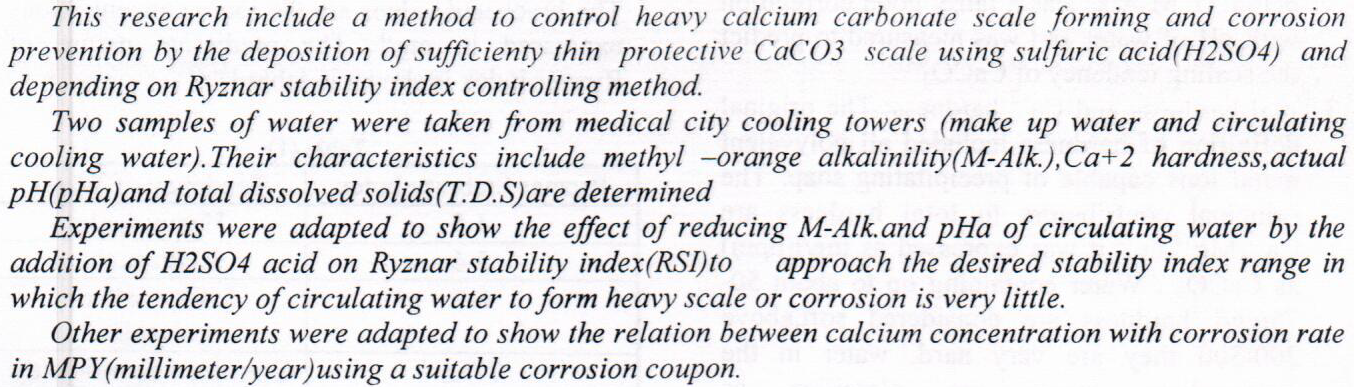
Control of Calcium Scale and Corrosion of Medical City Cooling Water System using Sulfuric Acid

The necessary optimality conditions with Lagrange multipliers are studied and derived for a new class that includes the system of Caputo–Katugampola fractional derivatives to the optimal control problems with considering the end time free. The formula for the integral by parts has been proven for the left Caputo–Katugampola fractional derivative that contributes to the finding and deriving the necessary optimality conditions. Also, three special cases are obtained, including the study of the necessary optimality conditions when both the final time and the final state are fixed. According to convexity assumptions prove that necessary optimality conditions are sufficient optimality conditions.
... Show More (13)
(13)
 (2)
(2)


In this paper, an experimental analysis of conventional air-cooled and microchannel condensers in automotive vapor compression refrigeration cycle concerning heat transfer coefficient and energy using R134a as a refrigerant was presented. The performance of two condensers and cycles tested regarding ambient temperature which it was varied from 40oC to 65oC, while the indoor temperature and load have been set to be 23oC and 2200 W respectively. Results showed that the microchannel condenser has 224 % and 77 % higher refrigerant side and air side heat transfer coefficient respectively than the coefficients of the conventional condenser. Thus, the COP, in case of using the microchannel
... Show More
(4)
(18)
(17)

The present paper investigates the role of fear and predator dependent refuge in the prey-predator system. The system describes the interaction between prey and a stage structure of predator that incorporates Holling II functional response. The predator splits into two compartments immature (juvenile) and mature (adult). The mature predators can hunt and reproduce but this capability is not found in the immature predators, the immature depend on their parents. The growth rate of prey decreases due to the existence of mature predators. The existence, uniqueness, and boundedness of the solution of the system are investigated. Three equilibrium points of the system are determined. The local stability of the system is studied. The global stabil
... Show More
(1)
Mesoporous silica (MPS) nanoparticle was prepared as carriers for drug delivery systems by sol–gel method from sodium silicate as inexpensive precursor of silica and Cocamidopropyl betaine (CABP) as template. The silica particles were characterized by SEM, TEM, AFM, XRD, and N2adsorption–desorption isotherms. The results show that the MPS particle in the nanorange (40-80 nm ) with average diameter equal to 62.15 nm has rods particle morphology, specific surface area is 1096.122 m2/g, pore volume 0.900 cm3/g, with average pore diameter 2.902 nm, which can serve as efficient carriers for drugs. The adsorption kinetic of Ciprofloxacin (CIP) drug was studied and the data were analyzed and found to match well with
... Show More
(31)
(13)
The aim of the research is the detection of heavy metals using (Inductively coupled Plasma ICP) for samples in Tigris river at intakes of water treatment plants Baghdad (Sharq dejla, Al-Wathba, Al-Wahda, and Al-Dora) and samples at Tigris banks near (Al-Adhamya, Al-Shuhda bridge and al-Jadrya).
All the recorded results were fitted with Iraqi standers No. 25 in 1967 for all samples with heavy metals (arsenic Ar, Cadmium Cd, Chromium Cr, Zinc Zn, Lead Pb, Copper Cu, Nickel Ni, Manganese Mn, Ferrous Fe) where all concentration were lower than standard values except Cadmium (0.01- 0.014) in plants intakes and (0.027- 0.048) in river samples while the standard value is (0.005).
Other tests such as chemical oxygen demand and oil &
Steps were taken to obtain the Kojic acid crystals from local fungal isolation A. flavus WJF81 by separating the fermentation products from the fungus mycelium from the production plant at the centrifuge at a speed of 5000 cycles for 10 minutes. The extraction was followed by ethyl acetate then supernatant concentrate by using rotary evaporator, and dried with heat oven 37ºC. Long, yellowish, pristine acid crystals were obtained that examined the optical microscope with a magnification force of 10x and 40x. The melting point of kojic acid was determined between 152.9-153.5 °C Results of the diagnosis of Kojic acid by applying High pressure liquid chromatography HPLC technique showed that the acid was at one peak, which was close to the
... Show MoreIn order to understand the effect of the number of piles (N), the history response of dynamic pile load in piled raft system and deflection time history of piled raft under repeated impact load applied on the center of piled raft resting on loose sand, laboratory model tests were conducted on small-scale models. The results of experimental work are found to be dynamic load increase with increase height of drop, the measured repeated dynamic load time history on the center of piled raft was close approximately to three a half sine wave shape with small duration in about (0.015 Sec). The maximum peak of impact loads occurs in pile and deflection time history occur after at the time of the peak repeated impact loads, dynamic pile load
... Show MoreA hydroponic experiment was carried out at the College of Agricultural Engineering Sciences - University of Baghdad during the fall season of 2019-2020 in order to improve the quality traits of broccoli grown hydroponically under the modified Nutrient Film Technique (NFT), using an internationally approved standard solution and alternative solution, the plant was enriched with ozone and the foliar application of organic nutrients. The Hydroponic study included two experiments with the standard solution (Cooper's solution) and the alternative solution (ABEER). Both experiments were implemented within the Nested Design with three replications, and both included the gas type in the main plot, which were oxygen and ozone, while the sub-
... Show More