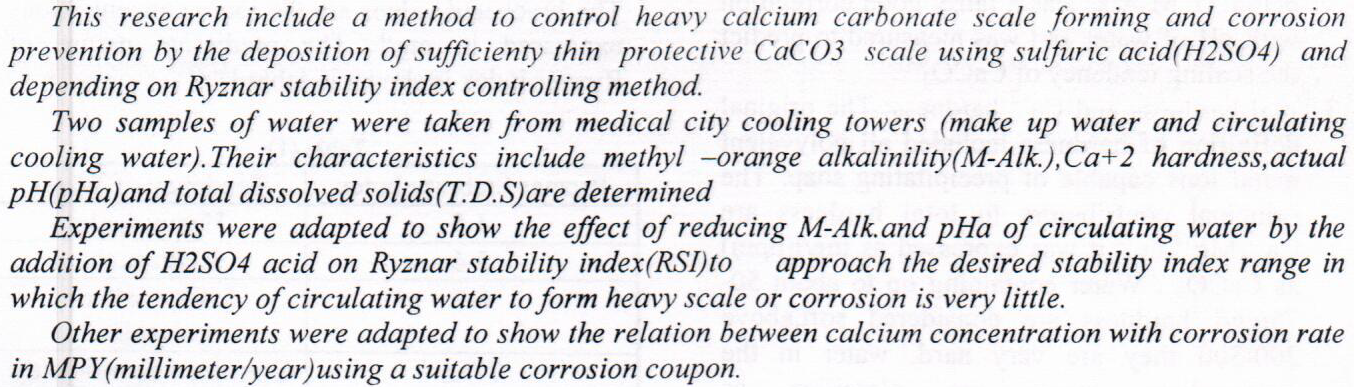
Control of Calcium Scale and Corrosion of Medical City Cooling Water System using Sulfuric Acid

This research studies the influence of water source on the compressive strength of high strength concrete. Four types of water source were adopted in both mixing and curing process these are river, tap, well and drainage water (all from Iraq-Diyala governorate). Chemical analysis was carried out for all types of the used water including (pH, total dissolved solids (TDS), Turbidity, chloride, total suspended solid (TSS), and sulfates). Depending on the chemical analysis results, it was found that for all adopted sources the chemical compositions was within the ASTM C 1602/C 1602M-04 limits and can be satisfactorily used in concrete mixtures. Mixture of high strength concrete for compressive strength of (60 MPa) was designed and checked using
... Show MoreGranular carbon can be used after conventional filtration of suspended matter or, as a combination of filtration - adsorption medium. The choice of equipment depends on the severity of the organic removal problem, the availability of existing equipment, and the desired improvement of adsorption condition.
Design calculations on dechlorination by granular - carbon filters considering the effects of flow rate, pH , contact time, head loss and bed expansion in backwashing , particle size, and physical characteristics were considered assuming the absence of bacteria or any organic interface .
Water pollution is one of the global challenges that the society must address in the 21st century aiming to improve the water quality, reduce human pollutants and ecosystem health impacts. In phytotoxicity test, the plant of Iresine herbstii was exposed to remove nickel from simulated wastewater using two different ratios (mass of plant to the mass of nickel) (,Rp/Ni) for 21 days with sub-surface batch system. During the exposure period, the removal of Ni concentrations (2, 5 and 10 mg/L) for two mass ratio (2,800 and 34,000) were (83.6%, 77.2%, 78.0%) and (86.8%, 97% and 95.6%), respectively. final result of the rate was found that the highest removal occurred, 97%, at a mass ratio of 34,000 and
... Show More (9)
(9)
 (7)
(7)


The Disi water samples were collected from different Disi aquifer wells in Jordan using a clean polyethylene container of 10-liter size. A hyper-pure germanium (HPGe) detector with high- resolution gamma-ray spectroscopy and a low background counting system was used for the identification of unknown gamma-rays emitting from radionuclides in the environmental samples. The ranges of specific activity concentrations of 226Ra and 228Ra in the Disi aquifer water were found to be from 0.302 ± 0.085 to 0.723 ± 0.207 and from 0.047 ± 0.010 to 0.525 ± 0.138 Bq L−1, with average values of 0.516 ± 0.090 and 0.287 ± 0.091 Bq L−1, respectively. The average combined radium (226Ra + 228Ra) activity and radium activity ratio (228Ra/226Ra) in Disi
... Show More
(5)
(17)
(11)
Forty patients with acute lymphoblastic leukemia(ALL) were tested for the serum levels of total sialic acid(TSA) and the immunoglobulins before and after treatnemnt with six diffrent chemotherapy protocols while significantly
In this study serum total sailie acid concentration were tested as a scrological marker of discases activity to cvalute the result of the test in the diagonosis oe enteric fever(TSA) was measured in the serum od (50) patines with typhi fever(50)pa-tients
Stable new derivative (L) Bis[O,O-2,3;O,O-5,6(carboxylic methyliden)]L-ascorbic acid was synthesized in good yield by the reaction of L-ascorbic acid with dichloroacetic acid with ratio (1:2) in presence of potassium hydroxide. The new (L) was characterized by 1H,13C-NMR, elemental analysis (C,H) and Fourier Transform Infrared (FTIR). The complexes of the ligand (L) with metal ion, M+2= (Cu, Co, Ni, Cd and Hg) were synthesized and characterized by FTIR, UV-Visible, Molar conductance, Atomic absorption and the Molar ratio. The analysis evidence showed the binding of the metal ions with (L) through bicarboxylato group manner resulting in six-coordinated metal ion.