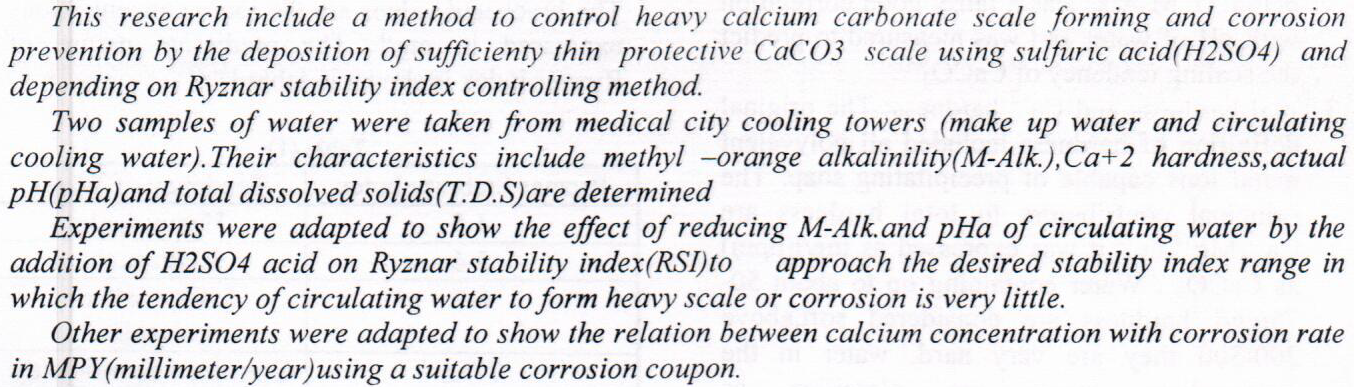
Control of Calcium Scale and Corrosion of Medical City Cooling Water System using Sulfuric Acid

This study aims to encapsulate atenolol within floating alginate-ethylcellulose beads as an oral controlled-release delivery system using aqueous colloidal polymer dispersion (ACPD) method.To optimize drug entrapment efficiency and dissolution behavior of the prepared beads, different parameters of drug: polymer ratio, polymer mixture ratio, and gelling agent concentration were involved.The prepared beads were investigated with respect to their buoyancy, encapsulation efficiency, and dissolution behavior in the media: 0.1 N HCl (pH 1.2), acetate buffer (pH 4.6) and phosphate buffer (pH 6.8). The release kinetics and mechanism of the drug from the prepared beads was investigated.All prepare
... Show More (1)
(1)

The objective of the investigation was to analyze the structure and administration of the political system in Iraq (post-ISIS). After 2003, the Iraqi political system suffered the fundamental problem of its failure to achieve the political and social inclusion that characterizes democratic systems, to guarantee the establishment of a "state for all", while respecting differences. Political representation has moved from the system of sectarian ethnic components, under the title of consensual democracy, to the representation of leaders and the realization of their interests and the interests of their parties at the expense of the groups that claim to represent them, which complicates the problem. In this sense, the new political syste
... Show More
(3)

Path planning in autonomous robotic systems (ARS) is challenging, especially in dynamic or uncertain environments. Many classical methods are computationally expensive and lack adaptability to real-world scenarios. In order to improve the overall path-planning capabilities of robots; this paper introduces a new smart robotic navigation system which uses Software Defined Network (SDN) and Multi-Spike Elman Neural Network (MS-ENN). The introduced system includes an innovative way to encode temporal information using multiple spikes which can capture much greater amounts of detail about changing environmental characteristics than conventional artificial neural networks. Additionally, it includes a spiking wave-front planner (SWP) to pr
... Show More
Abstract. In this research, the uranium concentration in (16) water samples collected from some agricultural areas surrounded with AlTuwitha nuclear site in Baghdad-Iraq was measured by using a CR-39 detector. The concentration of uranium in this study was from (0.6 ± 0.33mg/l) to (2.51 ± 0.49 mg/l), and the weighted average for the concentrations (1.262 ± 0.402 mg/l). The results showed it is a concentration of uranium level in water samples studied is higher than the allowed limit recommended by WHO and ICRP.
 (5)
(4)
(15)
(5)
(4)
(15)
Microwave heating is caused by the ability of the materials to absorb microwave energy and convert it to heat. The aim of this study is to know the difference that will occur when heat treating the high strength aluminum alloys AA7075-T73 in a microwave furnace within different mediums (dry and acidic solution) at different times (30 and 60) minutes, on mechanical properties and fatigue life. The experimental results of microwave furnace heat energy showed that there were variations in the mechanical properties (ultimate stress, yielding stress, fatigue strength, fatigue life and hardness) with the variation in mediums and duration times when compared with samples without treatment. The ultimate stress, yielding stress and fatigue streng
... Show More
The current work was designed to investigate serum angiopoietin like protein-8 and hyaluronic acid among Iraqi hemodialysis patients with and without type 2 diabetes mellitus, and to find relationship between them, as well as if these patients are at risk of kidney fibrosis. Subjects & Methods: in this study, serum samples were obtained from (60) Iraqis patients with end stage renal diseases (ESRD)on hemodialysis (HD) (30 patients with T2DM (G2) and 30 patients withoutT2DM (G3)) in addition to (30) healthy individuals as a control group (G1), their ages ranged from (35-65) years. The patients attended the Al-Yarmouk Teaching Hospital, Baghdad. Results: the results in this study showed a highly a significant elevation inserum angiopoietin li
... Show MoreThe ejector refrigeration system is a desirable choice to reduce energy consumption. A Computational Fluid Dynamics CFD simulation using the ANSYS package was performed to investigate the flow inside the ejector and determine the performance of a small-scale steam ejector. The experimental results showed that at the nozzle throat diameter of 2.6 mm and the evaporator temperature of 10oC, increasing boiler temperature from 110oC to 140oC decreases the entrainment ratio by 66.25%. At the boiler temperature of 120oC, increasing the evaporator temperature from 7.5 to 15 oC increases the entrainment ratio by 65.57%. While at the boiler temperature of 120oC and
... Show More
(3)
(1)
