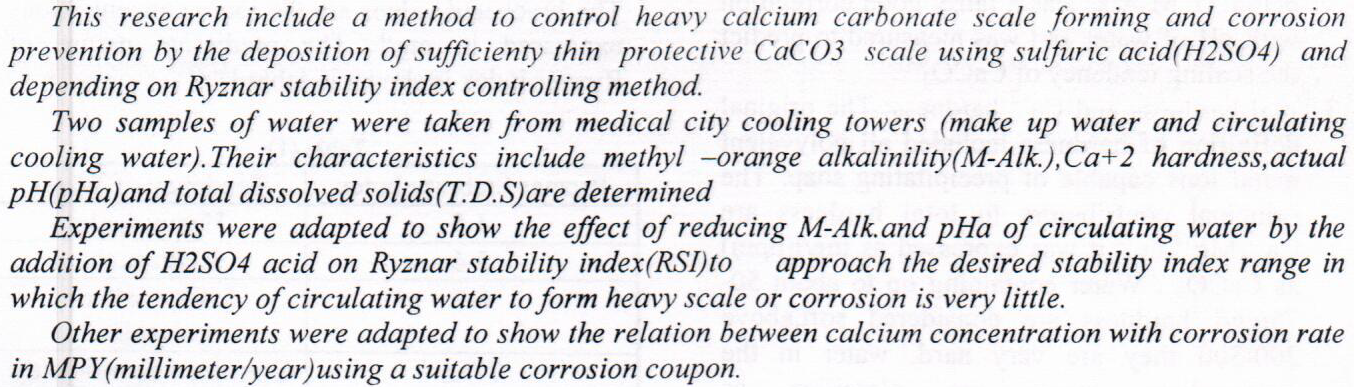
Control of Calcium Scale and Corrosion of Medical City Cooling Water System using Sulfuric Acid

Abstract
This work involves studying the effect of adding some selective organic component mixture on corrosion behavior of pure Al and its alloys in condensed synthetic automotive solution (CSAS) at room temperature. This mixture indicates the increasing of octane number in previous study and in this study show the increasing in corrosion resistance through the decreasing in corrosion rate values.
Electrochemical measurements were carried out by potentiostat at 3 mV/sec to estimate the corrosion parameters using Tafel extrapolation method, in addition to cyclic polarization test to know the pitting susceptibility of materials in tested medium.
The cathodic Tafel slope
... Show MoreObesity is a worldwide health complication. In 2014, 600 million adults and 42 million kids, less than five years of age, were obese. It is a hyperassembly of energy in the form of adipose tissues which has worse effects on health. The major factors of the obesity epidemic are: heavy meal which is rich in lipids, carbohydrates resulting in overweight and eventually obesity, and a decrease in physical activity that leads to defects in calorie conception. In health care facilities ferritin assay is used as a screening test to detect iron deficiency; however, its reliability in obesity has been questioned. The present study aimed to assess and compare the incidence of obesity, hyperferritinemia, hyperlipidemia, and hypouricemia among middle-ag
... Show More
Aeroelastic flutter in aircraft mechanisms is unavoidable, essentially in the wing and control surface. In this work a three degree-of-freedom aeroelastic wing section with trailing edge flap is modeled numerically and theoretically. FLUENT code based on the steady finite volume is used for the prediction of the steady aerodynamic characteristics (lift, drag, pitching moment, velocity, and pressure distribution) as well as the Duhamel formulation is used to model the aerodynamic loads theoretically. The system response (pitch, flap pitch and plunge) was determined by integration the governing equations using MATLAB with a standard Runge–Kutta algorithm in conjunction with Henon’s method. The results are compared with
... Show MoreChemotherapy is one of the most efficient methods for treating cancer patients. Chemotherapy aims to eliminate cancer cells as thoroughly as possible. Delivering medications to patients’ bodies through various methods, either oral or intravenous is part of the chemotherapy process. Different cell-kill hypotheses take into account the interactions of the expansion of the tumor volume, external drugs, and the rate of their eradication. For the control of drug usage and tumor volume, a model based smooth super-twisting control (MBSSTC) is proposed in this paper. Firstly, three nonlinear cell-kill mathematical models are considered in this work, including the log-kill, Norton-Simon, and hypotheses subject to parametric uncertainties and exo
... Show More (23)
(23)
 (22)
(22)


This paper explores a fuzzy-logic based speed controller of an interior permanent magnet synchronous motor (IPMSM) drive based on vector control. PI controllers were mostly used in a speed control loop based field oriented control of an IPMSM. The fundamentals of fuzzy logic algorithms as related to drive control applications are illustrated. A complete comparison between two tuning algorithms of the classical PI controller and the fuzzy PI controller is explained. A simplified fuzzy logic controller (FLC) for the IPMSM drive has been found to maintain high performance standards with a much simpler and less computation implementation. The Matlab simulink results have been given for different mechanical operating conditions. The simulated
... Show More
In this paper a dynamic behavior and control of a jacketed continuous stirred tank reactor (CSTR) is developed using different control strategies, conventional feedback control (PI and PID), and neural network (NARMA-L2, and NN Predictive) control. The dynamic model for CSTR process is described by a first order lag system with dead time.
The optimum tuning of control parameters are found by two different methods; Frequency Analysis Curve method (Bode diagram) and Process Reaction Curve using the mean of Square Error (MSE) method. It is found that the Process Reaction Curve method is better than the Frequency Analysis Curve method and PID feedback controller is better than PI feedback controller.
The results s
... Show More
(2)
(1)
There are two main categories of force control schemes: hybrid position-force control and impedance control. However, the former does not take into account the dynamic interaction between the robot’s end effector and the environment. In contrast, impedance control includes regulation and stabilization of robot motion by creating a mathematical relationship between the interaction forces and the reference trajectories. It involves an energetic pair of a flow and an effort, instead of controlling a single position or a force. A mass-spring-damper impedance filter is generally used for safe interaction purposes. Tuning the parameters of the impedance filter is important and, if an unsuitable strategy is used, this can lead to unstabl
... Show More
(70)
(58)
The regular job of a reservoir engineer is to put a development plan to increase hydrocarbon production as possible and within economic and technical considerations. The development strategy for the giant reservoir is a complex and challenging task through the decision-making analysis process. Due to the limited surface water treatment facility, the reservoir management team focuses on minimizing water cut as low as possible by check the flow of formation and injected water movement through the Mishrif reservoir. In this research, a representative sector was used to make the review of water injection configuration, which is considered an efficient tool to make study in a particular area of the entire field when compared with the ful
... Show More
(2)