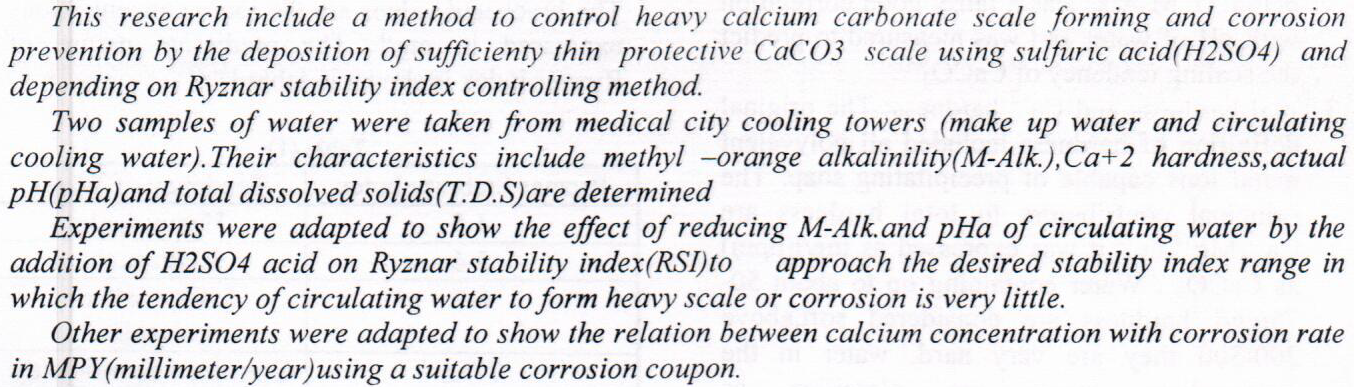
Control of Calcium Scale and Corrosion of Medical City Cooling Water System using Sulfuric Acid

On the basis of known coumarin-based prodrug system, a novel coumarin-based mutual prodrug of 5-fluorouracil and dichloroacetic acid was designed, synthesized and evaluated as a promising oral chemotherapeutic agent basing on in vitro stability study in HCl buffer (pH 1.2) and in phosphate buffer (pH 7.4), as well as in vitro release study in human serum. The chemical structure of prodrug was confirmed by analyzing its FTIR, 1H NMR, 13C NMR and MS-ESI spectra. The results of in vitro kinetic study indicated that the prodrug was significantly stable in HCl and in phosphate buffers, and was hydrolyzed in human serum followed pseudo first order kinetics.
Keywords: Coumarin-bas
... Show More (1)
(1)

Purpose: The research aims to study the measurement of the performance of accounting units level of the research sample by using the Federal quality Model European (EFQM) Design/methodology/approach: the (EFQM) which included seven dimensions "Leadership, Strategic Planning, External Focus, Information and Analysis, Faculty / Staff and Workplace Focus, Process Effectiveness & Outcomes and Achievements" And its effect on the Control Environment, which includes three dimensions: "Integrity, management philosophy and commitment to powers" . the sample is supervisory units of colleges affiliated with the University of Baghdad in Iraq, and a sample was chosen that included fifty-one individuals in the accounting departments.
... Show More (24)
(4)
(24)
(4)

The corrosion behavior of carbon steel at different Temperatures and in water containing different sodium chloride
concentrations under 3 bar pressure has been investigated using weight loss method . The carbon steel specimens were
immersed in water containing (100,400,700,1000PPM) of NaCl solution and under temperature was increased from
(90-120ºC) under pressures of 3 bar. The results of this investigation indicated that corrosion rate increased with NaCl
concentrations and Temperature.
Potentiostatic polarization and weight loss methods have been used to investigate the corrosion behavior of carbon steel in sodium chloride solution at different concentrations (0.1, 0.4 and 0.6) M under the influence of temperatures ( 293, 298, 303, 308 and 313) K. The inhibition efficiency of the amoxicillin drug on carbon steel in 0.6 M NaCl has also been studied based on concentration and temperature. The corrosion rate showed that all salt concentrations ( NaCl solution) resulted in corrosion of carbon steel in varying ratio and 0.6 M of salt solution was the highest rate (50.46 g/m².d). The results also indicate that the rate of corrosion increases at a temperature of 313 K.. Potentiodynamic polarization studi
... Show More
(17)
(10)

IN this work, a titanium dental implant was modified by electro-polymerized of 4-allyl-2-methoxyphenol (Eugenol) using direct current lower than 3.5 volt. The modification of titanium dental implant was achieved to improve its corrosion resistant. Fourier transform infrared spectroscopy (FTIR) was employed to confirm the electro-polymerization of Eugenol to Poly Eugenol (PE) on pure titanium. Deposition of PE on titanium was confirmed by X-ray diffraction and was characterized by thermogravimetric analysis (TGA). The surface morphology of polymeric film were examined through scanning electron microscopy (SEM). Coated titanium by (PE) revealed a good corrosion protection efficiency even at temperature ranged (293-323)K in artificial saliva.
... Show More
(18)
(5)
Many extracted material were used as mouthwash to settle different kinds of oral fungi and bacteria. In this study an extractive of Cyperus rotundus plant E.C.R. which is very active as a mouthwash, was used in concentration range (10-25) ppm in artificial saliva at pH=6.4 and temperature range (288-318) K, to study it’s inhibitory effect on the corrosion of dental amalgam. Potentiostatic and cyclic polarization were used to follow this study. The presence of E.C.R. lead to shift the corrosion potential to the active direction and decreased the corrosion rate to about 98.87%, the inhibition action of E.C.R. resulting from the adsorption of C.R.E. layer between amalgam and saliva as FTIR spectrums shows, where the variety of FTIR adsorptio
... Show More
(13)
(5)
(3)
(2)
(3)
(2)
In Indonesia, cattle feces (CF) and water hyacinth (WH) plants are abundant but have not been widely revealed. The use of microorganisms as decomposers in the fermentation process has not been widely applied, so researchers are interested in studying further. This study was to evaluate the effect of the combination of CF with WH on composting by applying white-rot fungal (WRF) (Ganoderma sp) microorganism as a decomposer. A number of six types of treatment compared to R1(ratio of CF:WH)(25%:75%)+WRF; R2(ratio of CF:WH)(50%:50%)+WRF; R3(ratio of CF:WH)(75%:25%)+WRF; R4(ratio of CF:WH)(25%:75%) without WRF; R5(ratio of CF:WH)(50%:50%) without WRF; R6(ratio of CF:WH)
... Show More
(4)
(2)
This study aimed to detect of contamination of milk and local soft cheese with Staphylococcus aureus and their enterotoxins with attempt to detect the enterotoxin genes in some isolates of this bacteria. A total of 120 samples, 76 of raw milk and 44 of soft cheese were collected from different markets of Baghdad city. Enterotoxins in these samples were detected by VIDAS Set 2 system and it was found that enterotoxin A is present in a rate of 44.74% in milk samples and in a rate 54.50% in cheese samples. While other enterotoxins B, C, D, E were not found in any rate in any samples.
Through the study 60 isolates obtained from milk and cheeses were identified as Staphylococcus aureus by cultural, morphological and biochemical test by u