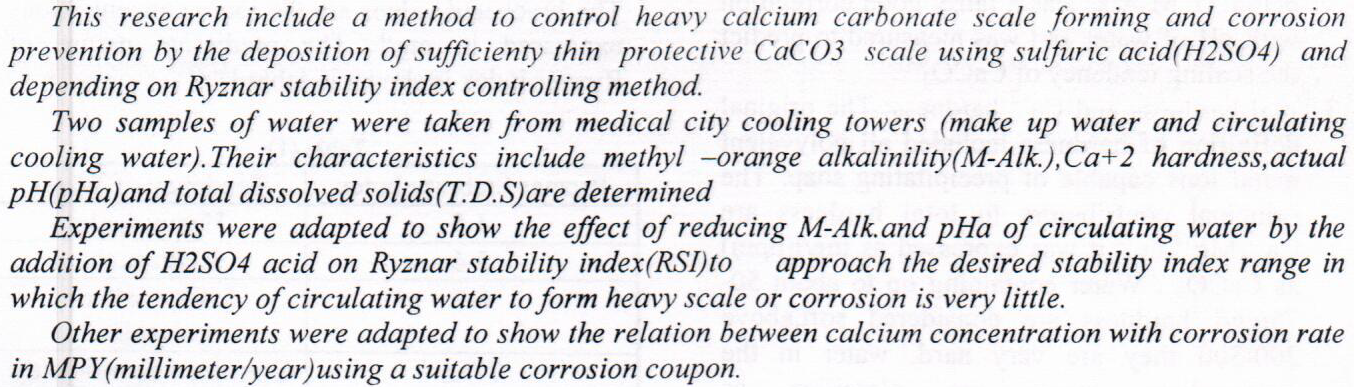
Control of Calcium Scale and Corrosion of Medical City Cooling Water System using Sulfuric Acid

In this review, previous studies on the synthesis and characterization of the metal Complexes with paracetamol by elemental analysis, thermal analysis, (IR, NMR and UV-Vis (spectroscopy and conductivity. In reviewing these studies, the authors found that paracetamol can be coordinated through the pair of electrons on the hydroxyl O-atom, carbonyl O-atom, and N-atom of the amide group. If the paracetamol was a monodentate ligand, it will be coordinated by one of the following atoms O-hydroxyl, O-carbonyl or N-amide. But if the paracetamol was bidentate, it is coordinated by atoms (O-carbonyl and N-amide), (O-hydroxyl and N-amide) or (O-carbonyl and O-hydroxyl). The authors also found that free paracetamol and its complexes have antimicrobial
... Show More (3)
(3)

In this study miconazole nitrate was formulated as topically applied emulgel; different formulas were prepared using sodium carboxymethylcellulose (SCMC) and carboxypolymethylene (carbomer 941) as gelling agents. The influence of type of gelling agent and concentration of both oil phase and emulsifying agent on drug release was studied and compared with commercially available miconazole nitrate cream (Mecozalen®). The results of in vitro release showed that SCMC emulgel bases gave better release than carbomer 941 bases and the release of drug increase from both bases as a function of increasing the concentration of emulisifying agent. The oil phase had retardation effect when
... Show More (7)
(7)

The organation ⁄monomer N-naphthylacrylamide (NAA) was prepared; subsequently the synthesized monomer was successfully copolymerized with acrylicacid (AA) and methylacrylate (MA) by free radical technique using dry benzene as solvent and benzoyl peroxide (BPO) as initiator. The overall conversion was kept low (≤ 10% wt/wt) for all studies copolymers samples. The synthesized monomer and copolymers were characterized using Fourier transform infrared spectroscopy (FT-IR), and their thermal properties were studied by DSC and TGA. The copolymers compositions were determined by elemental analysis. Kelen-Tudes and Finmman-Ross graphical procedures were employed to determine
... Show More
(11)
(2)
Silymarin (SM) is a plant extract obtained from Silybum marianum( milk thistle) . It is class II type drug according to Biopharmaceutics Classification System with low bioavailability due to its low solubility.
Micro/nanonization during crystallization, surface modification and crystal structure modification may improve the dissolution rate of poorly water-soluble drugs.
The aim of this study was to increase the water solubility and dissolution rate of SM by in-situ micronization using solvent change either by stirring or ultrasonic method. Stabilizers like Gelatin, PVP-K30, HPMC15, Pulullan were used to stabilize the prepared ultrafine crystals. Effect of type and concentration of hydrophilic polymer, solv
... Show More
(7)
(3)
(2)

A pioneering idea for increasing the thermal performance of heat transfer fluids was to use ultrafine solid particles suspended in the base fluid. Nanofluids, synthesized by mixing solid nanometer sized particles at low concentrations with the base fluid, were used as a new heat transfer fluid and developed a remarkable effect on the thermophysical properties and heat transfer coefficient. For any nanofluid to be usable in heat transfer applications, the main concern is its long-term stability. The aim of this research is to investigate the effect of using four different surfactants (sodium dodecyl benzene sulfonate (SDBS), sodium dodecyl sulfate (SDS), cetyl trimethylammonium bromide (CTAB), and gum Arabic (GA)), each with three different
... Show More
(206)
This study includes the synthesis of new derivatives of 1, 2, 4- Triazole which are contain Schiff bases derived from 1, 4, 5, 6- tetrahydropyrimidine. The structures of these derivatives were characterized from their melting points, infrared spectroscopy and elemental analysis. These derivatives were tested for inhibition of E-coli and were all found to be active.
ZnO nanostructures were synthesized in one step reaction at 80℃ without any extra treatments.(Zn (NO₃) ₂. 6H2O) and (NaOH) were used for synthesis. Production of ZnO nanostructures occurred relatively in short time. The obtained ZnO nanostructures were characterized by X-ray diffraction (XRD) and the atomic force microscope AFM. Carboxymethyleted PVA (CPVA) has been prepared and characterized.(CPVA) were composite with different ZnO nanoparticles concentrations. The composites are cast into films. The dielectric constant properties of the films were measured with hp LCR meter.