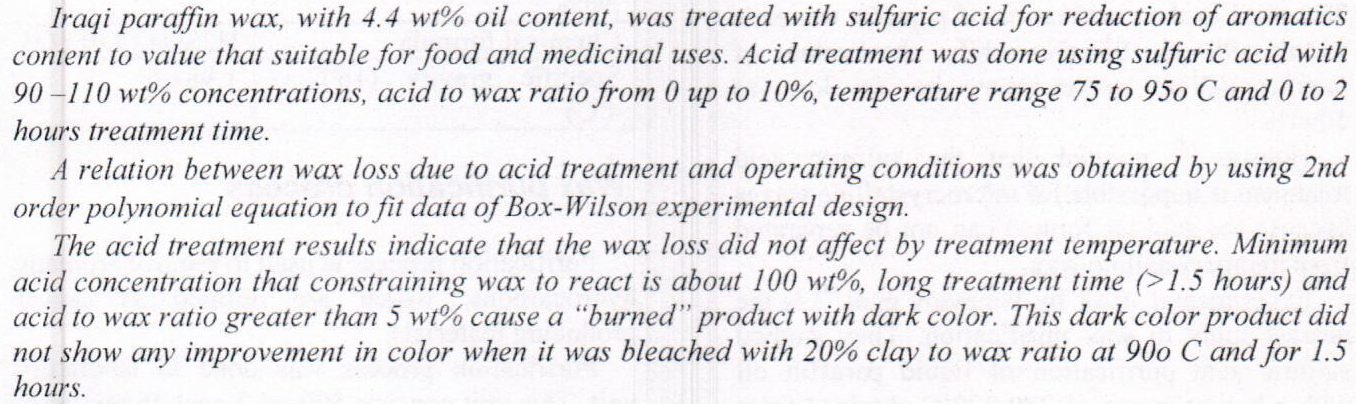
Acid Treatment of Iraqi Paraffin Wax

 (50)
(50)
 (31)
(31)



The present work provides to treat real oily saline wastewater released from drilling oil sites by the use of electrocoagulation technique. Aluminum tubes were utilized as electrodes in a concentric manner to minimize the concentrations of 113400 mg TDS/L, 65623 mg TSS/L, and the ions of 477 mg HCO3/L, 102000 mg Cl/L and 5600 mg Ca/L presented in real oily wastewater under the effect of the operational parameters (the applied current and reaction time) by making use of the central composite rotatable design. The final concentrations of TDS, TSS, HCO3, Cl, and Ca that obtained were 93555 ppm (17.50%), 11011 ppm (83.22%), 189ppm (60.38%), 80000ppm (22%), and 4200 ppm (25%), respectively, under the optimum values of the operational parameters
... Show More
(84)
(67)
Background: the conflict in opinions about the dental and skeletal changes induced by classII malocclusion activator therapy is still present. The aim of this study was to assess theskeletal and/or dental outcomes of treating moderate-severe skeletal class II division Imalocclusion by the activator.Materials and methods: the sample consisted of pre and post treatment records(cephalometric radiographs) of 11 iraqi adolescent patients (7 females 10-11 years old, and 4males 12-13 years old).Results: the results showed significant skeletal and dental changes that reflected significantimprovements in the cardinal features of class II (overjet, overbite, ANB angle, and loweranterior facial height).Conclusion: correlation of the overjet, overbite,
... Show MoreTo achieve safe security to transfer data from the sender to receiver, cryptography is one way that is used for such purposes. However, to increase the level of data security, DNA as a new term was introduced to cryptography. The DNA can be easily used to store and transfer the data, and it becomes an effective procedure for such aims and used to implement the computation. A new cryptography system is proposed, consisting of two phases: the encryption phase and the decryption phase. The encryption phase includes six steps, starting by converting plaintext to their equivalent ASCII values and converting them to binary values. After that, the binary values are converted to DNA characters and then converted to their equivalent complementary DN
... Show MoreExpired drug Metoclopramide was investigated as an antibacterial corrosion inhibitor for carbon steel in 0.5M H3PO4 solution using the electrochemical method at 30oC and 60oC. The results showed that this drug is an efficient inhibitor for carbon steel and the efficiency reached to 82.244 % for 175 ppm at 30oC and 76.146% for 225 ppm at 60oC. The adsorption of drug on carbon steel surface follows Langmuir adsorption isotherm with small values of adsorption-desorption constant. The polarization plots revealed that Metoclopramide acts as mixed-type inhibitor. Some parameters of inhibition process were calculated and discussed. The surface morphology of the carbon steel speci
... Show More
(6)
In this work a novel drug delivery system through modification of poly acrylic acid with Methionine as a spacer between the poly acrylic acid which was converted to its acyl chloride and reacted with Methionine as spacer unit which has been reacted with Ampicillin drug. In vitro drug release study had been conducted successfully in basic medium in pH 7.4 and acidic medium in pH 1.1 at 37?. Due to many problems associated with drug release and, this modification could decrease the side effect of drug. The prepared prodrug polymer was characterized by spectra method [FTIR and 1H?NMR]. Physical properties and intrinsic viscosity of drug polymer were determined. The good results were obtained in the presence of spacer unit with compar
... Show More
(3)
(1)
Dengke Naniura is a traditional food from Sumatera Utara, Indonesia, that is produced through fermenting process, and this food is believed to contain high probiotics. The objective of the current research is to determine the potential of LAB as a probiotic that has been obtained from Dengke Naniura. Dengke Naniura was traditionally prepared from Cyprinus carpio. Four LABs have been successfully isolated from Dengke Naniura, such as D7DA3, D7B3, D7DBF and D7DN3. Those four LAB isolates were identified as Lactobacillus sp. This result has been confirmed by the non-spore forming bacterium, non-motile, and Gram-positive. Also, it has been supported by biochemical test, for the example Voges Proskauer, catalase test, Methyl
... Show More
(10)
(4)
Doxycycline and levofloxacin are heterocyclic organic compounds that are now popularly used to treat some bacterial infections. In this study which was conducted on patients from a private clinic, we compared the use of two commonly used antibiotics for the treatment of diagnosed cases with vaginal chlamydial infection: levofloxacin and doxycycline. Vaginal chlamydial infection is considered to be a very common sexually transmitted infection. It may have minimal symptoms which can lead to neglect by the patient until it leads to some important complications among which is the inability to become pregnant. This indicates early diagnosis and treatment of this infection. By comparing the results of treatment we concluded that there is no much
... Show More
(2)