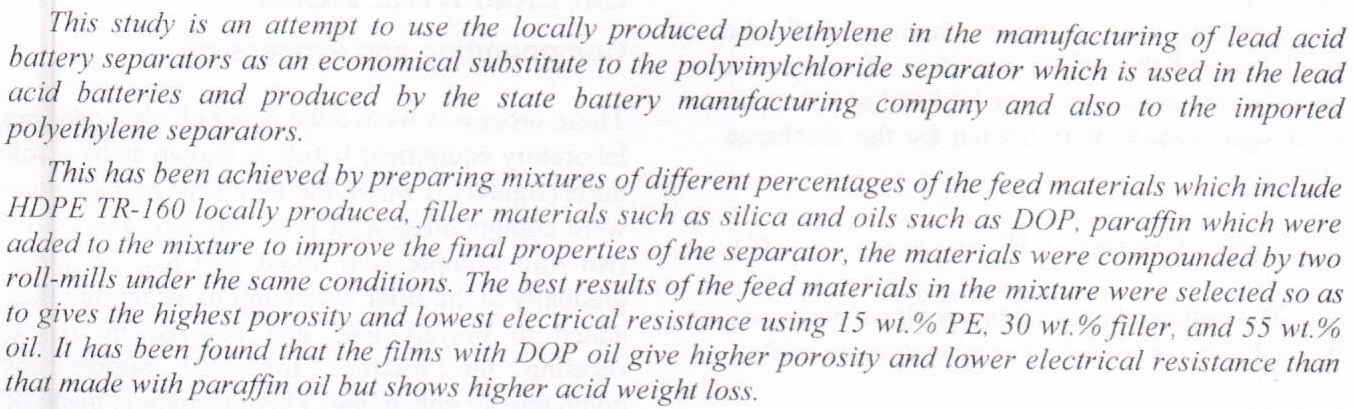
The Manufacture of Lead Acid Battery Separators using Locally Produced Polyethylene

Roller-Compacted Concrete (RCC) is a zero-slump concrete, with no forms, no reinforcing steel, no finishing and is wet enough to support compaction by vibratory rollers. Because the effectiveness of curing on properties and durability, the primary scope of this research is to study the effect of various curing methods (air curing, emulsified asphalt(flan coat) curing, 7 days water curing and permanent water curing) and different porcelanite (local material used as an Internal Curing agent) replacement percentages (volumetric replacement) of fine aggregate on some properties of RCC and to explore the possibility of introducing more practical RCC for road pavement with minimum requirement of curing. Cubes specimens were sawed from the slab
... Show More (6)
(6)

 (4)
(4)


Density Functional Theory at the generalized-gradient approximation level coupled with large unit cell method is used to simulate the electronic structure of (II-VI) zinc-blende cadmium sulfide nanocrystals that have dimensions 2-2.5 nm. The calculated properties include lattice constant, conduction and valence bands width, energy of the highest occupied orbital, energy of the lowest unoccupied orbital, energy gap, density of states etc. Results show that lattice constant and energy gap converge to definite values. However, highest occupied orbital, lowest unoccupied orbital fluctuates indefinitely depending on the shape of the nanocrystal.
A field experiment was carried out in Horticulture Department / Collage of Agricultur e/University of Baghdad to study influence of adding ascorbic acid(asa) and bread yeast extract in snap bean cv.primel under irrigation with saline water using sodium chloride salt (NaCl) during spr ing season of 2016 .A factorial experiment using Randomized Complete Block Design( RCBD) with three replications wereconducted . The first factor includes three treatments of salinity which were tap water ( S0), 4ds.m-1(S1) and 8ds.m-1 (S2) . The second factor includes three treatments which were control treatment without any adding (C) ,ascorbic acid 0.3g.l-1( A ) and yeast extract 12g.l -1( Y ). Results showed significant and gradually decreases in all studie
... Show MoreMixed ligand metal complexes are synthesized from oxalic acid with Schiff base, and the Schiff base was obtained from trimethoprim and acetylacetone. The synthesized complexes were of the type [M(L1)(L2)], where the metal, M, is Ni(II), Cu(II), Cr(III), and Zn(II), L1 corresponds to the trimethoprim ((Z)-4-((4-amino-5-(3,4,5- trimethoxybenzyl)pyrimidine-2-yl)imino)pentane-2-one) as the first ligand and L2 represent the oxalate anion (𝐶𝑂 ) as a second ligand. Characterization of the prepared compounds was performed by elemental analysis, molar conductivity, magnetic measurements, 1H-NMR, 13C-NMR, FT-IR, and Ultraviolet-visible (UV-Vis) spectral studies. The recorded infrared data is reinforced with density functional th
... Show MoreMixed ligand complexes of bivalent metal ions, viz; Co(II), Ni(II), Cu(II) and Zn(II) of the composition [M(A)2((PBu3)2]in(1:2:2)(M:A:(PBu3). molar ratio, (where A- Anthranilate ion ,(PBu3)= tributylphosphine. M= Co(II),Ni(II),Cu(II) and Zn(II). The prepared complexes were characterized using flame atomic absorption, by FT-IR, UV/visible spectra methods as well as magnetic susceptibility and conductivity measurements. The metal complexes were tested in vitro against three types of pathogenic bacteria microorganisms: (Staphylococcus, Klebsiella SPP .and Bacillas)to assess their antimicrobial properties. Results. The study shows that all complexes have octahedral geometry; in addition, it has high activity against tested bacteria. Based on th
... Show MoreMixed ligand complexes of bivalent metal ions, viz; Co(II), Ni(II), Cu(II) and Zn(II) of the composition [M(A)2((PBu3)2]in(1:2:2)(M:A:(PBu3). molar ratio, (where A- Anthranilate ion ,(PBu3)= tributylphosphine. M= Co(II),Ni(II),Cu(II) and Zn(II). The prepared complexes were characterized using flame atomic absorption, by FT-IR, UV/visible spectra methods as well as magnetic susceptibility and conductivity measurements. The metal complexes were tested in vitro against three types of pathogenic bacteria microorganisms: (Staphylococcus, Klebsiella SPP .and Bacillas)to assess their antimicrobial properties. Results. The study shows that all complexes have octahedral geometry; in addition, it has high activity against tested bacteria. Based on th
... Show MoreMixed ligand metal complexes are synthesized from oxalic acid with Schiff base, and the Schiff base was obtained from trimethoprim and acetylacetone. The synthesized complexes were of the type [M(L1)(L2)], where the metal, M, is Ni(II), Cu(II), Cr(III), and Zn(II), L1 corresponds to the trimethoprim ((Z)-4-((4-amino-5-(3,4,5-trimethoxybenzyl)pyrimidine-2-yl)imino)pentane-2-one) as the first ligand and L2 represent the oxalate anion ( ) as a second ligand. Characterization of the prepared compounds was performed by elemental analysis, molar conductivity, magnetic measurements, 1H-NMR, 13C-NMR, FT-IR, and Ultraviolet-visible (UV-Vis) spectral studies. The recorded infrared data is reinforced with density functional theory (DFT) calcul
... Show More
(16)
(8)