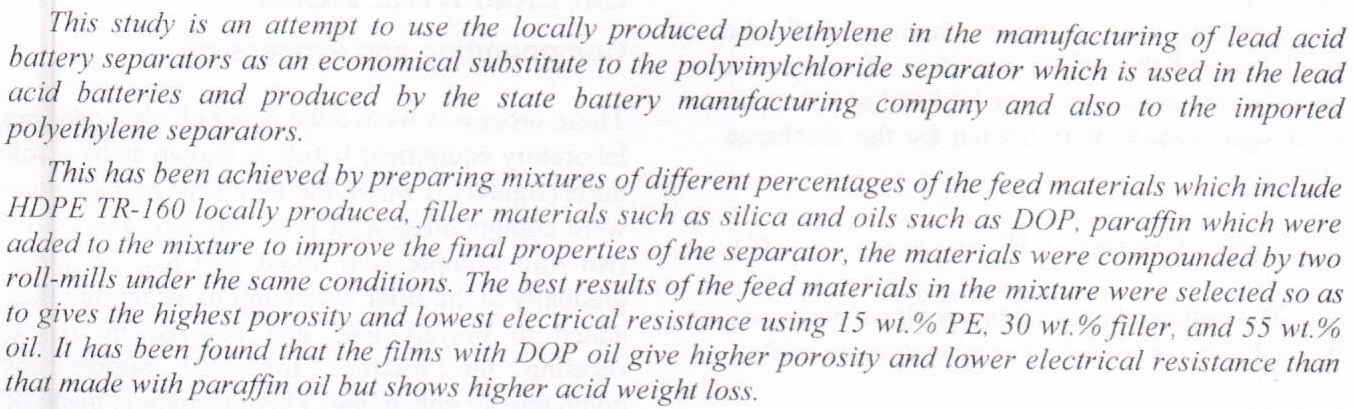
The Manufacture of Lead Acid Battery Separators using Locally Produced Polyethylene

To investigate the relationship between increased lipid peroxidation, and the lowering of both plasma total proteins and albumin in lead-exposed workers, and the effectiveness of antioxidants (vit. C and E) in modulating oxidative stress in those workers.
Thirty male and females workers employed in the Iraqi storage battery (age range 20-40 years) were participating in this study. Additionally, 11 healthy subjects were served as healthy controls, with the same age range compared to workers group, to avoid the effects of age variations on the studied parameters. Blood lead levels, erythrocytes and plasma MDA, erythrocytes and plasma GSH, total protein and albumin levels in healthy controls and lead-exposed workers pre- and post-tr
... Show More (2)
(2)

The present study is to investigate the possibility of using wastes in the form of scrap iron (ZVI) and/ or aluminum ZVAI for the detention and immobilization of the chromium ions in simulated wastewater. Different batch equilibrium parameters such as contact time (0-250) min, sorbent dose (2-8 g ZVI/100 mL and 0.2-1 g ZVAI/100 mL), initial pH (3-6), initial pollutant concentration of 50 mg/L, and speed of agitation (0-250) rpm were investigated. Maximum contaminant removal efficiency corresponding to (96 %) at 250 min contact time, 1g ZVAI/ 6g ZVI sorbent mass ratio, pH 5.5, pollutant concentration of 50 mg/L initially, and 250 rpm agitation speed were obtained.
The best isotherm model for the batch single Cr(III) uptake by ZVI
... Show More
(12)
In recent years, various methods have been developed to enhance the characteristics of asphalt pavement in order to face the continuous challenges of increasing traffic loads and changing climate conditions. One of the most popular and successful methods is modifying the asphalt mixtures or asphalt binder with the addition of polymers. Therefore, two types of Polyethylene (PE) polymer, High-Density PE (HDPE) and Low-Density PE (LDPE), are used in this research. Two methods were applied to prepare PE-modified asphalt mixtures: Semi-Wet Method (S-WM) and Dry Method (DM). The findings of the investigation indicated that the addition of PE polymer can reduce the wear loss of aggregate. In general, the experimental results revealed that asphalt
... Show More (3)
(1)
(3)
(1)


A hydraulic platform was manufactured to serve palm trees and to enhance palm tree services, with a height of 12 meters, by the General Company for Hydraulic Industries, one of the Ministry of Industry's formations. This platform was tested in the field after being manufactured according to a randomized complete block design using split-split plots with three factors. The first factor represented the shape of the orchard land, with two levels (flat land and uneven land), serving as the main plots. The second factor had three levels representing palm tree heights (4, 8, and 12 meters), which served as the sub-plots. The third factor was the palm tree services, represented at three levels (pruning, pollination, and harvesting), with each trea
... Show More
(4)
(4)
Bendable concrete, also known as Engineered Cementitious Composite (ECC) is a type of ultra-ductile cementitious composites reinforced with fibres to control the width of cracks. It has the ability to enhance concrete flexibility by withstanding strains of 3% and higher. The properties of bendable concrete mixes (compressive strength, flexural strength, and drying shrinkage) are here assessed after the incorporation of supplementary cementitious materials, silica fume, polymer fibres, and the use of ordinary Portland cement (O.P.C) and Portland limestone cement (IL). Mixes with Portland limestone cement show lower drying shrinkage and lower compressive and flexural strength than mixes with ordinary Portland cement, due to the ratio o
... Show MoreInvestigation of the adsorption of acid fuchsin dye (AFD) on Zeolite 5A is carried out using batch scale experiments according to statistical design. Adsorption isotherms, kinetics and thermodynamics were demonstrated. Results showed that the maximum removal efficiency was using zeolite at a temperature of 93.68751 mg/g. Experimental data was found to fit the Langmuir isotherm and pseudo second order kinetics with maximum removal of about 95%. Thermodynamic analysis showed an endothermic adsorption. Optimization was made for the most affecting operating variables and a model equation for the predicted efficiency was suggested.
The relationship between costs of environment and costs of product life – cycle. Boubtlessly when the economical unit exercise their productive works, they lead to pollution in water, air and soil as well as all stages of product life- cycle from Rans Dstage, production stage, packaging stage and finally abandonment stage- Pollution causes environmental costs. Lgnoring or hiding environmental costs and no taking them in consideration with product cost lead to a wrong account of preduot cost.
Therefore, environmental costs should be included and matched for all stages with in product costs to know which activities, processes
... Show More
Biosorpion of lead (Pb), Cadmium (Cd) and Nickl(Ni) by dried biomass of Chara sp. for sample of BMP was used as alternative approach of conventional method. The range of removal percentages was between 92-97%, 70-98.7% and 46.6-96.6% for Pb, Cd and Ni respectively at 3h.Treatment time, with 300-500 mg dried weight from Chara sp. powder at pH 4, with 60 rpm at shaker. FTIR analysis showed the active groups which are responsible for sequestration of heavy metals represented by carboxyl, hydroxyl alkyl, amine and amide. The Biosorption equilibrium experiment for elements showed that the highest sorption percentage for three elements was, Pb 96.6% after 30 minute, for Cd was 100% after 15 minute and 40% to Ni after 75 minute, while the biosorp
... Show More
