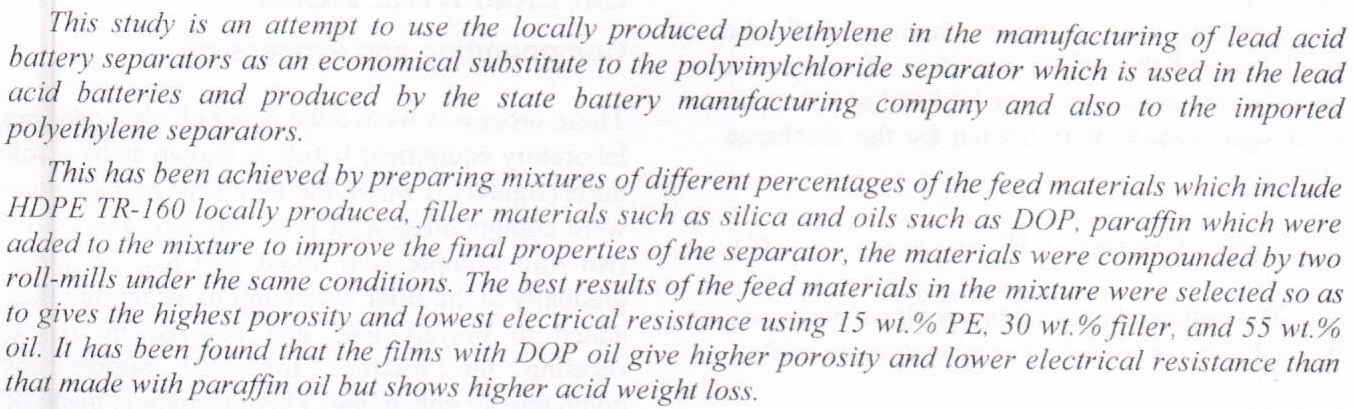
The Manufacture of Lead Acid Battery Separators using Locally Produced Polyethylene

 (6)
(6)

Bacteriocin is an important antimicrobial peptide that can be used in industrial and medical fields due to its characteristics of antibacterial, food preservation and anticancer activities. Fifty isolates of Bacillus sp were collected from different soil samples which were already recognized via morphological and biochemical identification process. The isolates were screened for bacteriocin production effective against Staphylococcus spp in order to select the highest producing isolate. The isolate NK16 showed the maximum bacteriocin production (80 AU/ml) which was further characterized as Bacillus subtilis NK 16 through using API identification system (API 20E and API 50CHB). Then, next step was to detect the optimal conditions for maximum
... Show More
(14)
 (7)
(7)
 (2)
(3)
(2)
(3)
This experiment was conducted to evaluate the effect of foliar spraying with gibberellic acid concentrations (0,50,100)mg.L¹ and proline acid concentrations (0, 25, 50)mg.L¹ and their interactions on some growth parameters of pea plant using clay pots in the botanical garden of Biology Department College of Education for pure science Ibn –Al-Haitham ,Baghdad University, for the growing season 2012-2013 the experiment involved the studing of some growth parameters as plant?s height, dry weight, wt. of pods.plant¹, biology yield and the concentration of some major elements (nitrogen, phosphorus and calcium) in plant?s seeds. The experiment was designed according to Completely Randomized Desig(CRD) with three replications. R
... Show More
A detailed experimental study was devoted to the anodic oxidation of oxalic acid using manganese dioxide rotating cylinder anode with the objective to evaluate in a systematic way the effect on the oxalic acid oxidation process of several relevant parameters, including the presence of sodium chloride, the current density (J), the rotation speed, the temperature, and the initial concentration of oxalic acid. Thin manganese dioxide film on graphite substrate has been prepared by electrochemical oxidation from MnSO4-H2SO4 electrolyte. The morphology of this electrode was investigated by XRD, SEM, EDS and AFM techniques. The results show that a firm γ-structure of MnO2 film on graphite rod can be obtained successfully. The results indicate tha
... Show More
(18)
(16)

Introduction and Aim: Klebsiella pneumoniae is a Gram-negative bacterium responsible for a wide range of infections, including respiratory tract infections (RTIs). This research was aimed to study the antibacterial and antibiofilm effect of AgNPs produced by Gram positive and negative bacteria on RTIs associated with K. pneumoniae. Materials and Methods: The biofilm formation of K. pneumoniae was determined by tube method qualitatively from select bacterial species characterized by UV-Visible spectroscopy. The antibacterial susceptibility of the bacteria AgNPs was tested for their antibacterial and antibiofilm activity on a clinical isolate of K. pneumoniae. Results: K. pneumoniae isolated from RTIs were strong biofilm producers. The ant
... Show MoreIntroduction and Aim: Klebsiella pneumoniae is a Gram-negative bacterium responsible for a wide range of infections, including respiratory tract infections (RTIs). This research was aimed to study the antibacterial and anti-biofilm effect of AgNPs produced by Gram positive and negative bacteria on RTIs associated with K. pneumoniae. Materials and Methods: The biofilm formation of K. pneumoniae was determined by tube method qualitatively from select bacterial species characterized by UV-Visible spectroscopy. The antibacterial susceptibility of the bacteria AgNPs was tested for their antibacterial and antibiofilm activity on a clinical isolate of K. pneumoniae. Results: K. pneumoniae isolated from RTIs were strong biofilm prod
... Show More
(6)
(3)
(14)
(12)
