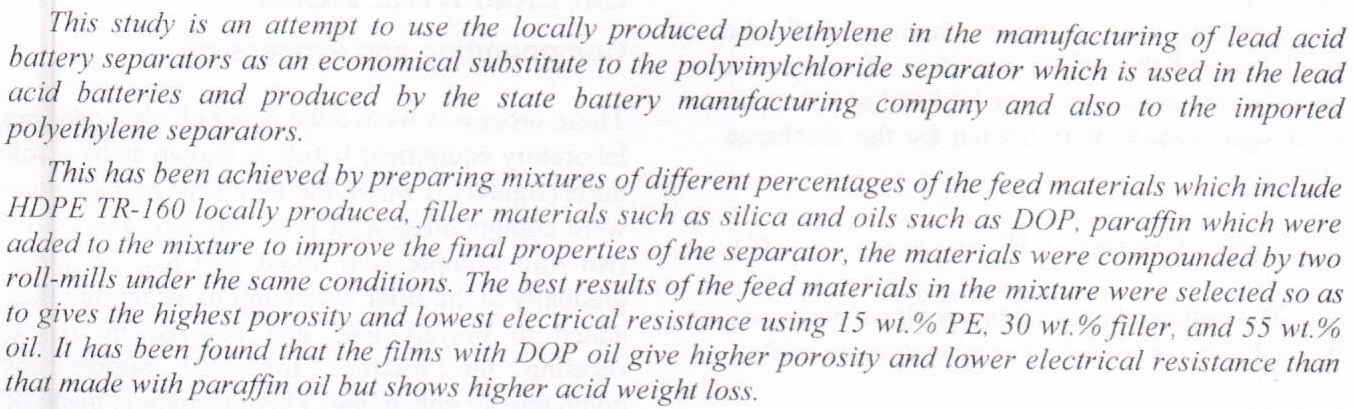
The Manufacture of Lead Acid Battery Separators using Locally Produced Polyethylene

 (15)
(15)
 (13)
(13)


A novel encapsulated deep eutectic solvent (DES) was introduced for biodiesel production via a two-step process. The DES was encapsulated in medical capsules and were used to reduce the free fatty acid (FFA) content of acidic crude palm oil (ACPO) to the minimum acceptable level (< 1%). The DES was synthesized from methyltriphenylphosphonium bromide (MTPB) and p-toluenesulfonic acid (PTSA). The effects pertaining to different operating conditions such as capsule dosage, reaction time, molar ratio, and reaction temperature were optimized. The FFA content of ACPO was reduced from existing 9.61% to less than 1% under optimum operating conditions. This indicated that encapsulated MTPB-DES performed high catalytic activity in FFA esterificatio
... Show More
(21)
(13)

The importance of algae as a natural source of various bioactive compounds continues to grow due to their diverse biological activities. One of such compounds is n-hexadecanoic acid, more commonly known as palmitic acid; it is more lipidous than many algal species. It is one of the most common saturated fatty acids in nature. One can find it in algal, animal, and plant oils and is extracted from numerous natural sources. Its chemical and biological attributes enable its widespread use in the pharmaceutical, food, and cosmetic industries. Numerous studies have found that palmitic acid is effective for fungal activities and does have pharmaceutical and environmental promising antioxidant capabilities.
(8)
Nutrient agar medium with various concentrations of cefotaxime was used for isolation spontaneous mutants from wild type strain of P.aeruginosa PHA-1. Eighty-two mutants were successfully isolated with the viable count 52×107 , these mutants were confirmed as spontaneous not physiological adaption mutants by reculture on the same medium. Then, wild type PHA-1 and mutants were examined for production pyocyanin; a blue greenish pigment was clearly noticed on King A medium. Remarkably the mutant strain named S300-8 was distinguished in productivity in comparison with wild type strain PHA-1; the amount of pigment was 56.0667mg/l and 74.53mg/l respectively. In addition, pyocyanin produced by mutant strain S300-8 revealed a potent efficacy again
... Show More
(1)
(1)
(3)
Kinetic and mechanism studies of the oxidation of oxalic acid by Cerium sulphate have been carried out in acid medium sulphuric acid. The uv- vis. Spectrophotometric technique was used to follow up the reaction and the selected wavelength to be followed was 320 nm. The kinetic study showed that the order of reaction is first order in Ce(IV) and fractional in oxalic acid. The effect of using different concentration of sulphuric acid on the rate of the reaction has been studied a and it was found that the rate decreased with increasing the acid concentration. Classical organic tests was used to identify the product of the oxidation reaction, the product was just bubbles of CO2.
Kinetic and mechanism studies of the oxidation of oxalic acid by Cerium sulphate have been carried out in acid medium sulphuric acid. The uv- vis. Spectrophotometric technique was used to follow up the reaction and the selected wavelength to be followed was 320 nm. The kinetic study showed that the order of reaction is first order in Ce(IV) and fractional in oxalic acid. The effect of using different concentration of sulphuric acid on the rate of the reaction has been studied a and it was found that the rate decreased with increasing the acid concentration. Classical organic tests was used to identify the product of the oxidation reaction, the product was just bubbles of CO2.
The action of high repeated trucks load associated with dramatically elevated ambient temperatures leads to the most harmful distress in asphalt pavements occurred in Iraq known as rutting. Essentially, it is produced from the accumulation of irrecoverable strains, which mainly occurred in the asphalt layers. That visually demonstrated as a longitudinal depression in the wheel paths as well as small upheavals to the sides. Poly Phosphoric Acid (PPA) has been used as a means of producing modified asphalt binders and the interest to use it has increased in recent years. The PPA provides modified asphalt binder, which is relatively cheaply produced compared to polymer-modified asphalt. In this paper, PPA was used by three-percentages 1
... Show More
(4)