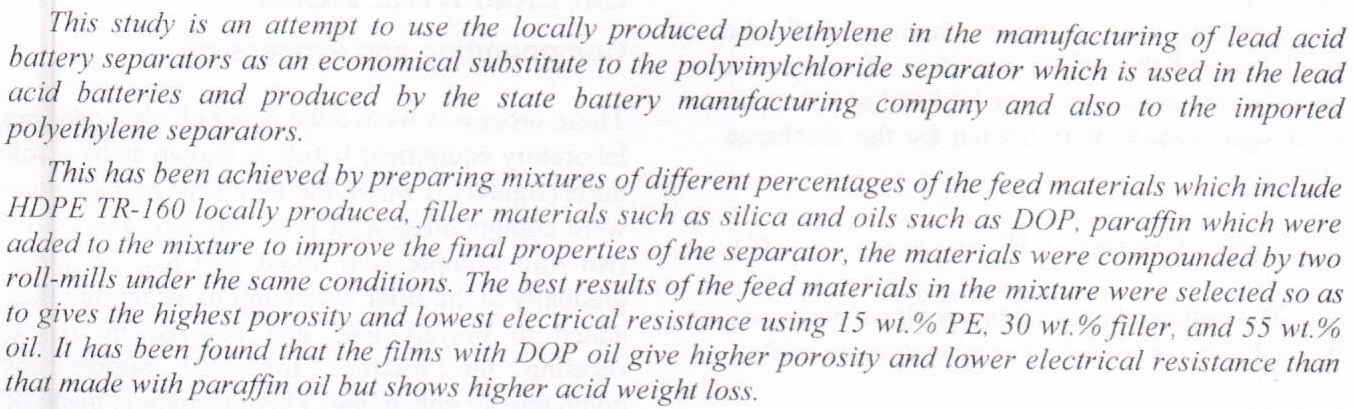
The Manufacture of Lead Acid Battery Separators using Locally Produced Polyethylene

The current study used extracts from the aloe vera (AV) plant and the hibiscus sabdariffa flower to make Ag-ZnO nanoparticles (NPs) and Ag-ZnO nanocomposites (NCs). Ag/ZnO NCs were compared to Ag NPs and ZnO NPs. They exhibited unique properties against bacteria and fungi that aren't present in either of the individual parts. The Ag-ZnO NCs from AV showed the best performance against E. coli, with an inhibition zone of up to 27 mm, compared to the other samples. The maximum absorbance peaks were observed at 431 nm and 410 nm for Ag NPs, at 374 nm and 377 nm for ZnO NPs and at 384 nm and 391 nm for Ag-ZnO NCs using AV leaf extract and hibiscus sabdariffa flower extract, respectively. Using field emission-scanning electron microscopes (FE-
... Show More (1)
(1)

The novel Vierordt’s approach, or simultaneous equation method, was created and validated for the concurrent determination of vincristine sulfate (VCS) and bovine serum albumin (BSA) in pure solutions utilizing UV spectrophotometry. It is simple, precise, economical, rapid, reliable, and accurate. This method depends on measuring absorbance at two wavelengths, 296 nm and 278 nm, which correspond to the λmax of VCS and BSA in deionized water, respectively. The calibration curves of VCS and BSA are linear at concentration ranges of 10–60 μg/mL and 200–1600 μg/mL, with correlation coefficient values (R2) of 1 and 0.999, respectively. The limits of detection (LOD) and quantification (LO
... Show More (2)
(1)
(2)
(1)


The possibility of using activated carbon developed from date palm seeds wastes as a permeable reactive barrier (PRB) to remove copper from polluted shallow groundwater was investigated. The activated carbon has been developed from date palm seeds by dehydrating methods using concentrated sulfuric acid. Batch tests were performed to characterize the equilibrium sorption properties of new activated carbon in copper-containing aqueous solutions, while the sandy soil (aquifer) was assumed to be inert. Under the studied conditions, the Langmuir isotherm model gives a better fit for the sorption data of copper by activated carbon than other models. At a pilot scale, One-dimensional column experiments were performed, and an integrated model ba
... Show MoreThis study involved the treatment of textile wastewater contaminated with direct blue 15 dye (DB15) using a heterogeneous photo-Fenton-like process. Bimetallic iron/copper nanoparticles loaded on bentonite clay were used as heterogeneous catalysts and prepared via liquid-phase reduction method using eucalyptus leaves extract (E-Fe/Cu@BNPs). Characterization methods were applied to resultant particles (NPs), including SEM, BET, and FTIR techniques. The prepared NPs were found with porous and spherical shapes with a specific surface area of particles was 28.589 m2/g. The effect of main parameters on the photo-Fenton-like degradation of DB15 was investigated through batch and continuous fixed-bed systems. In batch mode, pH, H2O2 dosage, DB15 c
... Show More
(18)
(18)
This study shows that it is possible to fabricate and characterize green bimetallic nanoparticles using eco-friendly reduction and a capping agent, which is then used for removing the orange G dye (OG) from an aqueous solution. Characterization techniques such as scanning electron microscopy (SEM), Energy Dispersive Spectroscopy (EDAX), X-Ray diffraction (XRD), and Brunauer-Emmett-Teller (BET) were applied on the resultant bimetallic nanoparticles to ensure the size, and surface area of particles nanoparticles. The results found that the removal efficiency of OG depends on the G‑Fe/Cu‑NPs concentration (0.5-2.0 g.L-1), initial pH (2‑9), OG concentration (10-50 mg.L-1), and temperature (30-50 °C). The batch experiments showed
... Show More
(12)
(11)
(1)
Multiplicative inverse in GF (2 m ) is a complex step in some important application such as Elliptic Curve Cryptography (ECC) and other applications. It operates by multiplying and squaring operation depending on the number of bits (m) in the field GF (2 m ). In this paper, a fast method is suggested to find inversion in GF (2 m ) using FPGA by reducing the number of multiplication operations in the Fermat's Theorem and transferring the squaring into a fast method to find exponentiation to (2 k ). In the proposed algorithm, the multiplicative inverse in GF(2 m ) is achieved by number of multiplications depending on log 2 (m) and each exponentiation is operates in a single clock cycle by generating a reduction matrix for high power of two ex
... Show More
(1)
(1)
Background: Removal of bacteria from the pulp system by instrumentation of an infected root canal, will be significantly reduced the number of bacteria, but it is well documented that instrumentation alone can-not clean and kill all bacteria found on the root canal walls. Antibacterial irrigants are needed to kill the remaining microorganisms. The aims of this study was to assess antibacterial effect of titanium tetrafluoride (TiF4) solution and brewing green tea against root canal bacteria and to compare with sodium hypochlorite and normal saline through microbiological and molecular studies. Materials and methods: Microbiological study was carried out to determine the concentration of titanium tetrafluoride and brewing green tea at which
... Show MoreBackground: The aim of this study is to evaluate the color change ∆E of the dental enamel following treatment with 2 kinds of protector (icon infiltrant, clinpro varnish) before fixed orthodontic treatment to avoid the possible white spot lesions. Materials and Methods: Fifty four subjects treated with fixed appliances were divided into 3 groups: the 1st group was control, while the 2nd and 3rd groups were treated with icon infiltrant and clinpro varnish before bonding procedure, respectively. Color parameters (L,a,b) were recorded for the middle and gingival thirds before and after bonding procedure to get the ∆E of each group. Results: One-way ANOVA test showed a non-significant difference in ∆E between the 3 groups a
... Show More
A new design of manifold flow injection (FI) coupling with a merging zone technique was studied for sulfamethoxazole determination spectrophotometrically. The semiautomated FI method has many advantages such as being fast, simple, highly accurate, economical with high throughput . The suggested method based on the production of the orange- colored compound of SMZ with (NQS)1,2-Naphthoquinone-4-Sulphonic acid Sodium salt in alkaline media NaOH at λmax 496nm.The linearity range of sulfamethoxazole was 3-100 μg. mL-1, with (LOD) was 0.593 μg. mL-1 and the RSD% is about 1.25 and the recovery is 100.73%. All various physical and chemical parameters that have an effect on the stability and development of
... Show More
(6)
(1)