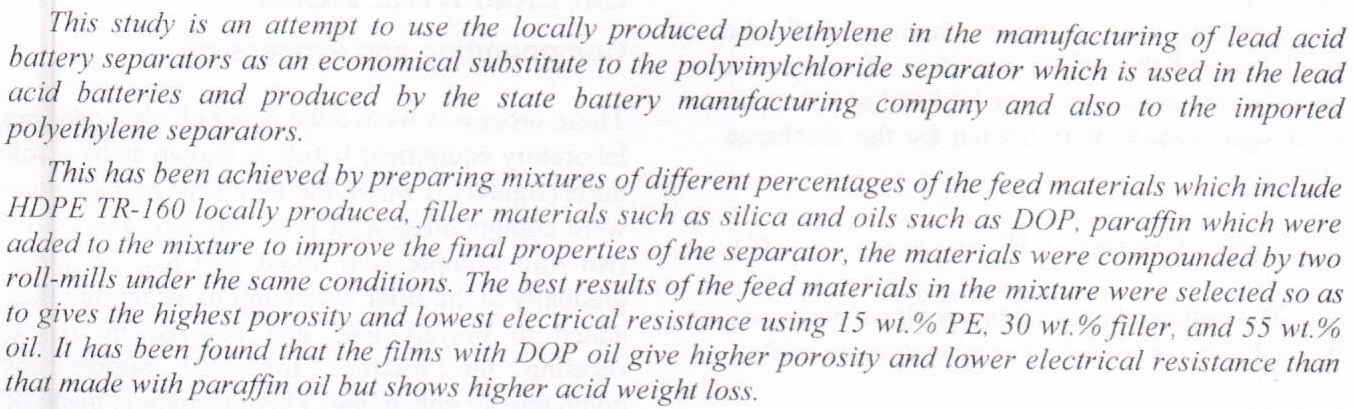
The Manufacture of Lead Acid Battery Separators using Locally Produced Polyethylene

Many researchers have tackled the shear behavior of Reinforced Concrete (RC) beams by using different kinds of strengthening in the shear regions and steel fibers. In the current paper, the effect of multiple parameters, such as using one percentage of Steel Fibers (SF) with and without stirrups, without stirrups and steel fibers, on the shear behavior of RC beams, has been studied and compared by using Finite Element analysis (FE). Three-dimensional (3D) models of (RC) beams are developed and analyzed using ABAQUS commercial software. The models were validated by comparing their results with the experimental test. The total number of beams that were modeled for validation purposes was four. Extensive pa
... Show More
Multilateral wells require a sophisticated type of well model to be applied in reservoir simulators to represent them. The model must be able to determine the flow rate of each fluid and the pressure throughout the well. The production rate calculations are very important because they give an indication about some main issues associated with multi-lateral wells such as one branch may produce water or gas before others, no production rate from one branch, and selecting the best location of a new branch for development process easily.  
... Show MoreThe increase globally fossil fuel consumption as it represents the main source of energy around the world, and the sources of heavy oil more than light, different techniques were used to reduce the viscosity and increase mobility of heavy crude oil. this study focusing on the experimental tests and modeling with Back Feed Forward Artificial Neural Network (BFF-ANN) of the dilution technique to reduce a heavy oil viscosity that was collected from the south- Iraq oil fields using organic solvents, organic diluents with different weight percentage (5, 10 and 20 wt.% ) of (n-heptane, toluene, and a mixture of different ratio
... Show More (6)
(6)
In this work, the precursor [2-(1,5-dimethyl-3-oxo-2-phenyl-2,3-dihydro-1H-pyrazol-4-ylimino)acetic acid] was synthesised from 4-aminoantipyrine and glyoxylic acid, this precursor has been used in the synthesis of new multidentate ligand [2-((E)-3-(2-hydroxyphenylimino)-1,5-dimethyl-2-phenyl-2,3-dihydro-1H-pyrazol-4-ylimino)acetic acid][H2L] type (N2O2). The ligand was refluxed in ethanol with metal ions [VO(II), Mn(II), Co(II) and Ni(II)] salts to give complexes of general molecular formula:[M(H2L)2(X)(Y)].B, where: M=VO(II), X=0, Y=OSO3-2, B=2H2O; M=Mn(II),Co(II) ,X=Cl, Y=Cl, B=0; M=Ni(II), X=H2O, Y=Cl, B=Cl. These complexes were characterised by atomic absorpition(A.A), F.T-I.R., (U.V-Vis)spectroscopies (1H,13C NMR for ligand only), alon
... Show MoreUsing sodium4-((4,5-diphenyl-imidazol-2-yl)diazenyl)-3-hydroxynaphthalene-1-sulfonate (SDPIHN) as a chromogenic reagent in presence of non-ionic surfactant (Triton x-100) to estimate the chromium(III) ion if the wavelength of this reagent 463 nm to form a dark greenish-brown complex in wavelength 586 nm at pH=10,the complex was stable for longer than 24 hours. Beer's low, molar absorptivity 0.244×10⁴L.mol-1.cm-1, and Sandal's sensitivity 0.021 µg/cm2 are all observed in the concentration range 1-11 µg/mL. The limits of detection (LOD) and limit of quantification (LOQ), respectively, were 0.117 µg/mL and 0.385µg/mL. (mole ratio technique, job's method) were employed to
... Show More (5)
(5)

Reactive Powder Concrete (RPC) can be incorporate as a one of the most important and progressive concrete technology. It is a special type of ultra-high strength concrete (UHSC) that’s exclude the coarse aggregate from its constitutive materials. In this research an experimental study had been carried out to investigate the effect of using three types of materials (porcelain aggregate) and others sustainable materials (glass waste and granular activated carbon) as a partial replacement of fine aggregate. Four percentages had considered (0, 10, 15 and 20) % to achieve better understanding for the influence of these materials upon the compressive strength of RPC. Four curing ages had included in this study, these are; 7, 28, 60 and
... Show More
(7)
In the last few years, the use of artificial neural network analysis has increased, particularly, in geotechnical engineering problems and has demonstrated some success. In this research, artificial neural network analysis endeavors to predict the relationship between physical and mechanical properties of Baghdad soil by making different trials between standard penetration test, liquid limit, plastic limit, plasticity index, cohesion, angle of internal friction, and bearing capacity. The analysis revealed that the changes in natural water content and plastic limit have a great effect on the cohesion of soil and the angle of internal friction, respectively. . On the other hand, the liquid limit has a great impact on the bearing capacity and
... Show MoreIn the last few years, the use of artificial neural network analysis has increased, particularly, in geotechnical engineering problems and has demonstrated some success. In this research, artificial neural network analysis endeavors to predict the relationship between physical and mechanical properties of Baghdad soil by making different trials between standard penetration test, liquid limit, plastic limit, plasticity index, cohesion, angle of internal friction, and bearing capacity. The analysis revealed that the changes in natural water content and plastic limit have a great effect on the cohesion of soil and the angle of internal friction, respectively. . On the other hand, the liquid limit has a great impact on the bearing capacity and
... Show MoreIn the last few years, the use of artificial neural network analysis has increased, particularly, in geotechnical engineering problems and has demonstrated some success. In this research, artificial neural network analysis endeavors to predict the relationship between physical and mechanical properties of Baghdad soil by making different trials between standard penetration test, liquid limit, plastic limit, plasticity index, cohesion, angle of internal friction, and bearing capacity. The analysis revealed that the changes in natural water content and plastic limit have a great effect on the cohesion of soil and the angle of internal friction, respectively. . On the other hand, the liquid limit has a great impact on the bearing capacity and
... Show More
(9)
Reactive Powder Concrete (RPC) can be incorporate as a one of the most important and progressive concrete technology. It is a special type of ultra-high strength concrete (UHSC) that’s exclude the coarse aggregate from its constitutive materials. In this research an experimental study had been carried out to investigate the effect of using three types of materials (porcelain aggregate) and others sustainable materials (glass waste and granular activated carbon) as a partial replacement of fine aggregate. Four percentages had considered (0, 10, 15 and 20) % to achieve better understanding for the influence of these materials upon the compressive strength of RPC. Four curing ages had included in this study, these are; 7, 28, 60 and
... Show More
(6)
(7)