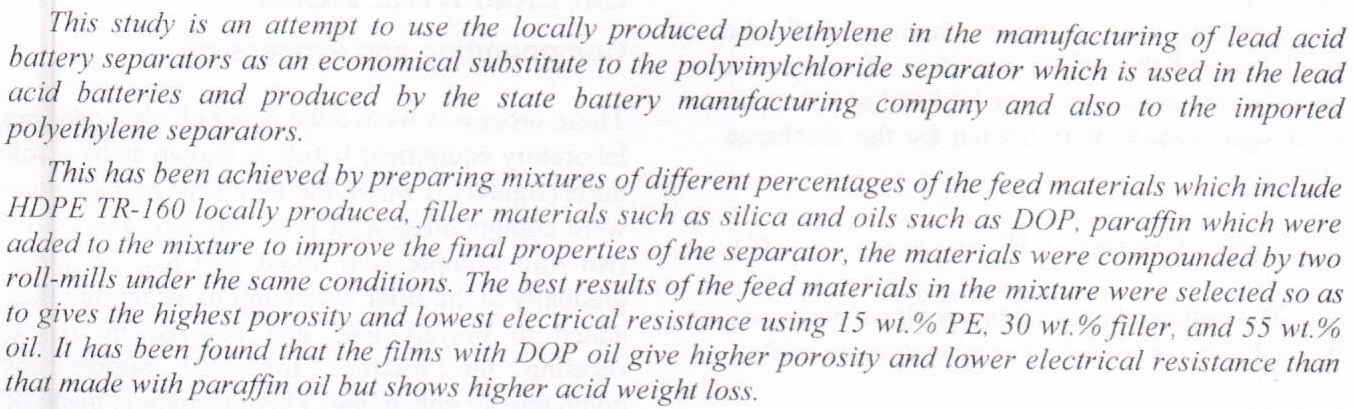
The Manufacture of Lead Acid Battery Separators using Locally Produced Polyethylene

The last ten years observed a shift enormous scientific in the method and way that it deals professional with the cost accounting and reflected the result those shift enormous scientific of increase the competitive environmental that accompanied the emergence of a modern manufacturing environmental on surface the long roductive life and emergence advanced information technology that give a central focus of his important on client with growing global markets growth on a large scale.
The research aim to define the concept of cost awareness, the concept and methods of strategic cost management and the role of cost awareness for managers of industrial units in strategic of cost managem
... Show MoreAbstract
This study aims to identify the most prominent factors that lead to bullying of students with intellectual disabilities in primary and middle schools from the perspectives of special education teachers. A quantitative descriptive approach was utilized. A questionnaire was used as a tool for data collection. The sample consisted of (72) male and female teachers from the Asir region in the Kingdom of Saudi Arabia. The results revealed the most prominent factors that lead to bullying as follows: factors associated with the school and its policies, factors associated with peers, factors associated with students with intellectual disabilities, and factors associated with general education teachers. The findin
... Show More (15)
(15)
 (9)
(9)



The removal of turbidity from produced water by chemical coagulation/flocculation method using locally available coagulants was investigated. Aluminum sulfate (alum) is selected as a primary coagulant, while calcium hydroxide (lime) is used as a coagulant aid. The performance of these coagulants was studied through jar test by comparing turbidity removal at different coagulant/ coagulants aid ratio, coagulant dose, water pH, and sedimentation time. In addition, an attempt has been made to examine the relationship between turbidity (NTU) and total suspended solids (mg/L) on the same samples of produced water. The best conditions for turbidity removal can be obtained at 75% alum+25% lime coagulant at coagulant dose of 80 m
... Show MoreThis study aimed to prepare a healthy Nutella rich in specific fatty acids (e.g., oleic, palmitic, and stearic acids) and fat-soluble vitamins (A, E, K, and D) by replacing sunflower oil with anhydrous milk fat (ghee) at substitution levels of 10%, 20%, and 30%. The effect of this substitution on the physicochemical and sensory properties of the laboratoryproduced Nutella was investigated. The chemical composition analysis revealed significant differences (p < 0.05) in fatty acid profiles and vitamin content among the treatments, while some other compositional parameters showed no significant differences. The percentages of oleic, palmitic, stearic, and linolenic fatty acids increased significantly with increasing substitution levels of anh
... Show More
Two series of bent and liner core mesogen containing 1,2,4-traizole ring [VI]a,g and series were synthesized by many steps starting from esterification of isophthalic acid and terephathalic acid with methanol to yield diester compound [I]a,b which was converted to their acid hydrazide [II]a,b and the acid hydrazide reacted with ammonium thiocyanate or diester reacted with thiosemicarbazide to yield compounds [III]a,b. Then cyclization by 4% NaOH to yielded 1,2,4 traizole-3- thiol compounds [IV]a,b , afterword adding hydrazine hydrate to yield compounds [V]a,b. These compounds condensated with different substituted aldehyde to give new Schiff bases[VI]a,b ,[VII]a,b . Also , reaction acid hydrazide [II]a,b with aldehyde [VII] to yielded Schif
... Show More
(2)
(2)
(1)
This prospective study investigates the prevalence of methicillin-resistant S.aureus (MRSA)
in burn unit of Al-Kindy Iraqi hospital, their susceptibility to antibiotics and bactericidal effect of near
infrared light from high powered 1064nm Nd: YAG laser and green light 532nm from SHG Nd: YAG laser
using various energy densities on these bacteria. Twenty four clinical isolates of S.aureus out of sixty
four examined patients with sever burn ulcers.MRSA was associated with 50% of S.aureus infections
.Results of antimicrobial susceptibility revealed that MRSA were multidrug resistant. After laser treatment
of non MRSA with Nd:YAG with wavelength of 1.064nm, 4mm beam diameter, energy density of
0.636 kh/cm2 and 180sec ex
