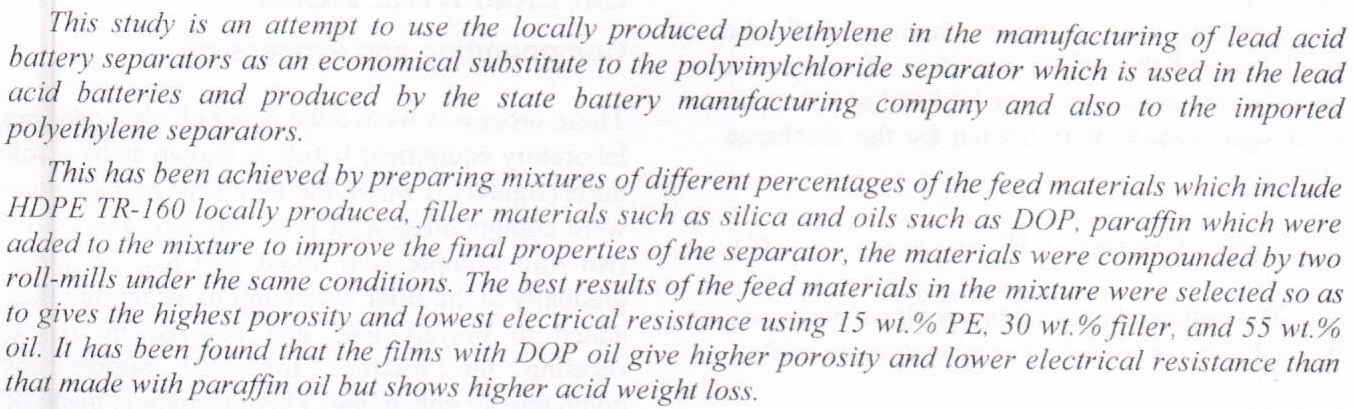
The Manufacture of Lead Acid Battery Separators using Locally Produced Polyethylene

The possibility of using zero-valent iron as permeable reactive barrier in removing lead from a contaminated groundwater was investigated. In the batch tests, the effects of many parameters such as contact time between adsorbate and adsorbent (0-240 min), initial pH of the solution (4-8), sorbent dosage (1-12 g/100 mL), initial metal concentration (50-250 mg/L), and agitation speed
(0-250 rpm) were studied. The results proved that the best values of these parameters achieve the maximum removal efficiency of Pb+2 (=97%) were 2 hr, 5, 5 g/100 mL, 50 mg/L and 200 rpm respectively. The sorption data of Pb+2 ions on the zero-valent iron have been performed well by Langmuir isotherm model in compared with Freundlich model under the studied
 (5)
(5)

The objective of this study was to isolate and identify the asparaginase-producing bacteria, then purify and characterize the enzyme in order to investigate their properties in the future. Fifteen local bacterial isolates were isolated from various sites in the city of Baghdad, identified by conventional morphological and biochemical procedures, and confirmed using vitek 2 methods, and submitted to primary screening processes for asparaginase production. For secondary screening, eight isolates with the greatest yellow zone ability on a specific solid medium were chosen. Bacillus sp. was reported to have the highest enzyme production (7.5 U/mg proteins). After 24 hours of incubation, submerged fermentation yielded optimal conditi
... Show More (1)
(1)

This study was designed to evaluate the ability of bioemulsifier to inhibit the growth of some pathogenic microorganisms. Fourteen isolates belonged to Serratia sp. were collected and tested for their ability to produce bioemulsifier. Results showed that Serratia marcescens S10 (isolated from the gut of the American cockroach) had the highest ability to produce bioemulsifier, among 14 isolates belong to Serratia spp. and it had the ability to inhibit the growth of some microorganisms. The production of bioemulsifier was detected by determination of emulsification index (E24%), qualitative drop-collapse test, emulsification activity (E.A) and measuring the surface tension (S.T). The results of bioemulsifier produced by Serratia marcescens S1
... Show More
(6)
Antitumor activity of dextran produced from localized Leuconostoc mesenteroides isolates
(4)
Diabetes mellitus, with adverse neonatal events are challenging issues to all obstetricians and pediatricians, where uric acid could play a vital role. We aimed to assess the relationship and prognostic benefits of serum uric acid measured at about 20 weeks’ gestation in normotensive pregnancy, with subsequent maternal diabetes, and neonatal complications. All singleton normotensive pregnant women with normal blood glucose, serum creatinine, and weight before pregnancy, whom attended Medical City Hospital, Department of Obstetrics and Gynecology in Baghdad, were involved and regarded as the case group, on the condition that their serum uric acid measured at 20 weeks’ gestation > 3 mg/dl, but if ≤ 3 mg/dl, they would be regi
... Show More
(12)
(5)
Biodegradation is utilizing microorganisms to degrade materials into products that are safe for the
environment, such as carbon dioxide, water, and biomass. The current study aims to isolate and characterize
bacteria with polyethylene terephthalate (PET) degradation ability isolated from Shatt al-Arab water and
sewage from Basra, the bacteria were identified as Klebsiella pneumonia. According to the findings, the
isolates showed a highly significant difference in degradation of PET (24% during 7 days) and the percent of
degradation increased to 46% at 4 weeks compared to the control. The study also involved determining the
optimum temperature of K. pneumonia growth, which was 37°C, while the preferred
(5)
Two locally isolated microalgae (Chlorella vulgaris Bejerinck and Nitzschia palea (Kützing) W. Smith) were used in the current study to test their ability to production biodiesel through stimulated in different nitrogen concentration treatments (0, 2, 4, 8 gl ), and effect of nitrogen concentration on the quantity of primary product (carbohydrate, protein ), also the quantity and quality of lipid. The results revealed that starvation of nitrogen led to high lipid yielding, in C. vulgaris and N. palea the lipid content increased from 6.6% to 40% and 40% to 60% of dry weight (DW) respectively.Also in C. vulgaris, the highest carbohydrate was 23% of DW from zero nitrate medium and the highest protein was 50% of DW in the treatment 8gl. Whil
... Show More
(3)