Preferred Language
Articles
/
ijcpe-688
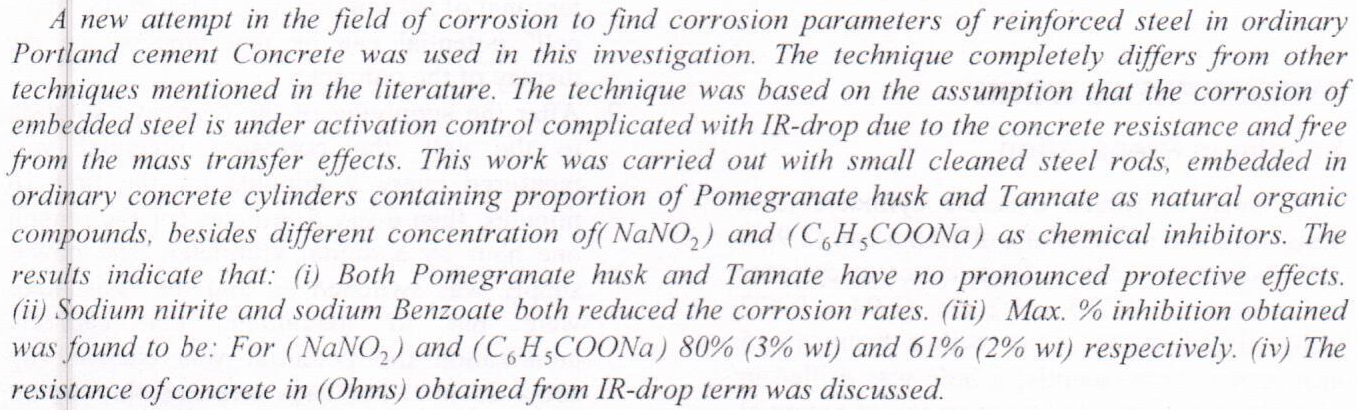
Corrosion Inhibition of Steel Reinforcement in Concrete
...Show More Authors

View Publication Preview PDF
Quick Preview PDF
Publication Date
Tue Jun 01 2021
Journal Name
Engineering, Technology & Applied Science Research
Producing Green Concrete with Plastic Waste and Nano Silica Sand
...Show More Authors

Abstract-Industrial and urban development has resulted in the spread of plastic waste and the increase in the emissions of carbon dioxide resulting from the cement manufacturing process. The current research aims to produce green (environmentally friendly) concrete by using plastic waste as coarse aggregates in different proportions (10% and 20%) and nano silica sand powder as an alternative to cement in different proportions (5% and 10% by weight). The results showed that compressive strength decreased by 12.10% and 19.23% for 10% and 20% plastic waste replacement and increased by 12.89% and 20.39% for 5% and 10% silica sand replacement respectively at 28 days. Flexural strength decreased by 12.95% and 19.64% for 10% and 20% plastic waste

... Show More
Publication Date
Sun May 01 2016
Journal Name
Journal Of Engineering
Experimental Behavior of Laced Reinforced Concrete One Way Slab under Static Load
...Show More Authors

Test results of eight reinforced concrete one way slab with lacing reinforcement are reported. The tests were designed to study the effect of the lacing reinforcement on the flexural behavior of one way slabs. The test parameters were the lacing steel ratio, flexural steel ratio and span to the effective depth ratio. One specimen had no lacing reinforcement and the remaining seven had various percentages of lacing and flexural steel ratios. All specimens were cast with normal density concrete of approximately 30 MPa compressive strength. The specimens were tested under two equal line loads applied statically at a thirds part (four point bending test) up to failure. Three percentage of lacing and flexural steel ratios wer

... Show More
View Publication Preview PDF
Publication Date
Tue Dec 05 2023
Journal Name
Baghdad Science Journal
Application of Sulfur-2,4-dinitrophenylhydrazine as Modifier for Producing an Advantageous Concrete
...Show More Authors

In this investigative endeavor, a novel concrete variety incorporating sulfur-2,4-dinitrophenylhydrazine modification was developed, and its diverse attributes were explored. This innovative concrete was produced using sulfur-2,4-dinitrophenylhydrazine modification and an array of components. The newly created sulfur-2,4-dinitrophenylhydrazine modifier was synthesized. The surface texture resulting from this modifier was examined using SEM and EDS techniques. The component ratios within concrete, chemical and physical traits derived from the sulfur-2,4-dinitrophenylhydrazine modifier, chemical and corrosion resistance of concrete, concrete stability against water absorption, concrete resilience against freezing, physical and mechanical p

... Show More
View Publication Preview PDF
Scopus (7)
Crossref (1)
Scopus Crossref
Publication Date
Wed Jul 14 2021
Journal Name
The Open Civil Engineering Journal
Producing Sustainable Concrete using Nano Recycled Glass
...Show More Authors
Background:

Many tools and techniques have been recently adopted to develop construction materials that are less harmful and friendlier to the environment. New products can be achieved through the recycling of waste material. Thus, this study aims to use recycled glass bottles as sustainable materials.

Objective:

Our challenge is to use nano glass powder by the addition or replacement of the weight of the cement for producing concrete with enhanced strength.

Methods:

A nano recycled glass p

... Show More
Scopus (18)
Crossref (17)
Scopus Crossref
Publication Date
Sun Jul 09 2023
Journal Name
Journal Of Engineering
Effect of high and low density polyethylene on some mechanical properties of concrete
...Show More Authors

The increasing use of plastics in various aspects of modern life resulted in the availability of enormous amount of wastes, including a negative effect on the environment and humans. So it is necessary to find solutions to deal with these wastes and ensure to use them as solutions to use in concrete mix . In this research the production of concrete containing high and low density polyethylene has been used by (5, 10, 15)% as a replacement of part of the volume of sand, so as to obtain concrete good compressive strength as well as other benefits such as improved possibility of pumping concrete and reduce the loss of concrete for workability polymer is a material that is non-absorbable of water . It is also intended to dispose of these was

... Show More
View Publication Preview PDF
Crossref
Publication Date
Sun Jul 09 2023
Journal Name
Journal Of Engineering
Assessing the Effect of Using Porcelanite on Compressive Strength of Roller Compacted Concrete
...Show More Authors

Roller-Compacted Concrete (RCC) is a zero-slump concrete, with no forms, no reinforcing steel, no finishing and is wet enough to support compaction by vibratory rollers. Because the effectiveness of curing on properties and durability, the primary scope of this research is to study the effect of various curing methods (air curing, emulsified asphalt(flan coat) curing, 7 days water curing and permanent water curing) and different porcelanite (local material used as an Internal Curing agent) replacement percentages (volumetric replacement) of fine aggregate on some properties of RCC and to explore the possibility of introducing more practical RCC for road pavement with minimum requirement of curing. Cubes specimens were sawed from the slab

... Show More
View Publication Preview PDF
Crossref (6)
Crossref
Publication Date
Tue Nov 01 2016
Journal Name
Journal Of Engineering
Experimental Investigations on the Strength and Serviceability of Biaxial Hollow Concrete Slabs
...Show More Authors

Biaxial hollow slab is a reinforced concrete slab system with a grid of internal spherical voids included to reduce the self-weight. This paper presents an experimental study of behavior of one-way prestressed concrete bubbled slabs. Twelve full-scale one-way concrete slabs of (3000mm) length with rectangular cross-sectional area of (460mm) width and (150mm) depth. Different parameters like type of specimen (solid or bubbled slabs), type of reinforcement (normal or prestress), range of PPR and diameter of plastic spheres (100 or 120mm) are considered. Due to the using of prestressing force in bubbled slabs (with ratio of plastic sphere diameter D to slab thickness H, D/H=0.67), the specimens showed an increase in ultimat

... Show More
View Publication Preview PDF
Publication Date
Tue Aug 01 2023
Journal Name
Journal Of Engineering
Flexural Behavior of Reinforced Rubberized Reactive Powder Concrete Beams under Repeated Loads
...Show More Authors

Non-biodegradability of rubber tires contributes to pollution and fire hazards in the natural environment. In this study, the flexural behavior of the Rubberized Reactive Powder Concrete (RRPC) beams that contained various proportions and sizes of scrap tire rubber was investigated and compared to the flexural behavior of the regular RPC. Fresh properties, hardened properties, load-deflection relation, first crack load, ultimate load, and crack width are studied and analyzed. Mixes were made using micro steel fiber of the straight type, and they had an aspect ratio of 65. Thirteen beams were tested under two loading points (Repeated loading) with small-scale beams (1100 mm, 150 mm, 100 mm) size.

The fine aggregate

... Show More
View Publication Preview PDF
Scopus (7)
Crossref (5)
Scopus Crossref
Publication Date
Mon Aug 05 2019
Journal Name
Journal Of Engineering
Behaviour of Segmental Concrete Beams Reinforced by Pultruded CFRP Plates: an Experimental Study
...Show More Authors

Research aims to develop a novel technique for segmental beam fabrication using plain concrete blocks and externally bonded Carbon Fiber Reinforced Polymers Laminates (CFRP) as a main flexural reinforcement. Six beams designed an experimentally tested under two-point loadings. Several parameters included in the fabrication of segmental beam studied such as; bonding length of carbon fiber reinforced polymers, the surface-to-surface condition of concrete segments, interface condition of the bonding surface, and thickness of epoxy resin layers. Test results of the segmental beams specimens compared with that gained from testing reinforced concrete beam have similar dimensions for validations. The results show the effectiven

... Show More
View Publication Preview PDF
Crossref (5)
Crossref
Publication Date
Fri Jul 01 2016
Journal Name
Composite Structures
Bond behaviour between CFRP laminates and steel members under different loading rates
...Show More Authors

Carbon fibre reinforced polymers are widely used to strengthen steel structural elements. These structural elements are normally subjected to static, dynamic and fatigue loadings during their life-time. A number of studies have focused on the characteristics of CFRP sheets bonded to steel members under static, dynamic and fatigue loadings. However, there is a gap in understanding the bonding behaviour between CFRP laminates and steel members under impact loading. This paper shows the effect of different load rates from quasi-static to 300 × 103 mm/min on this bond. Two types of CFRP laminate, CFK 150/2000 and CFK 200/2000, were used to strengthen steel joints using Araldite 420 epoxy. The results show a significant bond strength enhancemen

... Show More
Scopus (74)
Crossref (62)
Scopus Clarivate Crossref