Preferred Language
Articles
/
ijcpe-688
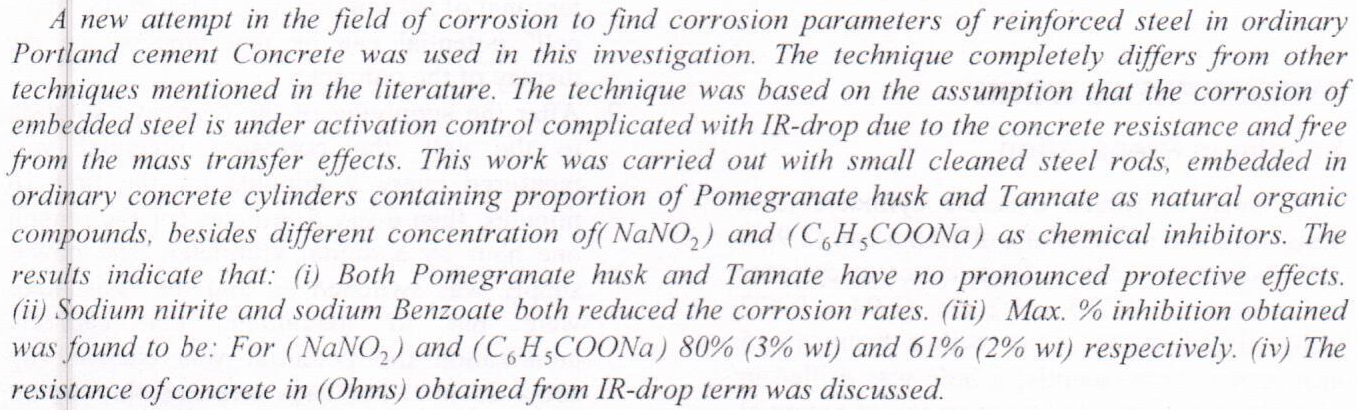
Corrosion Inhibition of Steel Reinforcement in Concrete
...Show More Authors

View Publication Preview PDF
Quick Preview PDF
Publication Date
Mon Dec 01 2008
Journal Name
Al-khwarizmi Engineering Journal
Effect of Chloride Ions on the Corrosion Behavior of Al – Zn Alloy in NaOH Solution at Four Different Temperatures
...Show More Authors

This research involves study effect of chloride ions in concentration range (0.01 – 0.50 mol.dm-3) on the corrosion behavior of Al-Zn alloy in basic media of 1x10⁻³ mol.dm-3 NaOH at pH=11 and four different temperatures in the range (298-313 K). Cathodic and anodic Tafel slopes (bc &ba) and transfer coefficients (αc & αa) were calculated and the results interprets according to the variation of the rate – determining steps. The results also indicate that the chloride ions are bonded chemically in the interface as an initial step of formation of different mixed oxohydroxy – and chloro complexes. Polarization resistance (Rp) is calculates

... Show More
View Publication Preview PDF
Publication Date
Thu Nov 01 2012
Journal Name
2012 First National Conference For Engineering Sciences (fnces 2012)
Laboratory investigation in the Hydrated lime effect on asphalt concrete mixture
...Show More Authors

This investigation was undertaken to evaluate the effectiveness of using Hydrated lime as a (partial substitute) by weight of filler (lime stone powder) with five consecutive percentage namely (1.0, 1.5, 2.0, 2.5, 3.0) % by means of aggregate treatment, by introducing dry lime on dry and 2–3% Saturated surface aggregate on both wearing and binder coarse. Marshall design method, indirect tensile test and permanent deformation under repeated loading of Pneumatic repeated load system at full range of temperature (20, 40, 60) C0 were examined The study revealed that the use of 2.0% and 1.5 % of dry and wet replacement extend the pavement characteristics by improving the Marshall properties and increasing the TSR%. Finally, increase permanent

... Show More
View Publication
Crossref (2)
Crossref
Publication Date
Sat Jan 01 2022
Journal Name
Materials Today: Proceedings
Shear strength of steel fibre RC beams under repeated loads
...Show More Authors

Scopus (1)
Scopus Clarivate Crossref
Publication Date
Mon Jul 10 2023
Journal Name
Journal Of Engineering
Analysis and Optimum Design of Self Supporting Steel Communication Tower
...Show More Authors

The present study deals with the optimum design of self supporting steel communication towers. A special technique is used to represent the tower as an equivalent hollow tapered beam with variable cross section. Then this method is employed to find the best layout of the tower among prespecified configurations. The formulation of the problem is applied to four types of tower layout
with K and X brace, with equal and unequal panels. The objective function is the total weight of the tower. The variables are the base and the top dimensions, the number of panels for the tower and member's cross section areas. The formulations of design constraints are based on the requirements of EIA and ANSI codes for allowable stresses in the members

... Show More
View Publication Preview PDF
Crossref
Publication Date
Fri Dec 01 2023
Journal Name
Case Studies In Construction Materials
Appraising the synergistic use of recycled asphalt pavement and recycled concrete aggregate for the production of sustainable asphalt concrete
...Show More Authors

Material obtained from the demolition of concrete structures and milling of flexible pavements has the highest potential for recyclability. This study aimed to evaluate the performance of hot mix asphalt with the concurrent use of recycled asphalt pavement (RAP) and recycled concrete aggregate (RCA). Contents of RAP and RCA were varied from 0% to 50% by fixing the total recycling materials percentage to 50%. Penetration grade 40/50 virgin binder and waste engine oil (WEO) as rejuvenator were used in the present study. A series of tests, such as Scanning electron microscopy (SEM), Marshall stability, indirect tensile strength test, IDEAL CT, uniaxial compression test, and resilient modulus test, were carried out to assess the performance of

... Show More
View Publication Preview PDF
Scopus (28)
Crossref (14)
Scopus Clarivate Crossref
Publication Date
Wed Jul 14 2021
Journal Name
The Open Civil Engineering Journal
Producing Sustainable Concrete using Nano Recycled Glass
...Show More Authors
Background:

Many tools and techniques have been recently adopted to develop construction materials that are less harmful and friendlier to the environment. New products can be achieved through the recycling of waste material. Thus, this study aims to use recycled glass bottles as sustainable materials.

Objective:

Our challenge is to use nano glass powder by the addition or replacement of the weight of the cement for producing concrete with enhanced strength.

Methods:

A nano recycled glass p

... Show More
View Publication Preview PDF
Crossref (16)
Crossref
Publication Date
Thu Jan 30 2020
Journal Name
Journal Of Engineering
Flexural Behavior of Fiber Reinforced Self-Compacting Rubberized Concrete Beams
...Show More Authors

The massive growth of the automotive industry and the development of vehicles use lead to produce a huge amount of waste tire rubber. Rubber tires are non-biodegradable, resulting in environmental problems such as fire risks. In this search, the flexural behavior of steel fiber reinforced self-compacting concrete (SFRSCC) beams containing different percentages and sizes of waste tire rubbers were studied and compared them with the flexural behavior of SCC and SFRSCC. Micro steel fiber (straight type) with aspect ratio 65 was used in mixes. The replacement of coarse and fine aggregate was 20% and 10% with chip and crumb rubber. Also, the replacement of limestone dust and silica fume was 50%, 25%, and 12% with ground rubbe

... Show More
View Publication Preview PDF
Crossref (8)
Crossref
Publication Date
Tue Sep 19 2017
Journal Name
International Journal Of Science And Research
Volumetric Change of Concrete Containing Water Absorption Polymer Balls
...Show More Authors

Polymers have the ability to extract water after they have been added to the mortar or concrete mixture. They provide the absorbed water during hydration functioning as internal water source. Absorption polymers can absorb up to hundred times of their own weight of pure water.This research deals with the use of water absorption polymer balls in concrete and study the volumetric change of these mixes and compared the results with reference mix (without polymers). Samples were cured both in air and in water for the mixes to compare results which show that samples in air behave for expansion while sample in water acted for shrinkage.

Publication Date
Thu Dec 01 2011
Journal Name
Journal Of Engineering
MECHANISTIC EVALUATION OF LIME-MODIFIED ASPHALT CONCRETE MIXTURES
...Show More Authors

Frequently, Load associated mode of failure (rutting and fatigue) as well as, occasionally, moisture damage in some sections poorly drained are the main failure types found in some of the newly constructed road within Baghdad as well as other cities in Iraq. The use of hydrated lime in pavement construction could be one of the possible steps taken in the direction of improving pavement performance and meeting the required standards. In this study, the mechanistic properties of asphalt concrete mixes modified with hydrated lime as a partial replacement of limestone dust mineral filler were evaluated. Seven replacement rates were used; 0,0.5, 1, 1.5, 2, 2.5 and 3 percent by weight of aggregate. Asphalt concrete mixes were prepared at their

... Show More
View Publication Preview PDF
Crossref
Publication Date
Mon Jun 01 2020
Journal Name
Journal Of Engineering
Effect of Biopolymer Alginate on some properties of concrete
...Show More Authors

Alginate from Large brown seaweeds act as natural polymer has been investigated as polymer and has been added to concrete in different percentages ( 0% , 0.5% , 1% and 1.5% ) by the cement weight and the study show the effect of using alginate biopolymer admixtures on  some of the fresh properties of the concrete (slump &  the density  fresh) also in the hardened state (  Compressive strength , Splitting tensile strength  and Flexural strength ) at 28 days. The mix proportion was (1:2.26:2.26) (cement: sand: gravel) respectively and at constant w/c equal to 0.47. The results indicate that the use of alginate as a percent of the cement weight possess a positive effect on fresh properties of co

... Show More
View Publication Preview PDF
Crossref (7)
Crossref