Preferred Language
Articles
/
ijcpe-688
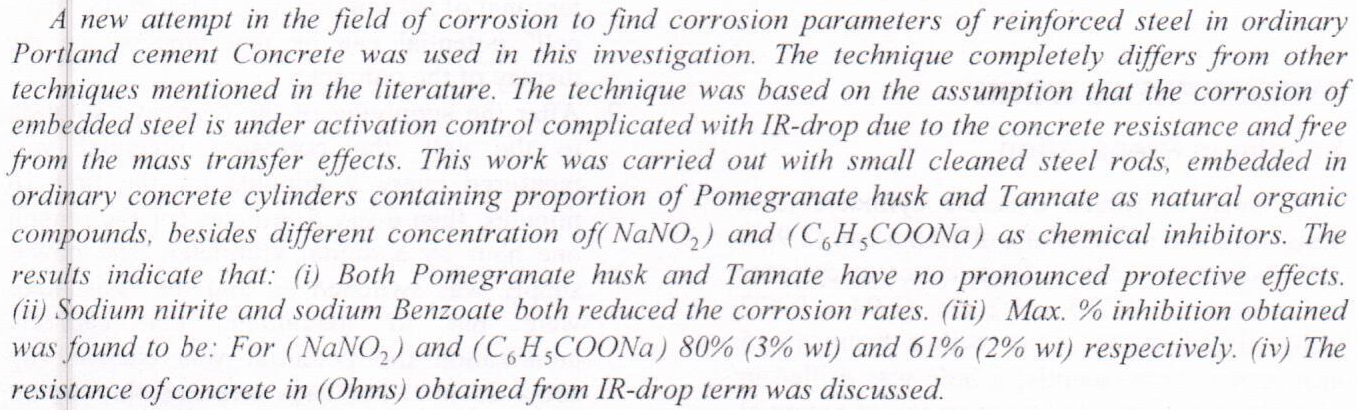
Corrosion Inhibition of Steel Reinforcement in Concrete
...Show More Authors

View Publication Preview PDF
Quick Preview PDF
Publication Date
Tue Dec 08 2020
Journal Name
Acs Infectious Diseases
Antileishmanial Chemotherapy through Clemastine Fumarate Mediated Inhibition of the <i>Leishmania</i> Inositol Phosphorylceramide Synthase
...Show More Authors

View Publication
Scopus (19)
Crossref (21)
Scopus Clarivate Crossref
Publication Date
Sun Mar 01 2009
Journal Name
Al-khwarizmi Engineering Journal
Mass Transfer Coefficient During Cathodic Protection of Low Carbon Steel in Seawater
...Show More Authors

The aim of this research is to calculate mass transfer coefficient, kd, during cathodic protection of low carbon steel in neutral seawater (3.5% W/V NaCl in distilled water with pH = 7). Two types of cathodic protection were used:

First: Sacrificial anode cathodic protection (SACP) were a pipeline of steel carrying seawater  using zinc as a sacrificial anode and with variable temperatures ranged (0 – 45oC) and volumetric flow rate ranged (5 – 900 lit/hr). It was found that the kd increases with increasing temperature and volumetric flow rate of seawater, where kd ranged (0.24×10⁻⁶ – 41.6×10⁻⁶ m/s).

Second: Impressed current cathodic pr

... Show More
View Publication Preview PDF
Publication Date
Mon Jun 19 2023
Journal Name
Journal Of Engineering
Assessing Durability of Roller Compacted Concrete
...Show More Authors

Roller Compacted Concrete (RCC) is a technology characterized mainly by the use of rollers for compaction; this technology achieves significant time and cost savings in the construction of dams and roads. The primary scope of this research is to study the durability and performance of roller compacted concrete that was constructed in the laboratory using roller compactor manufactured in local market. A total of (60) slab specimen of (38×38×10) cm was constructed using the roller device, cured for 28 days, then 180 sawed cubes and 180 beams are obtained from RCC slab. Then, the specimens are subjected to 60 cycles of freezing and thawing, sulfate attack test and wetting and drying. The degree of effect of the type of coarse aggregate (c

... Show More
View Publication Preview PDF
Crossref
Publication Date
Thu Dec 31 2015
Journal Name
Al-khwarizmi Engineering Journal
Corrosion Effective of Condensed Synthetic Automotive Solution Containing Selective Organic Component Mixtures on Al-alloys
...Show More Authors

Abstract

 This work involves studying the effect of adding some selective organic component mixture on corrosion behavior of pure Al and its alloys in condensed synthetic automotive solution (CSAS) at room temperature. This mixture indicates the increasing of octane number in previous study and in this study show the increasing in corrosion resistance through the decreasing in corrosion rate values.

Electrochemical measurements were carried out by potentiostat at 3 mV/sec to estimate the corrosion parameters using  Tafel extrapolation method, in addition to cyclic polarization test to know the pitting susceptibility of materials in tested medium.

The cathodic Tafel slope

... Show More
View Publication Preview PDF
Publication Date
Sun Dec 09 2018
Journal Name
Baghdad Science Journal
Anticorrosion Behavior of Deposited Magnetite on Galvanized Steel in Saline Water Using RF-Magnetron Sputtering
...Show More Authors

Thin films of Magnetite have been deposited on Galvanized Steel (G-S) alloy using RF-reactive magnetron sputtering technique and protection efficiency of the corrosion of G-S. A Three-Electrodes Cell was used in saline water (3.5 % NaCl) solution at different temperatures (298, 308, 318 & 328K) using potentiostatic techniques with. Electrochemical Impedance Spectroscopy (EIS) and fitting impedance data via Frequency Response Analysis (FRA) were applied to G-S alloy with Fe3O4 and tested in 3.5 % NaCl solution at 298K.Results taken from Nyquist and Bode plots were analyzed using software provided with the instrument. The results obtained show that the rate of corrosion of G.S alloy increased with increasing the temperatures from 298 t

... Show More
View Publication Preview PDF
Scopus Clarivate Crossref
Publication Date
Sun Jun 01 2014
Journal Name
Baghdad Science Journal
The inhibition effect of crude juice of olive Olea europeae on cancer cell line Rhabdomyosarcoma (RD)
...Show More Authors

The inhibition effect of crude juice of green and black olive on cancer cell line (RD) in vitro has been studied by depending on micro titration system . Eleven different concentration starting from (916-960) mg/ml of crude juice respectively ,for three periods of exposure(24-48-72)hours. The resulted showed that the inhibition effect dependent on type of olive fruit juice ,concentration of dose ,time of exposure and the high concentration of both type of olive juice increased the growth of cell line while other concentration caused decrease in different rates ,moreover the black juice was more effective than green and 48 hours' time exposure was the best for inhibition.

View Publication Preview PDF
Crossref
Publication Date
Wed Oct 28 2015
Journal Name
Al-khwarizmi Engineering Journal
Interaction of Corrosion-Cumulative Fatigue and Shot Peening of 1100-H12 Aluminum Alloy
...Show More Authors

Abstract

    Corrosion-fatigue occurs by the combined actions of cyclic loading and corrosive environment. The effect of shot peening on cumulative corrosion-fatigue life of 1100-H12 Al alloy was investigated. Before fatigue testing, specimens were submerged in 3.5%NaCl solution for 71 days. Constant fatigue tests were performed with and without corrosive environment. Cumulative corrosion-fatigue tests were also carried out in order to determine the fatigue life before and after shot peening. The constant fatigue life was significantly reduced due to corrosive environment and the endurance fatigue limit was reduced by 13% compared with dry fatigue. In case of shot peening the cumul

... Show More
View Publication Preview PDF
Publication Date
Fri Dec 15 2023
Journal Name
Iraqi Journal Of Laser
In vitro Investigation the Antifungal and 940 nm Diode Laser Effects on Inhibition of Candida Albicans Isolated from Oral Cavity
...Show More Authors

Background: Candida albicans is a prevalent commensal that can cause severe health problems in humans. One such condition that frequently returns after treatment is oral candidiasis. Aim: the goal of this research is to evaluate the efficiency of 940 nm as a fungicidal on the growth of Candida albicans in vitro. Material and Methods: In vitro samples (fungal swabs) were taken from the oral cavity of 75 patients suffering from oral thrush. Following the process of isolating and identifying Albicans. The samples are divided into four groups:(Group 1): Suspension of C. albicans was put in a solution of saline as a control group. (Group 2): Suspension of C. albicans that had been treated wit

... Show More
View Publication Preview PDF
Crossref (2)
Crossref
Publication Date
Fri Dec 26 2025
Journal Name
Journal Of Baghdad College Of Dentistry
Inhibition of bacterial growth around gutta percha cones by different antimicrobial solutions using antibiotic sensitivity test (An in vitro study)
...Show More Authors

Background: Decontamination of gutta percha cones was important factor for success of root canal treatment. The aim of the present in vitro study was to identify and to compare the antimicrobial effect of following disinfection solutions: 0.2% chlorhexidine gluconate, Iodine, tetracycline hydrochloride solution, EDTA & formocresol mixed with zinc oxide eugenol, on E faecalis, E coli and Candida albicans using sensitivity test Materials and Methods: Three types of microorganisms were isolated from infected root canals (E faecalis, E coli and Candida albicans) and cultured on Mueller Hinton agar petri-dishes. Disinfection of gutta percha cones done by immersion in six disinfection solutions (six groups), the groups are: distill water (used a

... Show More
View Publication Preview PDF
Publication Date
Fri Dec 15 2023
Journal Name
Iraqi Journal Of Laser
In vitro Investigation the Antifungal and 940 nm Diode Laser Effects on Inhibition of Candida Albicans Isolated from Oral Cavity
...Show More Authors

Background: Candida albicans is a prevalent commensal that can cause severe health problems in humans. One such condition that frequently returns after treatment is oral candidiasis. Aim: the goal of this research is to evaluate the efficiency of 940 nm as a fungicidal on the growth of Candida albicans in vitro. Material and Methods: In vitro samples (fungal swabs) were taken from the oral cavity of 75 patients suffering from oral thrush. Following the process of isolating and identifying Albicans. The samples are divided into four groups:(Group 1): Suspension of C. albicans was put in a solution of saline as a control group. (Group 2): Suspension of C. albicans that had been treated with nystatin. (Group 3): Suspension of C. albica

... Show More
Crossref (2)
Crossref