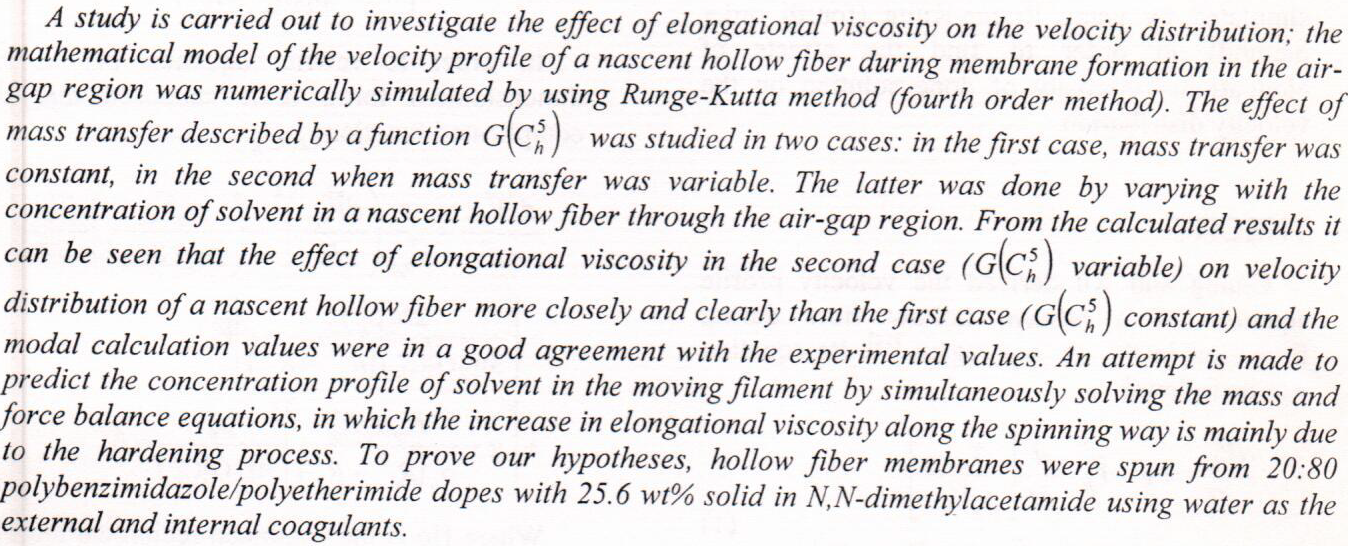
Studying Effect of Elongational Viscosity on the Velocity Distribution for Dry/Wet-Spun Nascent Hollow Fiber Membrane

Alternative distribution to estimate the Dose – Response model in bioassay excrement
This research concern to study five different distribution (Probit , Logistic, Arc sine , extreme value , One hit ), to estimate dose –response model by using m.l.e and probit method This is done by determining different weights in each distribution in addition find all particular statistics for vital model .

 (1)
(1)

This study was conducted for evaluating the cytotoxic effect of heat stable enterotoxin a (STa) produced by enterotoxigenic Escherichia coli on the proliferation of primary cancer cell cultures, obtained from tumor samples that were collected from (13) cancer patients and as follows: (five colon cancer patients, two bladder cancer patients, two breast cancer patients, two stomach cancer patients and two lung cancer patients), and on normal cell line (rat embryonic fibroblast / REF) (in vitro) with the use of different concentrations starting from (1) mg/ml and ending with (0.0002) mg/ml by making two fold serial dilutions by using the 96- well microtiter plate, and in comparison with negative (PBS) and positive (MMC, at concentration
... Show More
Flexible pavements are subjected to three main distress types: fatigue crack, thermal crack, and permanent deformation. Under severe climate conditions, thermal cracking particularly contributes largely to a considerable scale of premature deterioration of pavement infrastructure worldwide. This challenge is especially relevant for Europe, as weather conditions vary significantly throughout the year. Hydrated lime (HL) has been recognized as an effective additive to improve the mechanical properties of asphalt concrete for pavement applications. Previous research has found that a replacement of conventional limestone dust filler using hydrated lime at 2.5% of the total weight of aggregates generated an optimum improvement in the mec
... Show More
(8)
 (7)
(7)

In this research, the possibility of using waste wooden materials (reed and sawdust) was studied to produce sustainable and thermal insulation lightweight building units , which has economic and environmental advantages. This study is intended to produce light weight building units with low thermal conductivity, so it can be used as partitions to improve the thermal insulation in buildings. Waste wooden materials were used as a partial replacement of natural sand, in different percentages (10, 20, 30, and 40) % . The mix proportions were (1:2.5) (cement: fine aggregate) with w/c of 0.4. The values of 28 days oven dry density ranged between (2060-1693) kg/m3.The thermal conductivity decreased from (0.745 to 0.2
... Show MoreIn this study, the photodegradation of Congo red dye (CR) in aqueous solution was investigated using Au-Pd/TiO2 as photocatalyst. The concentration of dye, dosage of photocatalyst, amount of H2O2, pH of the medium and temperature were examined to find the optimum values of these parameters. It has been found that 28 ppm was the best dye concentration. The optimum amount of photocatalyst was 0.09 g/75 mL of dye solution when the degradation percent was ~ 96 % after irradiation time of 12 hours, while the best amount of hydrogen peroxide was 7μl/75 mL of dye solution at degradation percent ~97 % after irradiation time of 10 hours, whereas pH 5 was the best value to carry out the reaction at the highest degradation percent. In additio
... Show More
(18)
(13)
In this study, the photodegradation of Congo red dye (CR) in aqueous solution was investigated using Au-Pd/TiO2 as photocatalyst. The concentration of dye, dosage of photocatalyst, amount of H2O2, pH of the medium and temperature were examined to find the optimum values of these parameters. It has been found that 28 ppm was the best dye concentration. The optimum amount of photocatalyst was 0.09 g/75 mL of dye solution when the degradation percent was ~ 96 % after irradiation time of 12 hours, while the best amount of hydrogen peroxide was 7μl/75 mL of dye solution at degradation percent ~97 % after irradiation time of 10 hours, whereas pH 5 was the best value to carry out the reaction at the highest deg
... Show More
(18)
(13)
In this study, the photodegradation of Congo red dye (CR) in aqueous solution was investigated using Au-Pd/TiO2 as photocatalyst. The concentration of dye, dosage of photocatalyst, amount of H2O2, pH of the medium and temperature were examined to find the optimum values of these parameters. It has been found that 28 ppm was the best dye concentration. The optimum amount of photocatalyst was 0.09 g/75 mL of dye solution when the degradation percent was ~ 96 % after irradiation time of 12 hours, while the best amount of hydrogen peroxide was 7μl/75 mL of dye solution at degradation percent ~97 % after irradiation time of 10 hours, whereas pH 5 was the best value to carry out the reaction at the highest degradation percent. In additio
... Show More
(18)
(13)