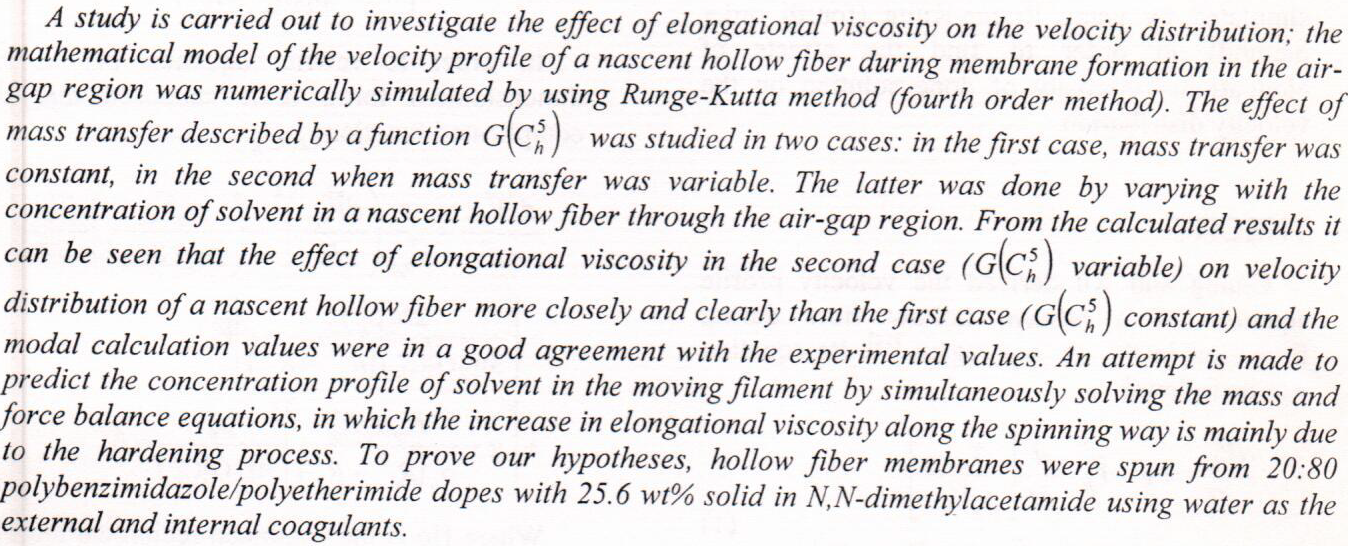
Studying Effect of Elongational Viscosity on the Velocity Distribution for Dry/Wet-Spun Nascent Hollow Fiber Membrane

In this article the unsteady magnetohydrodynamics oscillating flow of third order fluid with free stream velocity is proposed. It is found that the motion equation is controlled by five dimensionless parameters namely the coecostic parameter 4, viscoelostic parameter ?,acceleration/deceleration c,suction/blowing d and material constants ? . The effect of each of these parameters upon the velocity distribution is analysised

The aim of this study is to estimate the parameters and reliability function for kumaraswamy distribution of this two positive parameter (a,b > 0), which is a continuous probability that has many characterstics with the beta distribution with extra advantages.
The shape of the function for this distribution and the most important characterstics are explained and estimated the two parameter (a,b) and the reliability function for this distribution by using the maximum likelihood method (MLE) and Bayes methods. simulation experiments are conducts to explain the behaviour of the estimation methods for different sizes depending on the mean squared error criterion the results show that the Bayes is bet
... Show More (1)
(1)
This work studied the facilitation of the transportation of Sharqi Baghdad heavy crude oil characterized with high viscosity 51.6 cSt at 40 °C, low API 18.8, and high asphaltenes content 7.1 wt.%, by reducing its viscosity from break down asphaltene agglomerates using different types of hydrocarbon and oxygenated polar solvents such as toluene, methanol, mix xylenes, and reformate. The best results are obtained by using methanol because it owns a high efficiency to reduce viscosity of crude oil to 21.1 cSt at 40 °C. Toluene, xylenes and reformate decreased viscosity to 25.3, 27.5 and 28,4 cSt at 40 °C, respectively. Asphaltenes content decreased to 4.2 wt. % by using toluene at 110 °C. And best improvement in API of the heavy crude o
... Show MoreForward osmosis (FO) process was applied to concentrate the orange juice. FO relies on the driving force generating from osmotic pressure difference that result from concentration difference between the draw solution (DS) and orange juice as feed solution (FS). This driving force makes the water to transport from orange juice across a semi-permeable membrane to the DS without any energy applied. Thermal and pressure-driven dewatering methods are widely used, but they are prohibitively energy intensive and hence, expensive. Effects of various operating conditions on flux have been investigated. Four types of salts were used in the DS, (NaCl, CaCl2, KCl, and MgSO4) as osmotic agent and the experiments were performed at the concentration of
... Show MoreThis study aimed to determine the measurements and classification of Schneider membrane thickness correlated to age and sex factors using cone beam computed tomography (CBCT). Methods: The study included CBCT images for 100 maxillary sinuses of 50 consecutive patients, and the thickness of the maxillary sinus membrane (Schneiderian membrane) was measured in coronal view from the lowest point in the floor of the maxillary sinus to the highest point. The thickness of the Schneiderian membrane was classified into 4 types. Results: The study result revealed that out of the total cases, 45% of sinus membranes were classified as type 2, while only 10% were classified as type 4. The most frequent type of membrane thickness diagnosed in the age gro
... Show More (2)
(2)
(2)
(2)


In this study, polymeric ultrafiltration (UF) membranes were prepared by phase inversion method to obtain both antibacterial and organic antifouling properties. The membranes were cast from a solution of polyvinylidene fluoride (PVDF) and formative silver (Ag) nanoparticles were successfully immobilized on a polymer. This was done using a solvent N, N-dimethylformamide (DMF) which is a solvent for the PVDF polymer meanwhile it is a reducing agent for silver ion. The effect of silver nanoparticles additives on the performance of polymeric ultrafiltration membrane was verified. Chemical composition and morphology of the surfaces of the membranes were characterized by Fourier transform infrared spectroscopy
... Show More
(9)
The effect of operating parameters on the batch scale separation of hydrocarbon mixture (benzene and hexane) using
emulsion liquid membrane technique is reported. Sparkleen detergent was used as surfactant and heavy mineral oil as
solvent to receive the permeates.
From the experimental results, the parameters that influenced the permeation are, composition of feed, contact time
with solvent, ratio of volume of solvent to volume of hydrocarbon feed, ratio of volume of surfactant solution to volume
of hydrocarbon feed, surfactant concentration, mixing intensity and glycerol as polar additive in the surfactant solution
to eliminate drop breakup.
The best conditions for the separation in this study were found to be: comp
New technologies have risen into popularity causing the Liquid membrane techniques to evolve over other separation techniques due to its high selectivity and recovery, increased fluxes, and reduced investment and operating cost. This work focuses on extracting Methylene Blue (MB), a cationic dye using a simple BLM separation technique from its aqueous phase. It combines extraction and stripping in a single unit operation. The feed phase was an aqueous solution of MB, the solvent chosen was soybean oil for the liquid/organic membrane phase, and tri-octyl amine acted as a carrier. The strip phase was a hydrochloric acid solution for this study. A two-phase equilibrium study was done to choose the correct solvent, carrier,
... Show More
(3)
(2)
(10)
(3)
(2)
(3)