Study of the Factors Affecting Cells of Sodium Chlorate Production
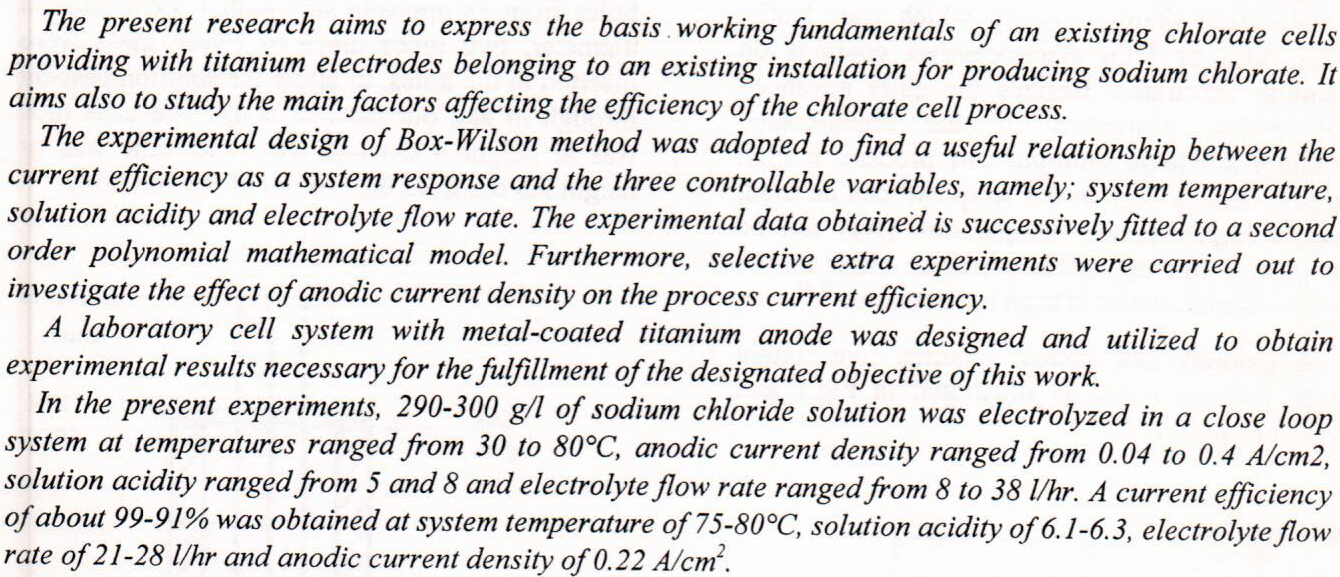

 (45)
(45)
 (42)
(42)



The research aimed to modeling a structural equation for tourist attraction factors in Asir Region. The research population is the people in the region, and a simple random sample of 332 individuals were selected. The factor analysis as a reliable statistical method in this phenomenon was used to modeling and testing the structural model of tourism, and analyzing the data by using SPSS and AMOS statistical computerized programs. The study reached a number of results, the most important of them are: the tourist attraction factors model consists of five factors which explain 69.3% of the total variance. These are: the provision of tourist services, social and historic factors, mountains, weather and natural parks. And the differenc
... Show MoreThis research aims were to evaluate management of broiler production projects in Baghdad province via using the criteria of management, included production index and economic figure (PI and EF) that specified to those projects. in addition to criteria of economic efficiency also applied (INME) index number of management efficiency, in order to the research requirements, data were obtained based on a questionnaire prepared for this purpose, which was collected by personal interview of (60) projects of the broiler production projects from (516) projects representing 11.6% of the research community in Baghdad province in 2016. The results show that mean of PI and EF was (338). The increase in these two criteria is generally due to co
... Show More
The efficient exploitation of production inventory systems is of significant importance in the modern industrial reality. This paper explores the effect of such a system on dynamic behaviour of a system when the control is provided synergistically by a method called synergetic control (SC). The mathematical model of the system is first constructed and SC introduced to improve the responsiveness of the system when the time-varying demand condition is taken into account. To cope with the problem of unavailability of the systems' state signals and to estimate the demand, the extended state observer (ESO) is introduced. Moreover, mountain gazelle optimizer (MGO) is employed to tune the adjustable design parameters of the SC and the ESO based on
... Show More
Production of fatty acid esters (biodiesel) from oleic acid and 2-ethylhexanol using sulfated zirconia as solid catalyst for the production of biodiesel was investigated in this work.
The parameters studied were temperature of reaction (100 to 130°C), molar ratio of alcohol to free fatty acid (1:1 to 3:1), concentration of catalyst (0.5 to 3%wt), mixing speed (500 to 900 rpm) and types of sulfated zirconia (i.e modified, commercial, prepared catalyst according to literature and reused catalyst). The results show the best conversion to biodiesel was 97.74% at conditions of 130°C, 3:1, 2wt% and 650 rpm using modified catalyst respectively. Also, modified c
... Show MoreBiodiesel as an attractive energy source; a low-cost and green synthesis technique was utilized for biodiesel preparation via waste cooking oil methanolysis using waste snail shell derived catalyst. The present work aimed to investigate the production of biodiesel fuel from waste materials. The catalyst was greenly synthesized from waste snail shells throughout a calcination process at different calcination time of 2–4 h and temperature of 750–950 ◦C. The catalyst samples were characterized using X-Ray Diffraction (XRD), Brunauer-Emmett-Teller (BET), Energy Dispersive X-ray (EDX), and Fourier Transform Infrared (FT-IR). The reaction variables varying in the range of 10:1–30:1 M ratio of MeOH: oil, 3–11 wt% catalyst loading, 50–
... Show More
(23)
(27)
Orthophoto provides a significant alternative capability for the presentation of architectural or archaeological applications. Although orthophoto production from airphotography of high or lower altitudes is considered to be typical, the close range applications for the large-scale survey of statue or art masterpiece or any kind of monuments still contain a lot of interesting issues to be investigated.
In this paper a test was carried out for the production of large scale orthophoto of highly curved surface, using a statue constructed of some kind of stones. In this test we use stereo photographs to produce the orthophoto in stead of single photo and DTM, by applying the DLT mathematical relationship as base formula in differenti
... Show MoreThis study aimed to obtain a local isolation of Aspergillus niger and then studied its ability to produce citric acid from raw materials available locally using solid state fermentation. Six local isolates were collected from different sources including some samples of the damaged fruits such as grapefruit, oranges and sindi. Wheat bran was used as a raw material or as culture medium for the production of citric acid from the collected isolates. The conditions for citric acid production were determined by humidity percentage of 1: 1 (water: culture medium), temperature of 28 C, pH 4 and inoculum dose with 5× 10⁶ spore/ml and for 3 days of incubation. The orange was the best model for citric acid production with a concentration of 12.8 mg/m
... Show More
(5)
(2)
In present study 74 specimens of urine were collected from patients suffering from urinary tract infections.Fifty (67.56%) isolates were identified as Escherichia coli. 78% of isolates were identified as extendedspectrum beta lactamases (ESBL) producer. Antibiotic susceptibility t est was done and ceftazidime wasselected to complete this study by implying stress at sub-MIC on isolate harbor high number of resistancegenes (N11) and compared with sensitive isolate (S). Only four β-lactamase coding genes were detected;blaTEM, blaPER, blaVIM and blaCTX-M-2 and N11 had blaTEM, blaPER, and blaVIM. It was found that the resistantisolate did not form biofilm when compared with the sensitive one, which formed moderate biofilm. Inaddition, ceftazidi
... Show More
(91)
(91)