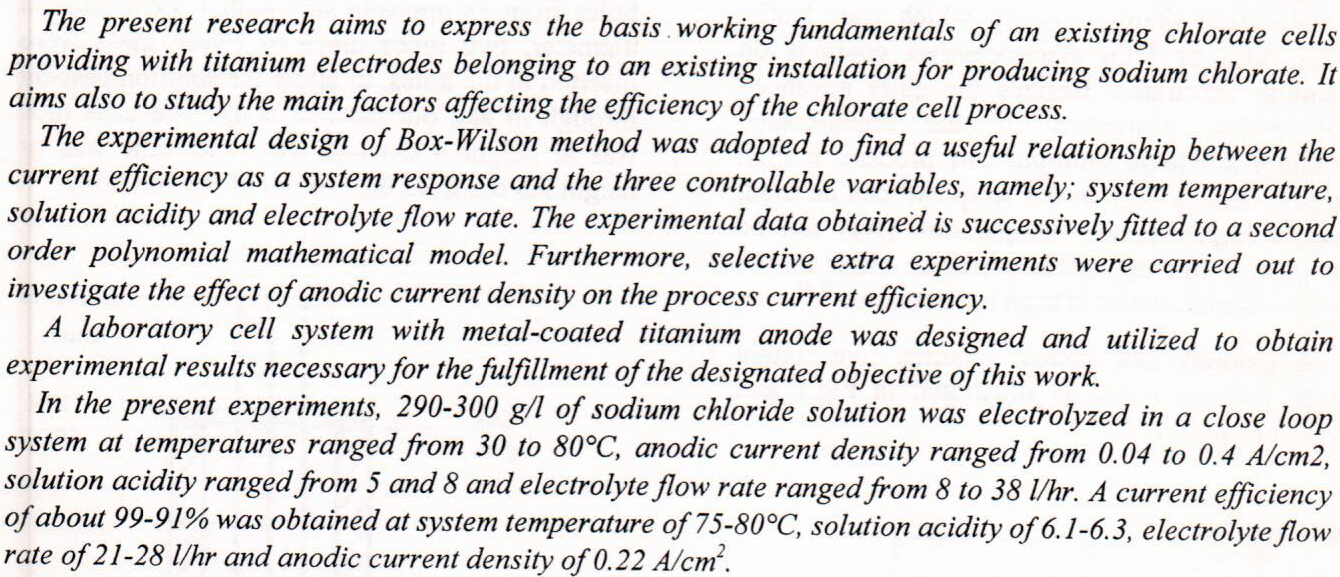
Study of the Factors Affecting Cells of Sodium Chlorate Production

Production logging is used to diagnose well production problems by evaluating the flow profile, entries of unwanted fluids and downhole flow regimes. Evaluating wells production performance can be easily induce from production logs through interpretation of production log data to provide velocity profile and contribution of each zone on total production. Production logging results supply information for reservoir modeling, provide data to optimize the productivity of existing wells and plan drilling and completion strategies for future wells. Production logging was carried out in a production oil well from Mishrif formation of West Qurna field, with the objective to determine the flow profile and fluid contributions from the perforations af
... Show MoreAnaerobic digestion is a technology widely used for treatment of organic waste for biogas production as a source for clean energy. In this study, poultry house wastes (PHW) material was examined as a source for biogas production. The effects of inoculum addition, pretreatment of the substrate, and temperature on the biogas production were taken into full consideration. Results revealed that the effect of inoculum addition was more significant than the alkaline pretreatment of raw waste materials. The biogas recovery from inoculated waste materials exceeds its production from wastes without inoculation by approximately 70% at mesophilic conditions. Whereby, the increase of biogas recovery from pretreated wastes was by 20% higher than its
... Show More (2)
(2)

 (9)
(6)
(9)
(6)
 (3)
(3)
(3)
(3)
The detection of fungi contaminating maize grain and the effect of four plant extracts Azadirachta indica, Eucalyptus globulus Glycyrrhiza glabra and Zingiber officinale on the growth of A. flavus and its ability to produce AflatoxinB1. The results showed that the incidence of Aspergillus spp., was 52.75% of the isolated fungi, of which 29.50% was due to Aspergillus flavus, followed by Penicillium spp., with an incidence of 21.06%, and then Fusarium spp., with a rate of 18.13%. The percentage of toxin-producing A. flavus isolates reached 70.8% out of 24 isolates. The results showed the effect of alcoholic plant extracts at a concentration of 10 mg/ml on the fungal growth activity of A. flavus, the alcoholic extract of neem leaves was superi
... Show More
(14)
(4)
This study was aimed to director wheat production's technical efficiency grown under two irrigation systems(fixed and pivot sprinkler irrigation systems)using random border analysis.Samples were collected randomly from267farmers from Salah Al-Din Governorate/Iraq.The samples were divided into two groups;187farmers used a pivot sprinkler irrigation system with three categories of possession(80,60and120dunums),while the other group used a fixed sprinkler irrigation system with four categories of possession(40,30,20and10dunums).Transcendent production function was used to study the effect of production factors on wheat yield. The results indicated that the mechanization work and the amount of added irrigation water increased by 1% whil
... Show More
(7)
(4)
This study aims to remove Cd(II) ions from simulated wastewater by using Chlorophyceae algae (CA). Different parameters were studied to show their effects on the biosorption efficiency of CA. These parameters are: the effect of pH 3-7, initial metal ion concentration 20-200 mg/L, sorbent dos-age 0.05-2 g/L, contact time 5-180 min, and agitation speed 100-300 rpm. We found that both the Langmuir and Freundlich models appropriate for characterizing the metal removal process. The biosorption data fit best with the results of the pseudo-second-order kinetic model, demonstrating that the chemisorption process is the dominant mechanism controlling the removal. CA was char-acterized using the scanning electron microscopy test, prior to and post bi
... Show More
(10)
(6)

The present study was conducted to estimate the antimicrobial activity and the potential biological control of the killer toxin produced by
(48)
(39)
(73)
(68)
Aryl hydrocarbon receptor (AhR) is a ligand-activated transcription factor and 2,3,7,8-tetrachlorodibenzo-p-dioxin (TCDD) is a potent ligand for AhR and a known carcinogen. While AhR activation by TCDD leads to significant immunosuppression, how this translates into carcinogenic signal is unclear. Recently, we demonstrated that activation of AhR by TCDD in naïve C57BL6 mice leads to massive induction of myeloid derived-suppressor cells (MDSCs). In the current study, we investigated the role of the gut microbiota in TCDD-mediated MDSC induction. TCDD caused significant alterations in the gut microbiome, such as increases in Prevotella and Lactobacillus, while decreasing Sutterella and Bacteroides. Fecal transplants from TCDD-treated
... Show More
(40)
(40)