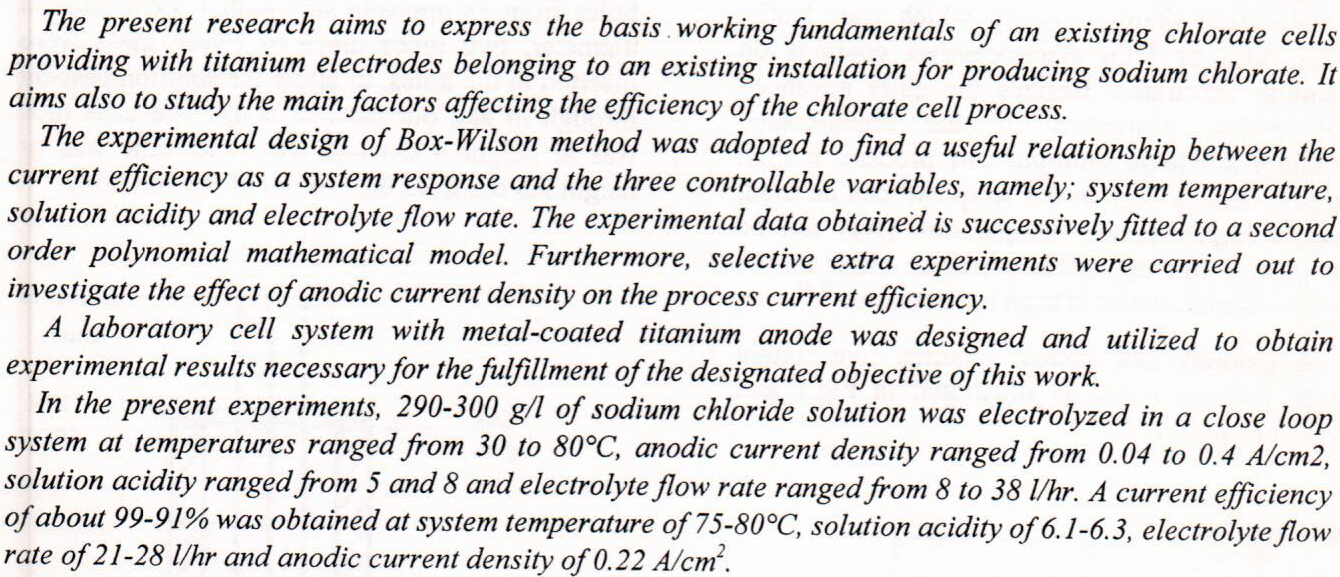
Study of the Factors Affecting Cells of Sodium Chlorate Production

Abstract. Froth flotation is a well-known solid-liquid separation technique. Hydrophobicity is the main driving force for such processes. Hydrophobic solids attach to air bubbles and rise up while hydrophilic or less hydrophobic species settle down. Froth can be produced with chemical frothers such as alcohols and polyglycols. However, the use of chemicals limits the use of this separation method in applications such as drinking water, food, and pharmaceutical industries. Therefore, developing a technique that produces froth without adding any chemicals would be useful to such industries. This work demonstrates that with suitable operating parameters a 27 cm froth height can be obtained in a 20 cm diameter column by using an air
... Show More
With increasing population and development, the resources of fossil fuels decreased, leading to the need to find alternative sources of energy. Furthermore, the use of fossil fuels is accompanied by several downsides including environmental fatality associated with toxic gas emissions from diesel engines and continuous increase of the price of diesel fuel. Biodiesel is one of the most important types of renewable energy that replaces the fossil fuel requirement (mineral diesel) and maintains eco-friendly sustainability. Calcium is an essential plant nutrient as it plays an important role in the formation of plant cell walls and membranes. Therefore, the fallen leaves of mango tree can be utilized to produce nano calcium oxide a
... Show More
Bioethanol production from sugar fermentation is one of the most sustainable alternatives to substitute fossil fuel. production of bioethanol from low grade dates which are rich of sugars. An available sugar from a second grade dates (reduction sugar) was 90g/l in this study. Sugar can be served as essential carbon sources for yeast growth in aerobic condition and can also be converted to bioethanol in anaerobic condition. The effect of various parameters on bioethanol production, fermentation time, pH-values, inoculum size and initial sugar concentration were varied in order to determine the optimal of bioethanol production. The highest bioethanol yield was 33g/l which was obtained with sugar concentration 90 g/l, inocu
... Show More (4)
(4)
Bioethanol production from sugar fermentation is one of the most sustainable alternatives to substitute fossil fuel. production of bioethanol from low grade dates which are rich of sugars. An available sugar from a second grade dates (reduction sugar) was 90g/l in this study. Sugar can be served as essential carbon sources for yeast growth in aerobic condition and can also be converted to bioethanol in anaerobic condition. The effect of various parameters on bioethanol production, fermentation time, pH-values, inoculum size and initial sugar concentration were varied in order to determine the optimal of bioethanol production. The highest bioethanol yield was 33g/l which was obtained with sugar concentration 90 g/l, inoculum size 1%,
... Show More
(5)
An expression for the transition charge density is investigated where the deformation in nuclear collective modes is taken into consideration besides the shell model transition density. The inelastic longitudinal form factors C2 calculated using this transition charge density with excitation of the levels for Cr54,52,50 nuclei. In this work, the core polarization transition density is evaluated by adopting the shape of Tassie model together with the derived form of the ground state two-body charge density distributions (2BCDD's). It is noticed that the core polarization effects which represent the collective modes are essential in obtaining a remarkable agreement between the calculated inelastic longitudinal F(q)'s and those of experimen
... Show More
(1)
 (8)
(10)
(8)
(10)

Pluripotent stem cells (PSC) possess unlimited proliferation, self-renewal, and a differentiation capacity spanning all germ layers. Appropriate culture conditions are important for the maintenance of self-renewal, pluripotency, proliferation, differentiation, and epigenetic states. Oxygen concentrations vary across different human tissues depending on precise cell location and proximity to vascularisation. The bulk of PSC culture-based research is performed in a physiologically hyperoxic, air oxygen (21% O2) environment, with numerous reports now detailing the impact of a physiologic normoxia (physoxia), low oxygen culture in the maintenance of stemness, survival, morphology, proliferation, differentiation potential, and epigenetic
... Show More
(6)
(3)

As the reservoir conditions are in continuous changing during its life, well production rateand its performance will change and it needs to re-model according to the current situationsand to keep the production rate as high as possible.Well productivity is affected by changing in reservoir pressure, water cut, tubing size andwellhead pressure. For electrical submersible pump (ESP), it will also affected by numberof stages and operating frequency.In general, the production rate increases when reservoir pressure increases and/or water cutdecreases. Also the flow rate increase when tubing size increases and/or wellhead pressuredecreases. For ESP well, production rate increases when number of stages is increasedand/or pump frequency is
... Show More
(1)
This study utilized low-cost agricultural waste (molasses production waste powder) to extract copper ions from aqueous solutions. The present investigation explored a range of factors that influence the adsorption process, including temperature, pH, ionic strength, contact time, quantity of adsorbent, and particle size. Spectrophotometric analysis was used to determine the solution's absorbance both before and after the adsorption procedure. The Langmuir and Freundlich adsorption models were used to match the equilibrium data. The Freundlich model was determined to be the best isotherm model using the linear regression coefficient R2=0.9868. Thermodynamic parameters, including enthalpy, entropy, and Gibbs free energy, were calculate
... Show More
Urinary tract infections (UTIs) mean microbial pathogens in the urethra or bladder (lower urinary tract). Important risk factors for recurrent UTI include obstruction of the urinary tract, use of a bladder catheter or a suppressed immune system. This study aims to isolate and identify bacteria from patients with TCC-bladder cancer or patients with a negative cystoscope and estimate antibiotic susceptibility patterns and evaluate some of the virulence factors. From a total of 62 patients with TCC-BC or negative cystoscope, only 35 favorable bacterial growths were obtained, including Escherichia coli (UPEC), a significant bacterial isolate, and Stenotrophomonas maltophilia. The percentage of multi drug-resistance bacteria
... Show More
(7)
(4)