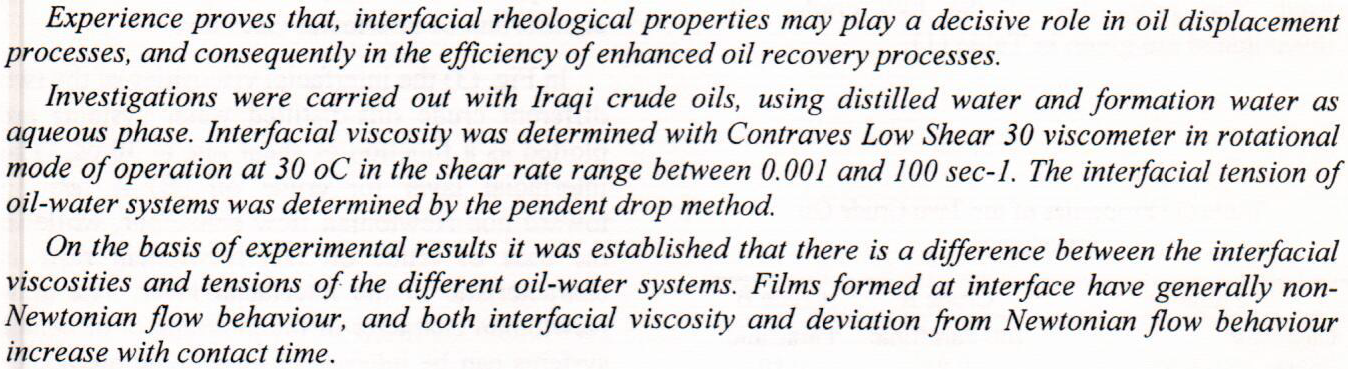
Interfacial Rheological Properties of Iraqi Crude Oils Water System

Solubility problem of many of effective pharmaceutical molecules are still one of the major obstacle in theformulation of such molecules. Candesartan cilexetil (CC) is angiotensin II receptor antagonist with very low water solubility and this result in low and variable bioavailability. Self- emulsifying drug delivery system (SEDDS) showed promising result in overcoming solubility problem of many drug molecules. CC was prepared as SEDDS by using novel combination of two surfactants (tween 80 and cremophore EL) and tetraglycol as cosurfactant, in addition to the use of triacetin as oil. Different tests were performed in order to confirm the stability of the final product which includes thermodynamic study, determination of self-emulsificat
... Show More (8)
(8)
 (1)
(1)


Abstract
Electric arc furnace applications in industry are related to position system of its pole, up and down of pole. The pole should be set the certain gap. These setting are needed to calibrate. It is done manually. In this research will proposed smart hydraulic to make this pole works as intelligent using proportional directional control valve. The output of this research will develop and improve the working of the electric arc furnace. This research requires study and design of the system to achieve the purpose and representation using Automation Studio software (AS), in addition to mathematically analyzed and where they were building a laboratory device similar to the design and conduct experiments to stud
... Show MoreCold plasma is a relatively low temperature gas, so this feature enables us to use cold plasma to treat thermally sensitive materials including polymers and biologic tissues. In this research, the non-thermal plasma system is designed with diameter (3 mm, 10 mm) Argon at atmospheric pressure as well as to be suitable for use in medical and biotechnological applications.
The thermal description of this system was studied and we observed the effect of the diameter of the plasma needle on the plasma, when the plasma needle slot is increased the plasma temperature decrease, as well as the effect of the voltages applied to the temperature of the plasma, where the temperature increasing with increasing the applied voltage . Results showed t
(2)
Littoral and benthic invertebrates from Roundwood Reservoir System were sampled. Oligochaetes and molluscs were the dominant organisms in the littoral and benthic areas Trichopterans and chironomids were the most abundant insect groups. Scuba diving samples reinforced that view. Other groups of macroinvertebrates were poorly represented. Vertical and horizontal hauls of zooplankton revealed that there were twelve species of zooplankton present. Daphnia hyalina Leydig and Bosmina coregoni Baird were the two dominant species.
In this paper, the human robotic leg which can be represented mathematically by single input-single output (SISO) nonlinear differential model with one degree of freedom, is analyzed and then a simple hybrid neural fuzzy controller is designed to improve the performance of this human robotic leg model. This controller consists from SISO fuzzy proportional derivative (FPD) controller with nine rules summing with single node neural integral derivative (NID) controller with nonlinear function. The Matlab simulation results for nonlinear robotic leg model with the suggested controller showed that the efficiency of this controller when compared with the results of the leg model that is controlled by PI+2D, PD+NID, and F
... Show More
(73)
(58)

The interplay of species in a polluted environment is one of the most critical aspects of the ecosystem. This paper explores the dynamics of the two-species Lokta–Volterra competition model. According to the type I functional response, one species is affected by environmental pollution. Whilst the other degrades the toxin according to the type II functional response. All equilibrium points of the system are located, with their local and global stability being assessed. A numerical simulation examination is carried out to confirm the theoretical results. These results illustrate that competition and pollution can significantly change the coexistence and extinction of each species.
(19)
(3)
The research aims to achieve a set of objectives, the most important of which is determining the extent to which the auditors of the research sample in the Federal Bureau of Financial Supervision adhere to the requirements of the quality control system according to the Iraqi Audit Manual No. The federal financial / research sample with the quality control system according to the Iraqi audit guide No. 7), and the researcher seeks to test the main research hypothesis and sub-hypotheses, and to achieve this, a questionnaire was designed by (Google Form) and distributed electronically to the elements of the research sample, Through the statistical package program (SPSS), the results of the questionnaire were analysed. In light of the applied
... Show MoreThis research aims at calculating the optimum cutting condition for various types of machining methods, assisted by computers, (the computer program in this research is designed to solve linear programs; the program is written in v. basic language). The program obtains the results automatically, this occur through entering the preliminary information about the work piece and the operating condition, the program makes the calculation actually by solving a group of experimental relations, depending on the type of machining method (turning, milling, drilling). The program was transferred to package and group of windows to facilitate the use; it will automatically print the initial input and optimal solution, and thus reduce the effort and t
... Show MoreAt the heart of every robust economy is a vital banking system. The functional banking system can effectively perform several functions such as mobilizing savings, allocating credit, monitoring managers, transforming risks, and facilitating the financial transactions. This paper aims to measure the impact of banking system development on economic growth in Iraq. Credit to private sector divided by GDP used as a proxy of banking development. Real per capita GDP used as a proxy of economic growth. By using Autoregressive Distributed Lag (ARDL) model, the paper finds that the undeveloped Iraqi banking system could not promote economic growth in the country. Therefore, a variety of policies need to be taken to spur the role of bankin
... Show More
(1)