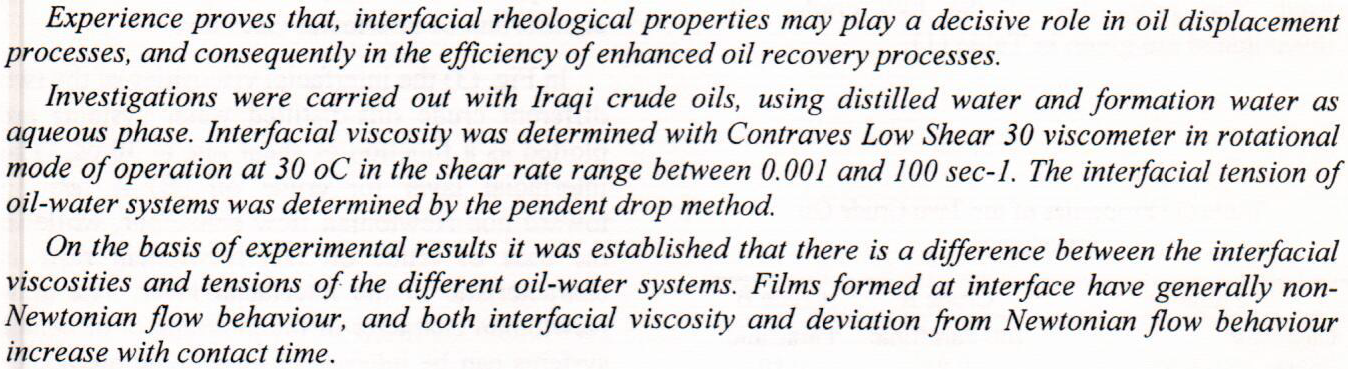
Interfacial Rheological Properties of Iraqi Crude Oils Water System

In this paper thermo-hydrodynamic characteristics were investigated experimentally for a new type shell-helical coiled tube heat exchanger used as a storage tank of closed loop solar water heater system. Triple concentric helical coils were made of copper tubes of (12.5mm OD and 10mm ID) with coils diameter of (207, 152.2, 97mm) for outer, middle and inner coils respectively. The experiments were carried out during a clear sky days of (March and April 2012). The parameters studied in this work are: history of average temperature of shell side of the storage tank, collector heat gain, heat rejected from coils to shell side of the storage tank, collector efficiency, thermal effectiveness of the heat exchanger (storage tank), and pressure d
... Show More (1)
(1)

Used automobile oils were subjected to filtration to remove solid material and dehydration to remove water, gasoline and light components by using vacuum distillation under moderate pressure, and then the dehydrated waste oil is subjected to extraction by using liquid solvents. Two solvents, namely n-butanol and n-hexane were used to extract base oil from automobile used oil, so that the expensive base oil can be reused again.
The recovered base oil by using n-butanol solvent gives (88.67%) reduction in carbon residue, (75.93%) reduction in ash content, (93.73%) oil recovery, (95%) solvent recovery and (100.62) viscosity index, at (5:1) solvent to used oil ratio and (40 oC) extraction temperature, while using n-hexane solvent gives (6
This paper presents the thermophysical properties of zinc oxide nanofluid that have been measured for experimental investigation. The main contribution of this study is to define the heat transfer characteristics of nanofluids. The measuring of these properties was carried out within a range of temperatures from 25 °C to 45 °C, volume fraction from 1 to 2 %, and the average nanoparticle diameter size is 25 nm, and the base fluid is water. The thermophysical properties, including viscosity and thermal conductivity, were measured by using Brookfield rotational Viscometer and Thermal Properties Analyzer, respectively. The result indicates that the thermophysical properties of zinc oxide nanofluid increasing with nanoparticle volume f
... Show More (5)
(6)
(5)
(6)

The aim of this work is to study the effect of mud compositions on it’s rheological behavior under high temperature conditions. Seventeen samples of five types of water base mud in which (fresh water bentonite mud. Lignosulphonate mud, gypsum mud, polymer mud, and salt saturated mud) were tested with different temperatures using the fann viscometer model 50-c. All the tested samples, except the fresh water bentonite mud, have the same trend reduction in both plastic viscosity and yield point with increasing temperature. Six rheological models has been adapted: Bingham plastic, power law, Casson model represent the laboratory data accurately
Directional control valve is the main part in hydraulic system which has complex construction, such as moving spool to control the direction of actuator for required speed. Utilizing MR fluid properties, direct interface can be realized between magnetic field and fluid power without the need for moving parts like spool in directional control valves. This paper dedicates the experimental test of four ways, three position MR directional control valve. The experimental methods were done by connecting the MR directional control valve with hydraulic actuators. The experiment was conducted to show the principle work of the valve functionally and performance test for valve was done. The valve works proportionally to control the direction a
... Show More
(5)
(3)
 (18)
(20)
(18)
(20)
Subsurface soil water retention (SWRT) is a recent technology for increasing the crop yield, water use efficiency and then the water productivity with less amount of applied water. The goal of this research was to evaluate the existing of SWRT with the influence of surface and subsurface trickle irrigation on economic water productivity of cucumber crop. Field study was carried out at the Hawr Rajab district of Baghdad governorate from October 1st, to December 31st, 2017. Three experimental treatments were used, treatment plot T1 using SWRT with subsurface trickle irrigation, plot T2 using SWRT with surface trickle irrigation, while plot T3 without using SWRT and using surface tickle irrigation system. The obtained results showed th
... Show More
(3)
There is an increase in the need for cost accounting in all organizations and from different sectors to provide detailed information to the totals of financial accounting, first and help solve problems associated with inventory and analysis, tabulation and allocation of cost elements II and do the planning process and provide the necessary oversight and help to take the right decisions such as pricing decisions that need to Information cost accounting.
And suffer most of the non-governmental organizations from the lack of a cost accounting system provides information on the cost of service in these organizations and the department research sample circle v
Oil is considered the most important source for providing the funds for the national economic sectors. The revenues of oil constitute %95 of the GPD. Therefore, the development of the remaining sectors depend on oil..
The Iraqi Oil Marketing Organization (SOMO) depended on the a unified price for all the buyers, That may not reflect the real value of market and did not contribute in marketing the type of heavy oil. Then, to what extent had SOMO been able to market the light and heavy crude oil in a way that contains the expected increase in the crude oil production.
(1)
There are many configurations of directional control valve. Directional control valve has complex construction, such as moving spool to control the direction of actuator and desired speed. Magneto-rheological (MR) fluid is one of controllable fluids. Utilizing the MR fluid properties, direct interface can be realized between magnetic field and fluid power without the need for moving parts like spool in directional control valves. This paper presents the design of multi configuration MR directional control valve. The construction and the principle of work of the valve are presented. The experiment was conducted to show the working principle of the valve functionally. The valve worked proportionally to control the direction and speed of hydra
... Show More
(1)