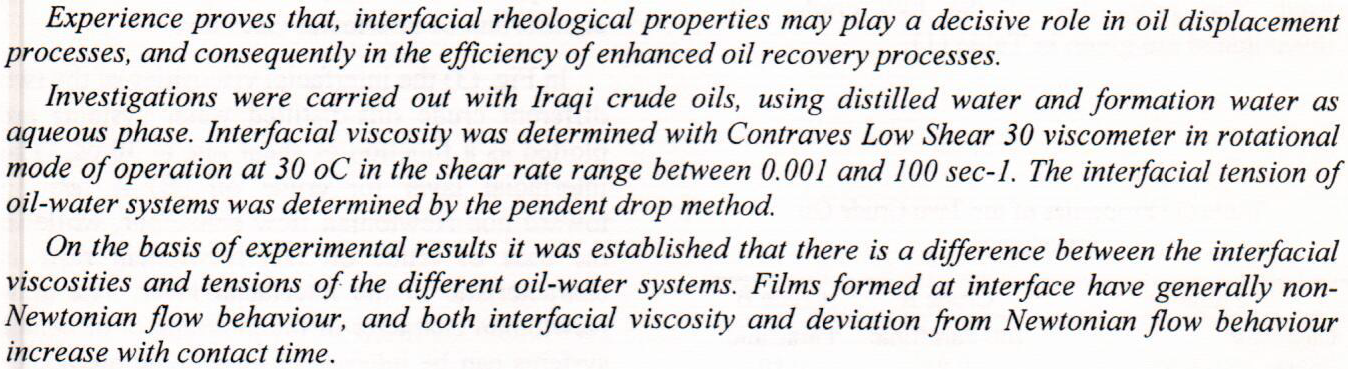
Interfacial Rheological Properties of Iraqi Crude Oils Water System

Polymers have the ability to extract water after they have been added to the mortar or concrete mixture. They provide the absorbed water during hydration functioning as internal water source. Absorption polymers can absorb up to hundred times of their own weight of pure water.This research deals with the use of water absorption polymer balls in concrete and study the volumetric change of these mixes and compared the results with reference mix (without polymers). Samples were cured both in air and in water for the mixes to compare results which show that samples in air behave for expansion while sample in water acted for shrinkage.
Recycling process presents a sustainable pavement by using the old materials that could be milled, mixed with virgin materials and recycling agents to produce recycled mixtures. The objective of this study is to evaluate the impact of water on recycled asphalt concrete mixtures, and the effect of the inclusion of old materials into recycled mixtures on the resistance of water damage. A total of 54 Marshall Specimens and 54 compressive strength specimens of (virgin, recycled, and aged asphalt concrete mixtures) had been prepared, and subjected to Tensile Strength Ratio test, and Index of Retained Strength test. Four types of recycling agents (used oil, oil + crumb rubber, soft grade asphalt cement, and asphalt cement + Su
... Show More (19)
(19)

Dora petroleum refinery waste water is the one of the important source of pollution by priority pollutant aromatic compound discharged to Tigris river in Iraq. the station has waste water treatment unit contains many treatment subunits The most important sub units is :skimmer units ,physiochemical unit ,daf unit, biological unit. The aim of research project is to study the ability of unit to remove the priority pollutant aromatic compound and follow up these compounds in river to study ability of river to self removal. A solid phase extraction (SPE) followed by high performance liquid chromatography-ultra violet (HPLC-UV) technique is depicted for the quantitative estimation of benzidines and phenols. Experimental studies were performed to
... Show MoreThe study aims mainly to evaluate the performance of Sharq Dijila water treatment plant in removing turbidity for the period of 1-4-2001 to 31-3-2004. Daily data for turbidity of raw, clarified, filtered, and supplied water were analyzed. The results of the study showed that there is a wide variation in turbidity levels of raw water fluctuating between 10-1000 NTU with mean value of 41.3 NTU. Turbidity values of the clarified water varied between 1.4-77 NTU. Based on the turbidity value of 10 NTU and 20 NTU (the design maximum turbidity) the readings gave an acceptable percentage of 32.4% and 86% respectively. The turbidity of filtered water ranged between 0.2-4.5 NTU which are completely in compliance with Iraqi and WHO standards. In ac
... Show MoreThe vacancy of natural resources is undoubtedly limited by time. The sustainable development principle recommends modern technology for its protection and renewal. This project conducted analyses on two underground water sources in the north of Algeria (Mechroha Province). Besides, the use of the hardness factor and the adoption of the titration method, which is the determining the concentration of an unknown solution using a known solution concentration, have permitted the characterization of the examples taken and to verify their conformity to the standard required, the results found showed HT=6.66 French degrees (oF) ) for Ain Guilloume water spring in comparison to Ain Messai water spring H

 (4)
(4)
(4)
(4)
The analysis and efficiency of phenol extraction from the industrial water using different solvents, were investigated. To our knowledge, the experimental information available in the literature for liquid-liquid equilibria of ternary mixtures containing the pair phenol-water is limited. Therefore the purpose of the present investigation is to generate the data for the water-phenol with different solvents to aid the correlation of liquid-liquid equilibria, including phase diagrams, distribution coefficients of phenol, tie-lines data and selectivity of the solvents for the aqueous phenol system.
The ternary equilibrium diagrams and tie-lines
... Show MoreAbstract
That Iraq's dependence on the revenues of the oil product in financing its development programs and growth rates , Making the economy affected by external forces represented by fluctuations in crude oil prices in the global market, Which is directly reflected on the performance and efficiency of the Iraqi economy.
The study adopted its objectives to analyze the time series for the period (1988 - 2015) through the use of standard and statistical methods, Four standard models were estimated to reach those targets, Where the results of the stability test showed instability of most variables at their original level, But to achieve stability when taking the first differences, While the result
... Show More
The inhibitive action of polyvinyl alcohol –sodium nitrite (PVASN) composite on the corrosion of mild steel in simulated cooling water (SCW) has been investigated by weight loss and potentiodynamic polarization. The effect of composite concentration (PVA/SN) , pH, and exposure time on corrosion rate of mild steel were verified using 2 levels factorial design and surface response analysis through weight loss approach, while the electrochemical measurements were used to study the behavior of mild steel in (SCW) with pH between 6 and 8 and in absence and presence of (PVA) in solution containing different concentration of NaNO2. It was verified that all three main variables studied were statistically significant while their interaction is
... Show More