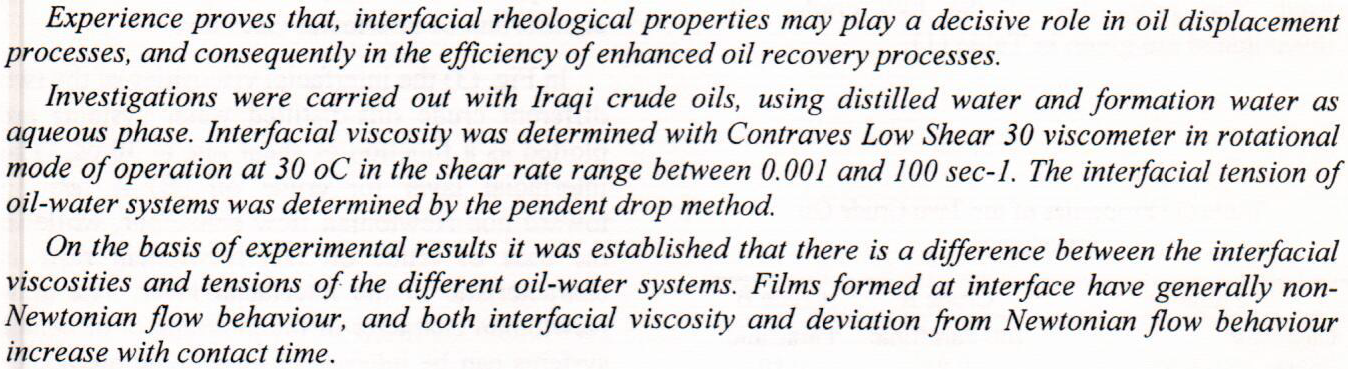
Interfacial Rheological Properties of Iraqi Crude Oils Water System

A phytoremediation experiment was carried out with kerosene as a model for total petroleum hydrocarbons. A constructed wetland of barley was exposed to kerosene pollutants at varying concentrations (1, 2, and 3% v/v) in a subsurface flow (SSF) system. After a period of 42 days of exposure, it was found that the average ability to eliminate kerosene ranged from 56.5% to 61.2%, with the highest removal obtained at a kerosene concentration of 1% v/v. The analysis of kerosene at varying initial concentrations allowed the kinetics of kerosene to be fitted with the Grau model, which was closer than that with the zero order, first order, or second order kinetic models. The experimental study showed that the barley plant designed in a subsu
... Show More (14)
(14)
 (10)
(10)



Source, sedimentation, coagulation, flocculation, filter, and tank are parts of a water treatment plant. As a result, some issues threaten the process and affect the drinking water quality, which is required to provide clean drinking water according to special standards and international and local specifications, determined by laboratory results from physical, chemical, and biological tests. In order to keep the water safe for drinking, it is necessary to analyze the risks and assess the pollution that occurs in every part of the plant. The method is carried out in a common way, which is monitoring through laboratory tests, and it is among the standards of the global and local health regulators
Irrigation scheduling techniques is one of the suggested solutions for water scarcity problem. The study aims to show the possibility of using practical and applicable irrigation scheduling program which was designed by Water Resources Department at the University of Baghdad by using Spreadsheet Formulas for Microsoft Excel program, version 2007, with some modification to generalize it and made it applicable to various climatic zone and different soil types, as a salvation for the shortage of irrigation water inside the irrigation projects. Irrigation projects which incidence of Tigris River basin will be taken as an applicable example. This program was based on water budgeting and programmed depending on scientific concepts which facili
... Show More
(1)
In the current study, a novel approach for separating ethanol-water mixture by microbubble distillation technology was investigated. Traditional distillation processes require large amounts of energy to raise the liquid to its boiling point to effect removal of volatile components. The concept of microbubble distillation by comparison is to heat the gas phase rather than the liquid phase to achieve separation. The removal of ethanol from the thermally sensitive fermentation broths was taken as a case of study. Consequently the results were then compared with those which could be obtained under equilibrium conditions expected in an “ideal” distillation unit. Microbubble distillation has achieved vapour compositions higher than th
... Show More
(22)
(15)
(11)
(9)
Source, sedimentation, coagulation, flocculation, filter, and tank are parts of a water treatment plant. As a result, some issues threaten the process and affect the drinking water quality, which is required to provide clean drinking water according to special standards and international and local specifications, determined by laboratory results from physical, chemical, and biological tests. In order to keep the water safe for drinking, it is necessary to analyze the risks and assess the pollution that occurs in every part of the plant. The method is carried out in a common way, which is monitoring through laboratory tests, and it is among the standards of the global and local health regulators
The purpose of this study was to find out the connection between the water parameters that were examined in the laboratory and the water index acquired from the examination of the satellite image of the study area. This was accomplished by analysing the Landsat-8 satellite picture results as well as the geographic information system (GIS). The primary goal of this study is to develop a model for the chemical and physical characteristics of the Al-Abbasia River in Al-Najaf Al-Ashraf Governorate. The water parameters employed in this investigation are as follows: (PH, EC, TDS, TSS, Na, Mg, K, SO4, Cl, and NO3). To collect the samples, ten sampling locations were identified, and the satellite image was obtained on the
... Show More
(1)
Many managers in geometrical and technical organizations prefer to deal with quantitative values to choose between the available options and choose the best alternative to avoid randomization and bias in decision making. One of them Baghdad Water Department, which seeks to develop the quality of its product (drinking water) and achieve its objectives under increasing growing population and the demand for water, Some of TQM tools, especially the statistical, have this ability because there is chance to use historical data and experiment of employees in Application . Two statistical tools were applied: the nominal group technique, matrix data analysis technique as well as the brainstorming tool to search for the best o
... Show More
Different frequency distributions models were fitted to the monthly data of raw water Turbidity at water treatment plants (WTPs) along Tigris River in Baghdad. Eight water treatment plants in Baghdad were selected, with raw water turbidity data for the period (2008-2014). The frequency distribution models used in this study are the Normal, Log-normal, Weibull, Exponential and two parameters Gamma type. The Kolmogorov-Smirnov test was used to evaluate the goodness of fit. The data for years (2008-2011) were used for building the models. The best fitted distributions were Log-Normal (LN) for Al-Karkh, Al-Wathbah, Al-Qadisiya, Al- Dawrah and, Al-Rashid WTPs. Gamma distribution fitted well for East Tigris and Al-Karamah WTPs. As for Al-
... Show MoreDifferent frequency distributions models were fitted to the monthly data of raw water Turbidity at water treatment plants (WTPs) along Tigris River in Baghdad. Eight water treatment plants in Baghdad were selected, with raw water turbidity data for the period (2008-2014). The frequency distribution models used in this study are the Normal, Log-normal, Weibull, Exponential and two parameters Gamma type. The Kolmogorov-Smirnov test was used to evaluate the goodness of fit. The data for years (2008-2011) were used for building the models. The best fitted distributions were Log-Normal (LN) for Al-Karkh, Al-Wathbah, Al-Qadisiya, Al-Dawrah and, Al-Rashid WTPs. Gamma distribution fitted well for East Tigris and Al-Karamah
... Show More