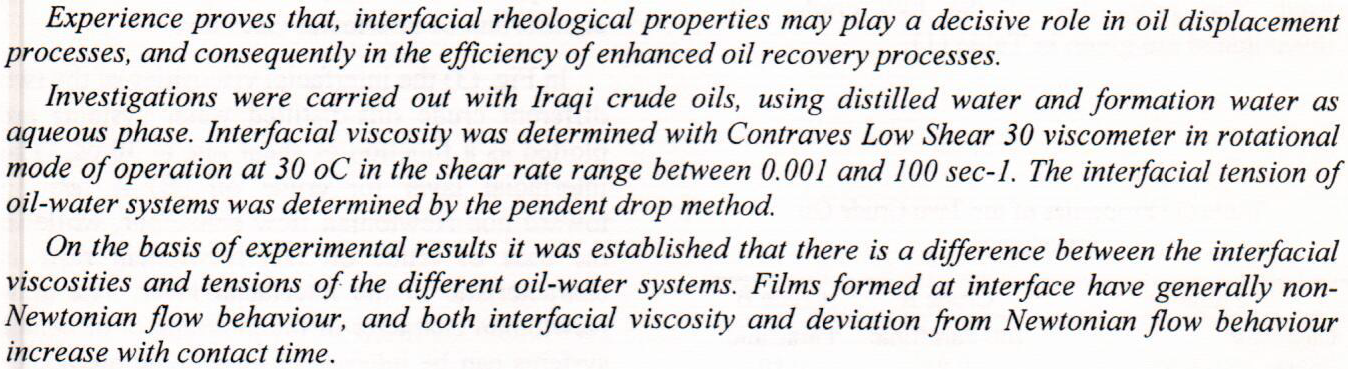
Interfacial Rheological Properties of Iraqi Crude Oils Water System

The inhibition effect of crude juice of green and black olive on cancer cell line (RD) in vitro has been studied by depending on micro titration system . Eleven different concentration starting from (916-960) mg/ml of crude juice respectively ,for three periods of exposure(24-48-72)hours. The resulted showed that the inhibition effect dependent on type of olive fruit juice ,concentration of dose ,time of exposure and the high concentration of both type of olive juice increased the growth of cell line while other concentration caused decrease in different rates ,moreover the black juice was more effective than green and 48 hours' time exposure was the best for inhibition.

Corncob is an agricultural biomass waste that was widely investigated as an adsorbent of contaminants after transforming it into activated carbon. In this research carbonization and chemical activation processes were achieved to synthesize corncob-activated carbon (CAC). Many pretreatment steps including crushing, grinding, and drying to obtain corncob powder were performed before the carbonization step. The carbonization of corncob powder has occurred in the absence of air at a temperature of 500 °C. The chemical activation was accomplished by using HCl as an acidic activation agent. Fourier transform infrared spectroscopy (FT-IR), scanning electron microscopy (SEM), X-ray diffraction (XRD), and Brunauer–Emmett–Teller (BET) facilitate
... Show More (7)
(7)
 (7)
(7)


The presence of residual antibiotics in water results in the development of antibiotics resistant genes. The available wastewater treatment systems are not capable of removing such antibiotics from sewage. Thus, antibiotics need to be removed before the discharge of wastewater. Adsorption is among the promising techniques for the wastewater treatment to aid the removal of a wide range of organic and inorganic pollutants. The present work is a contribution to the search for an economical method for the removal of low concentrations of amoxicillin (AMX) from water by adsorption on water treatment residue, WTR, taken from a local drinking water facility. The chemical composition and the adsorptive characteristics of the material were first
... Show More
(25)
(21)
The Purpose of this study is mainly to improve the competitive position of products economic units using technique target cost and method reverse engineering and through the application of technique and style on one of the public sector companies (general company for vegetable oils) which are important in the detection of prices accepted in the market for items similar products and processing the problem of high cost which attract managerial and technical leadership to the weakness that need to be improved through the introduction of new innovative solutions which make appropriate change to satisfy the needs of consumers in a cheaper way to affect the decisions of private customer to buy , especially of purchase private economic units to
... Show More
(14)
(12)
Isolation of fungi was performed from February to July, 2019. One hundred clinical specimens were collected from King Abdullah Hospital (KAH) Bisha, Saudi Arabia. Samples were collected from twenty patients of different ages (30 - 70 years old) ten males and ten females. The samples were collected from patients with the two types of diabetics. Specimens included blood, hair, nail, oral swabs and skin. Specimens were inoculated on Sabourauds Dextrose agar containing chloramphenicol. Thirteen fungal species were isolated and identified. The isolated species were: Aspergillus flavus, A. niger, A. terrus, A. nidulans, A. fumigatus, Candida albicans, C. krusei, C. parapsilosis, C. Tropicalis, Curvularia lunata, Fusarium solani, Penicill
... Show More
(5)
(2)
In this study , Iraqi Bentonite clay was used as a filler for polyvinyl chloride polymer. Bentonite clay was prepared as a powder for some certain particle size ,followed by calcinations process at (300,700,900) OC ,then milled and sieved. The selected sizes were D ~75 µm and D ~150. After that polyvinyl Al-Cohool solution prepared and used as a coated layer covered the Bentonite powder before applied as a filler ,followed by drying , milling and sieving for limited recommend sizes. polyvinyl chloride solutions were prepared and adding of modified Bentonite power at certain quantities were followed .Sheet of these variables on the mechanical and thermal properties of the prepared reinforced particular polyvinyl chloride composite
... Show More
In this research, radon concentrations in some types of healthy drinking water samples available in Iraq's market were measured using a technique called Durridge RAD-7-H2O with closed loop. Then the rate of annual effective dose in human taken this water is determined.
It was found that, radon concentrations in studied samples ranged between 1.2 Bq.m-3 to 142 Bq.m-3. The results of the radon concentrations and the rate of annual effective dose for drinking water samples were significantly lower than the USEPA and WHO recommended limits that equal 500 Bq/m3 and 1 mSv/y resp
... Show More
(3)