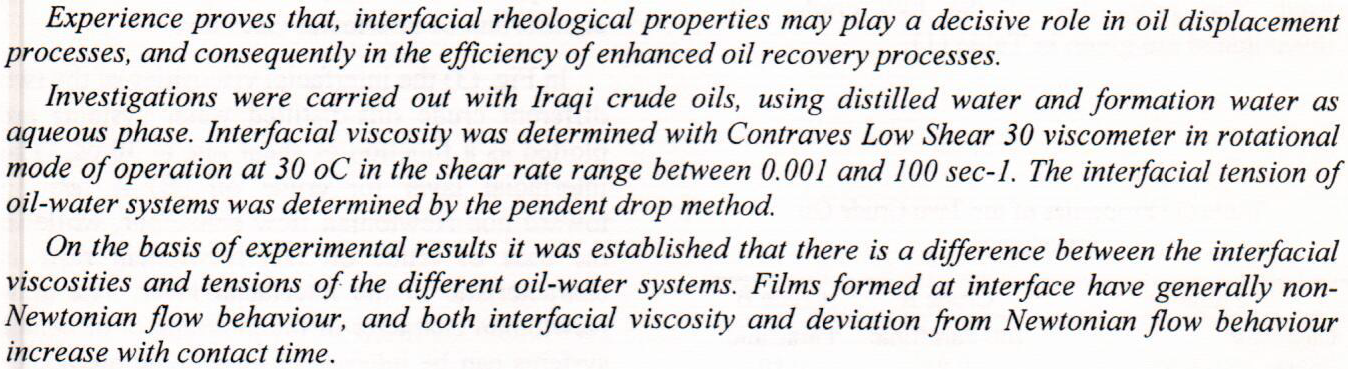
Interfacial Rheological Properties of Iraqi Crude Oils Water System

High-performance liquid chromatographic methods are used for the determination of water-soluble vitamins with UV-Vis. Detector. A reversed-phase high-performance liquid chromatographic has been developed for determination of water-soluble vitamins. Identification of compounds was achieved by comparing their retention times and UV spectra with those of standards solution. Separation was performed on a C18 column, using an isocratic 30% (v/v) acetonitril in dionozed water as mobile phase at pH 3.5 and flow rate 1.0m/min. The method provides low detection and quantification limits, good linearity in a large concentration interval and good precision. The detection limits ranged from 0.01 to 0.025µg/ml. The accuracy of the method was
... Show More (4)
(4)

 (3)
(2)
(3)
(2)

A comparative study was carried out on ecological and genetical adaptation of three Iraqi
freshwater snails, Physa acuta, Melanopsis buccinoidea and Melanoides tuberculata, in
respect to acute toxicity of heavy metals (Zn, Cd and Hg). Longevity are used as poisoning
tolerance criterion. LT 50 and LT 100 were determined for the studied snails at (0.5, 1, 5, and
10 ppm), for the three metals. Results indicated that Physa acuta had a higher tolerance than
Melanopsis buccinoidea and Melanoides tuberculata, which was the lower one. Previous
exposure to heavy metals in the original habitat was affecting on experimental tolerance and
no relationships of physical and chemical factors (total hardness, temperature, D. O. and
(6)
(5)

In the present work, a closed loop circulation system consist of three testing sections was designed and constructed. The testing sections made from (3m) of commercial carbon steel pipe of diameters(5.08, 2.54 and 1.91 cm) . Anionic surfactant (SDBS )with concentrations of (50, 100, 150, 200 and 250 ppm) was tested as a drag reducing agent. The additive(SDBS)studied using crude oil from south of Iraq. The flow rates of crude oil were used in 5.08 and 2.54 cm I.D. pipes are (1 - 12) m3/hr while (1-6) m3/hr were used in 1.91 cm J .D. pipe . Percentage drag reduction (%Dr) was found to increase by increasing solution velocity, pipe diameter and additives concentration (i.e. increasi
... Show More
(2)
(1)
This work studied the facilitation of the transportation of Sharqi Baghdad heavy crude oil characterized with high viscosity 51.6 cSt at 40 °C, low API 18.8, and high asphaltenes content 7.1 wt.%, by reducing its viscosity from break down asphaltene agglomerates using different types of hydrocarbon and oxygenated polar solvents such as toluene, methanol, mix xylenes, and reformate. The best results are obtained by using methanol because it owns a high efficiency to reduce viscosity of crude oil to 21.1 cSt at 40 °C. Toluene, xylenes and reformate decreased viscosity to 25.3, 27.5 and 28,4 cSt at 40 °C, respectively. Asphaltenes content decreased to 4.2 wt. % by using toluene at 110 °C. And best improvement in API of the heavy crude o
... Show MoreThis work aimed to investigate the prevalence of pathogenic fungi and evaluate the antifungal activity of Trichoderma orientale FMR12486 crude extract against pathogenic fungi isolated from patients attending the National Center for Thoracic and Respiratory Diseases (having a history of tuberculosis) and consultant of Dermatology of Baghdad hospital, Iraq. A total of 80 clinical specimens were collected: 20 skin scrapings specimens and 60 sputum specimens. The results of direct examination by KOH 10% and culture showed that 11 (55%) cases from 20 skin specimens were positive for fungal infections, while in the sputum specimens, 28 (47%) cases from 60 were positive. Candida albicans represented the most common fungal infection isolat
... Show More
(4)
(2)
This work studied the facilitation of the transportation of Sharqi Baghdad heavy crude oil characterized with high viscosity 51.6 cSt at 40 °C, low API 18.8, and high asphaltenes content 7.1 wt.%, by reducing its viscosity from break down asphaltene agglomerates using different types of hydrocarbon and oxygenated polar solvents such as toluene, methanol, mix xylenes, and reformate. The best results are obtained by using methanol because it owns a high efficiency to reduce viscosity of crude oil to 21.1 cSt at 40 °C. Toluene, xylenes and reformate decreased viscosity to 25.3, 27.5 and 28,4 cSt at 40 °C, respectively. Asphaltenes content decreased to 4.2 wt. % by using toluene at 110 °C. And best improvement in API of the heavy cr
... Show More
(7)
