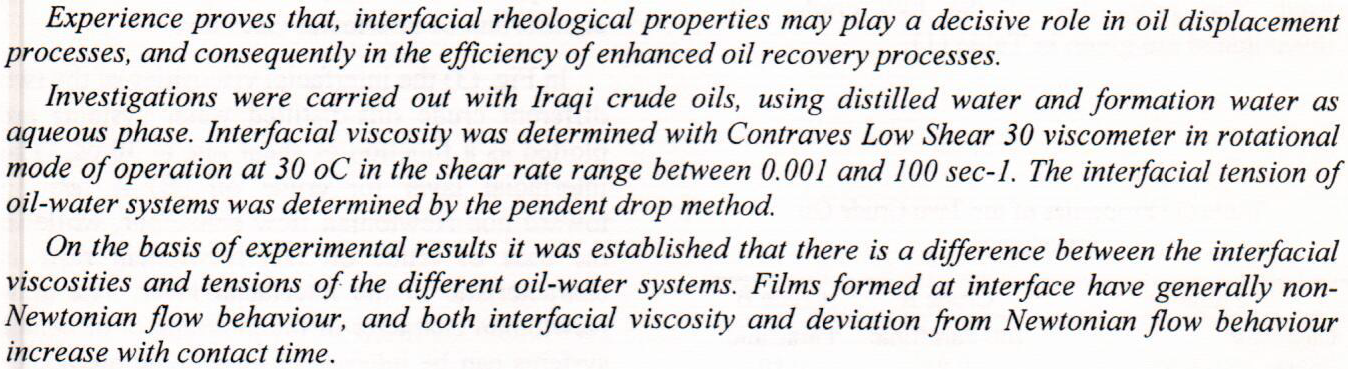
Interfacial Rheological Properties of Iraqi Crude Oils Water System

In this research, the effects of both current and argon gas pressure on the bending properties of welded joints were studied. Using the possible ranges of welding gas pressures and currents, Tungsten inert gas welding (TIG) of stainless steel (304) sheet was used to obtain their influence on the maximum bending force of the (TIG) welded joints. Design of experiment (DOE) ‘version 10' was used to determine the design matrix of experiments depending on the used levels of the input factors. Response surface methodology (RSM) technique was used to obtain an empirical mathematical model for the maximum bending force as a function of welding parameters (Current and Argon gas pressure). Also, the analysis of variance (ANOVA) was used to verif
... Show More (4)
(4)

 (3)
(1)
(3)
(1)

Three new polyphosphates were synthesized in good yields by reacting diethylenetriamine with the appropriate phosphate ester in ethanol under acidic conditions. The polyphosphate structures were determined using FT-IR and 1H-NMR spectroscopies, and their elemental compositions were confirmed by EDX spectroscopy. Polyphosphates were added to poly(vinyl chloride) (PVC) at low concentrations to fabricate thin films. The PVC films were irradiated with ultraviolet light for long periods, and the effect of polyphosphates as the photostabilizer was investigated by determining changes in the infrared spectra (intensity of specific functional group peaks), reduction in molecular weight, weight loss, and surface morphology. Minimal changes we
... Show More
(46)
(37)
 (85)
(83)
(85)
(83)
Polymer matrix composites are suitable materials for medical applications, such as denture base resin polymethyl methacrylate (PMMA). This includes light weight and high strength. This paper describes the effect of selected weight fractions (1, 2, 3, 4 & 5) % wt of nano(Alumina AL2O3, Zirconia ZrO2, Hydroxyapatite HA and Halloysite nanoClay) reinforcements on the biopolymer matrix (PMMA). Some tribology tests were used to evaluate the prepared system (impact strength, hardness surface, and wear rate) tests. The samples were fabricated by (Hand Lay-Up) with different particle reinforcement percentages. All tests were accomplished at room temperature, and samples were developed according to the ASTM standard. The weight fraction o
... Show More
(2)
(3)
(4)
(5)
(53)
(50)
The last decade has seen a variety of modifications of glass-ionomer cements (GICs), such as inclusion of bioactive glass particles and dispensing systems. Hence, the aim was to systematically evaluate effect of mixing modes and presence of reactive glass additives on the physical properties of several GICs.
The physical properties of eight commercial restorative GICs; Fuji IX GP Extra (C&H), KetacTM Fill Plus Applicap (C&H), Fuji II LC (C&H), Glass Carbomer Ce
(32)
(23)
Exposure to cryogenic liquids can significantly impact the petrophysical properties of rock, affecting its density, porosity, permeability, and elastic properties. These effects can have important implications for various applications, including oil and gas production and carbon sequestration. Cryogenic liquid fracturing is a promising alternative to traditional hydraulic fracturing for exploiting unconventional oil and gas resources and geothermal energy. This technology offers several advantages over traditional hydraulic fracturing, including reduced water consumption, reduced formation damage, and a reduced risk of flow-back fluid contamination. In this study, an updated review of recent studies demonstrates how the
... Show More
(3)
(15)
(15)