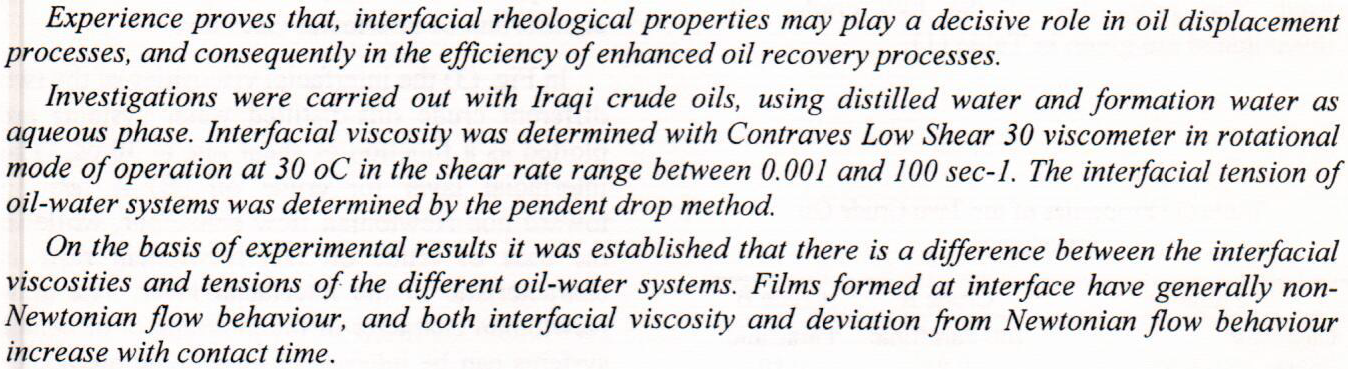
Interfacial Rheological Properties of Iraqi Crude Oils Water System

Background: Fluoridated acrylic resin material can present more stable properties when compared with conventional one.The most widely used fluoride –containing substance added to dental resin materials is sodium fluoride (Naf). This study evaluated the effect of Naf in different concentration to the acrylic resin denture base material and its effect on tensile strength ,modules of elasticity with long –term water immersion (after 4 months immersion in de-ionized water) Materials and methods: Eighty specimens from dumbbells shaped metal pattern for tensile strength test were preparedaccording to ISO 527: 1993 plastic –Determination tensile properties ,in dimensions(60mm, 12mm, 3 ± 0.2mm) length, width and depth respec
... Show MoreThe aim of this work is to evaluate some mechanical and physical
properties (i.e. the impact strength, hardness, flexural strength,
thermal conductivity and diffusion coefficient) of
(epoxy/polyurethane) blend reinforced with nano silica powder (2%
wt.). Hand lay-up technique was used to manufacture the composite
and a magnetic stirrer for blending the components. Results showed
that water had affected the bending flexural strength and hardness,
while impact strength increased and thermal conductivity decreased.
In addition to the above mentioned tests, the diffusion coefficient
was calculated using Fick’s 2nd law.
 (3)
(3)

The crude aqueous extract of menthespicata , the objective of this study was to investigate the effects of this extraction , on the histological changes of the ovares and levels of sex hormone , ( FSH , LH , Estradiol ) in albino female mice . the extract was given orally for( 45 ) days . fourty mature female mice were used in this study , the animals divided into four major groups . each group was include ten mice . the first three groups was given different concentration )) (21 , 14 , 7 %) . While the fourth group considered as control group which had been administrated tab water . For ( 45 ) days each group had been killed for hormonal assay in blood
... Show More
(36)
Thrust blocks and restraint joints are the two most popular methods of counteracting the thrust force that generated at pipe fittings (bends, Tee, wye, reducers, dead ends, etc…). Both systems perform the same function, which is to prevent the joints from separating from the pipes. The aim of the study is to review previous studies and scientific theories related to the study and design of thrust blocks and restraint joints to study the behavior of both systems under thrust force and to study the factors and variables that affect the behavior of these systems. The behavior of both systems must be studied because they cannot be abandoned, as each system has conditions whose use is more feasible, scientific, and economic
... Show More (3)
(3)
(3)
(3)

The removal of turbidity from produced water by chemical coagulation/flocculation method using locally available coagulants was investigated. Aluminum sulfate (alum) is selected as a primary coagulant, while calcium hydroxide (lime) is used as a coagulant aid. The performance of these coagulants was studied through jar test by comparing turbidity removal at different coagulant/ coagulants aid ratio, coagulant dose, water pH, and sedimentation time. In addition, an attempt has been made to examine the relationship between turbidity (NTU) and total suspended solids (mg/L) on the same samples of produced water. The best conditions for turbidity removal can be obtained at 75% alum+25% lime coagulant at coagulant dose of 80 m
... Show More
(7)
(4)

The experiments were conducted in laboratory conditions of a temperature of 25± 2C and relative moisture of 40± 5 % to evaluate the effectiveness of the cinnamon, lavender and clove essential oils on some biological life aspects of cowpea beetle, C. maculates. Results of the obligative experiment for the effect of the oils on insect adult killing showed that the concentration of 5% caused a mortality percentage averaged 13.33% of the insect males. The mortality percentage of the insect females was 11.3% for the cinnamon and lavender oils. The lavender oil had the lowest effect on adult killing, not exceeding 0. For the effect of the oils on egg laying, clove oil affected the number of eggs highly at the concentration of 5%, result
... Show More
(1)
The experiments were conducted in laboratory conditions of a temperature of 25± 2C and relative moisture of 40± 5 % to evaluate the effectiveness of the cinnamon, lavender and clove essential oils on some biological life aspects of cowpea beetle, C. maculates. Results of the obligative experiment for the effect of the oils on insect adult killing showed that the concentration of 5% caused a mortality percentage averaged 13.33% of the insect males. The mortality percentage of the insect females was 11.3% for the cinnamon and lavender oils. The lavender oil had the lowest effect on adult killing, not exceeding 0. For the effect of the oils on egg laying, clove oil affected the number of eggs highly at the concentration of 5%, result
... Show More
(1)