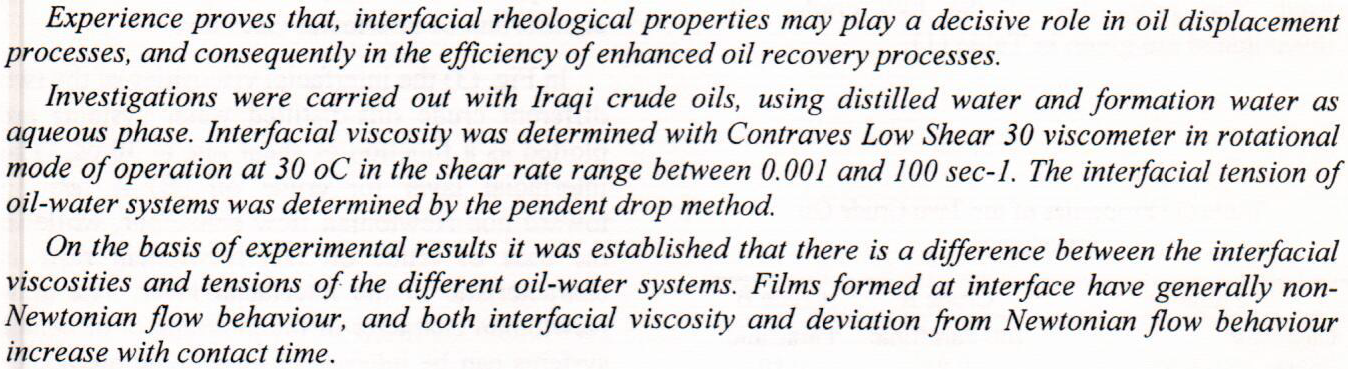
Interfacial Rheological Properties of Iraqi Crude Oils Water System

Using photo electrochemical etching technique (PEC), porous silicon (PS) layers were produced on n-type silicon (Si) wafers to generate porous silicon for n-type with an orientation of (111) The results of etching time were investigated at: (5,10,15 min). X-ray diffraction experiments revealed differences between the surface of the sample sheet and the synthesized porous silicon. The largest crystal size is (30 nm) and the lowest crystal size is (28.6 nm) The analysis of Atomic Force Microscopy (AFM) and Field Emission Scanning Electron Microscope (FESEM) were used to research the morphology of porous silicon layer. As etching time increased, AFM findings showed that root mean square (RMS) of roughness and po
... Show More (1)
(1)

... Show More (2)
(2)
(2)
(2)

This study exposed to use the liquid whey (which was produced from of soft cheese processed) partially or completely instead of milk in fatty cake, this whey residue is still not used, instead it is thrown in rivers which effect different environment and economic problems. Different concentrations was used (25% , 50% , 75% , and 100%) of whey in baked cake , Volume , height and other different properties ( panel taste ) was studied too . Sensory evaluation results showed that an improved in all the character of the baked cake was happen by the used of 25% and 50% of the whey in comparison with the control treatment, the 75% replacement showed a decrease in appearance , texture and tenderness , while the degrees of color and fla
... Show More
(1)
This research study the effect of Titanium dioxide on the tensile properties of
Polystyrene (PS) and Polycarbonate (PC) polymers. The stress – strain curve for pure PS
and pure PC, shows that Young modulus for PS is higher than Young modulus for PC,
because PS have higher ultimate strength than PC.
The addition of TiO2 to PS and PC will reduce the Young modulus and ultimate stress,
because the TiO2 particles will reduces or freeze the orientation of these molecular chain
and reduced the toughness of PC, while when the TiO2 were added to PS, the value of
toughness will be stabilized because TiO2 particles make these chains interlocked and the
mobility of the chains will be restrict.
The spectroscopic properties, potential energy curve, dipole moments, total charge density, Electrostatic potential as well as the thermodynamic properties of selenium diatomic halides have been studied using code Mopac.7.21 and hyperchem, semi-empirical molecular orbital of MNDO-method (modified neglected of differential overlap) of parameterization PM3 involving quantum mechanical semi-empirical Hamiltonian. The relevant molecular parameters like interatomic distance, bond angle, dihedral angle and net charge were also calculated.
Thin films of Mn2O3 doped with Cu have been fabricated using the simplest and cheapest chemical spray pyrolysis technique onto a glass substrate heated up to 250 oC. Transmittance and absorptance spectra were studied in the wavelength range (300 -1100) nm. The average transmittance at low energy was about 60% and decrease with Cu doping, Optical constants like refractive index, extinction coefficient and dielectric constants (εr), (εi) are calculated and correlated with doping process.
Ferrite with general formula Ni1-x Cox Fe2O4(where x=0.0.1,0.3,0.5,0.7, and 0.9), were prepared by standard ceramic technique. The main cubic spinel structure phase for all samples was confirmed by x-ray diffraction patterns. The lattice parameter results were (8.256-8.299 °A). Generally, x -ray density increased with the addition of Cobalt and showed value between (5.452-5.538gm/cm3). Atomic Force Microscopy (AFM) showed that the average grain size and surface roughness was decreasing with the increasing cobalt concentration. Scanning Electron Microscopy images show that grains had an irregular distribution and irregular shape. The A.C conductivity was found to increase with the frequency and the addition of Cobal
... Show More
(1)
In this research the effect of cooling rate and mold type on mechanical properties of the eutectic
and hypoeutectic (Al-Si) alloys has been studied. The alloys used in this research work were (Al- 12.6%Si
alloy) and (Al- 7%Si alloy).The two alloys have been melted and poured in two types of molds with
different cooling rates. One of them was a sand mold and the other was metal mold. Mechanical tests
(hardness, tensile test and impact test) were carried out on the specimens. Also the metallographic
examination was performed.
It has been found that the values of hardness for the alloys(Al-12.6%Si and Al-7%Si) which poured in
metal mold is greater than the values of hardness for the same alloy when it poured in a heated
(2)
The effect of doping by methyl red and methyl blue on the absorption spectra and the optical energy gap of poly (methyl methacrylat) PMMA film have been studied. The optical transmission (T%) in the wavelength range 190-900 nm for films deposited by using solvent casting method were measured. The Absorptance data reveals that the doping affected the absorption edge as a red and blue shift in its values. The films show indirect allowed interband transitions that influenced by the doping. Optical constants; refractive index, extinction coefficient and real and imaginary part of dielectric constant were calculated and correlated with doping.