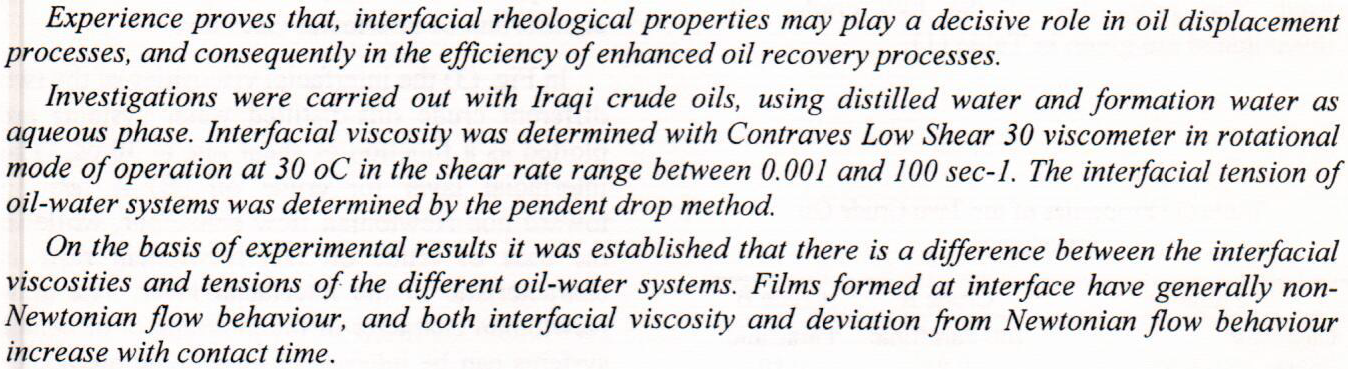
Interfacial Rheological Properties of Iraqi Crude Oils Water System

Background: Several infectious lung diseases often develop in patients with Rheumatoid arthritis (RA), especially during immunosuppressive medication, including disease-modifying anti-rheumatic drugs (DMARDs). The present study aimed to determine the role of respiratory tract bacterial infection in RA activity. Methods: Blood and sputum samples were collected from 31 patients with RA and 12 healthy subjects as control. The bacterial isolates were isolated and identified in collected sputum by biochemical tests and Vitec 2 system. Results: In the present study, thirty-one patients with RA were compared with 12 healthy subjects. Eight patients with RA were not infected with pathogenic bacteria (RA-NIPB) (25.8%). Twenty-three RA patients wer
... Show More
Nanoparticles of copper sulfide have been prepared by simple reaction between using copper nitrate with different concentrations ratio 0.1, 0.3, and 0.5 mM, thiourea by a simple chemical route. The prepared Nano powders have been deposited onto glass substrates by casting method at 60°C. The structure of the product Nano- films has been studied by x-ray diffraction, where the patterns showed that all the samples have a hexagonal structure of covellite copper sulfide with the average crystalline sizes 14.07- 16.51 nm. The morphology has been examined by atomic force microscopy, and field emission scan electron microscopy. The AFM images showed particles with almost spherical and rod shapes with average diameter sizes of 49.11- 90.64 nm.
... Show More (12)
(12)
 (2)
(2)

 (39)
(32)
(39)
(32)
Polyaniline membranes of aniline were produced using an electrochemical method in a cell consisting of two poles. The effect of the vaccination was observed on the color of membranes of polyaniline, where analysis as of blue to olive green paints. The sanction of PANI was done by FT-IR and Raman techniques. The crystallinity of the models was studied by X-ray diffraction technique. The different electronic transitions of the PANI were determined by UV-VIS spectroscopy. The electrical conductivity of the manufactured samples was measured by using the four-probe technique at room temperature. Morphological studies have been determined by Atomic force microscopy (AFM). The structural studies have been measured by (SEM).
(13)
(9)
The effect of saline magnetized water irrigation on seed germination and seedling growth of wheat cultivar Iraq were studied. Irrigation water was supplemented with different levels of Sodium chloride 6, 12 or 18 mmhos/ cm in addition control treatment, and passed through a proper magnetic felid with 1000, 1250, 1500 or 2000 gaus in addition control treatment. The results showed significantly stimulated shoot development and led to the increase of germination, seedling emergence, area leaf, length of shoot and root and fresh and dry weight compared to the controls. Results also showed significant interaction between saline water and magnetized water. So, using magnetic treatment of saline water could be a promising technique
... Show More
(1)
Objective: The objective of the present study was to design and optimize oral fast dissolving film (OFDF) of practically insoluble drug lafutidine in order to enhance bioavailability and patient compliance especially for a geriatric and unconscious patient who are suffering from difficulty in swallowing.Methods: The films were prepared by a solvent casting method using low-grade hydroxyl propyl methyl cellulose (HPMC E5), polyvinyl alcohol (PVA), and sodium carboxymethyl cellulose (SCMC) as film forming polymers. Polyethylene glycol 400 (PEG400), propylene glycol (PG) and glycerin were used as a plasticizer to enhance the film forming properties of the polymer. Tween 80 (1% solution) and poloxamer407 were used as a surfactant, citri
... Show More
(15)
(7)
(2)
Bacteria strain H8, which produces high amount of exopolysaccharide (EPS), was isolated from soil, and identified as strain of Azotobacter chrococcum by its biochemical /physiological characteristics, EPS was extracted, partially purified and used as bioflocculant. The biochemical analysis of the partially purified EPS revealed that it was an alginate. analysis of EPS by Fourier transform infrared spectrometry (FTIR) show that the -OH groups present in bioflocculant are clearly seen at 3433.06 cm-1, the peaks attributed to the -CH3 groups present at 2916.17 cm-1 , and some distinct peaks such as carboxyl group showed strong absorption bands at 1604.66 cm-1, 1411.80 cm-1 and 1303.79 cm-1 indicate the chemical structure of alginate. The effe
... Show MoreThe aim of this investigation was to study the impact of various reaction parameters on wastewater taken from Al-Wathba water treatment plant on Tigris River in south of Baghdad, Iraq with sodium hypochlorite solution. The parameters studied were sodium hypochlorite dose, contact time, initial fecal coliform bacteria concentration, temperature, and pH. In a batch reactor, different concentrations of sodium hypochlorite solution were used to disinfect 1L of water. The amount of hypochlorite ions in disinfected water was measured using an Iodimetry test for different reaction times, whereas the Most Probable Number (MPN) test was used to determine the concentration of coliform bacteria. Total Plate Count (TPC) was utilized in this study to
... Show More
Previously, many empirical models have been used to predict corrosion rates under different CO2 corrosion parameters conditions. Most of these models did not predict the corrosion rate exactly, besides it determined effects of variables by holding some variables constant and changing the values of other variables to obtain the regression model. As a result the experiments will be large and cost too much. In this paper response surface methodology (RSM) was proposed to optimize the experiments and reduce the experimental running. The experiments studied effects of temperature (40 – 60 °C), pH (3-5), acetic acid (HAc) concentration (1000-3000 ppm) and rotation speed (1000-1500 rpm) on CO2 corrosion performance of t
... Show More