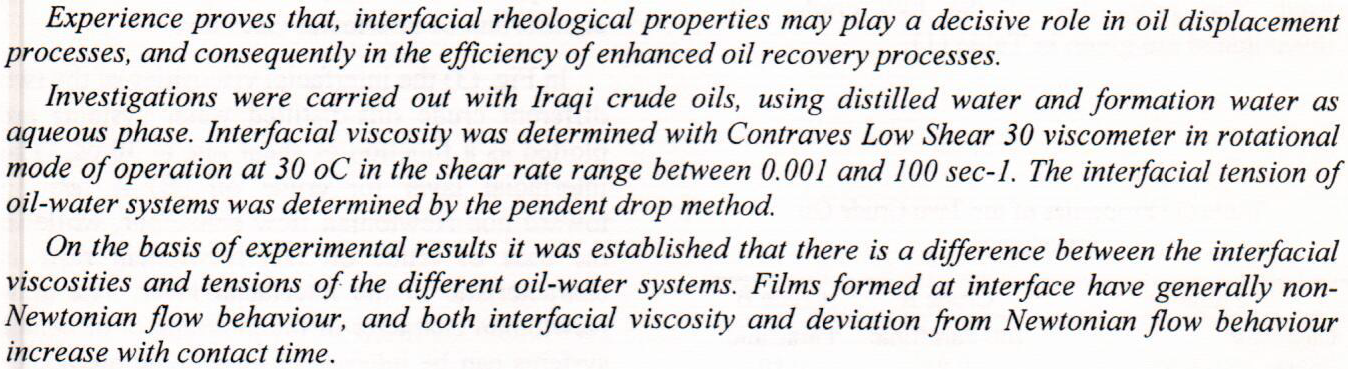
Interfacial Rheological Properties of Iraqi Crude Oils Water System

This study is concerned with the effect of Deep Cryogenic Treatment (DCT) at liquid nitrogen temperature (-196 o C) on the mechanical properties and performance of low carbon steel (A858). The tests specimens were divided in to two groups, the first group was subjected to the conventional heat treatment of normalizing, and the second group was also normalized then subjected to (DCT). The results have shown that after (DCT), the Hardness, Tensile properties and the impact energy absorbed were all slightly increased. However the fatigue test showed some positive improvement in fatigue limit by 20(N/mm2 ), and the volume wear rates at different loads were significantly decreased after (DCT). The changes in microstructure due to (DCT) were c
... Show More (1)
(1)

This research aims to investigate and evaluate a reactive powder concrete (RPC) cast using economical materials. Its mechanical properties were investigated and evaluated by studying the effects of using different cement and silica fume contents and locally steel fibers aspect ratios as reinforcement for this concrete. A compressive strength of about 155.2MPa, indirect tensile strength of 16.0MPa, modulus of elasticity of 48.7GPa, flexural strength of 43.5MPa, impact energy of 3294.4kN.m and abrasion loss 0.59% have been achieved for reinforced RPC contains 910 kg/m3 cement content, silica fume content 185 kg/m3 of cement weight and fiber volume fraction 2%. The water absorption values w
... Show MoreAbstract:Porous Silicon (PSi) has been produced in this work by using Photochemical (PC) etching process by using a hydrofluoric acid (HF) solution. The irradiation has been achieved using quartz- tungsten halogen lamp. The influence of various irradiation times on the properties of PSi اmaterial such as layer thickness, etching rate and porosity was investigated in this work too. The XRD has been studied to determine the crystal structure and the crystalline size of PSi material
Cobalt substituted nickel copper ferrite samples with general formula Ni0.95-xCoxCu0.05Fe2O4, where (x= 0.00, 0.01, 0.02, 0.03, 0.04 and 0.05) were prepared by solid-state reactions method at 1373 K for 4h. The samples prepared were examined by X-ray diffraction (XRD(, atomic force microscope (AFM), Fourier transform infra-red spectroscopy (FTIR) and Vickers hardness. X-ray diffraction patterns confirm the formation of a single phase of cubic spinel structure in all the prepared samples . XRD analysis showed that the increase in the cobalt concentration causes an increase in the lattice constant, bulk density (ρm) and the x-ray density (ρx), whereas porosity (p) and crystallite size (D) decrease. The Topography of the surface observed
... Show More
(1)
Sheets of Epoxy (EP) resin with addition of TiO2 of grain size (1.5μm, and 50nm) and weight percentage (1%, 3%, and 5%) were prepared. Discs of 20mm diameter and 3mm thickness were cut for dielectric measurements. Dielectric properties (dielectric constant, dispassion factor and electrical conductivity) over the frequency range 102 -106 Hz were measured.
Comparison was made between the effect of micro and nano particles of TiO2 on the dielectric properties of EP composites with different weight percentage. Epoxy composites with micro sized particles of TiO2 were observed to have the better values of dielectric properties.
During the last quarter century, many changes have taken place in the tanks industry and also in the materials that used in its production، while concrete is the most suitable material where concrete tanks has the benefits of strength, long service life and cost effectiveness. So, it is necessary improvement the
conventional concrete in order to adapt the severe environment requirements and as a result high
performance concrete (HPC) was used. It is not fundamentally different from the concrete used in the past, although it usually contains fly ash, ground granulated blast furnace slag and silica fume, as well as
superplasticizer. So, the content of cementitious material is high and the water/cement ratio is low. In this
stu
(2)
Free cement refractory concrete is a type of refractory concrete with replacing alumina cement by bonding materials such as white kaolin, red kaolin and fumed silica. The free cement refractory concrete used in many applications like Petrochemicals, iron furnaces and cement production industries. The research clarifies the effect of steel fibers with two types crimped steel fibers and hooked steel
fibers with percentages 0.5%, 1% and 1.5% by volume from weight of bauxite aggregates. The additions of steel fibers with two types gave good properties in high temperatures where the specimens keep the dimension without failure and the properties made the best. the percentage of increasing for thermal conductivity was 44% for 1.5% crimped
(6)
Tin Oxide (SnO2) films have been deposited by spray pyrolysis technique at different substrate temperatures. The effects of substrate temperature on the structural, optical and electrical properties of SnO2 films have been investigated. The XRD result shows a polycrystalline structure for SnO2 films at substrate temperature of 673K. The thickness of the deposited film was of the order of 200 nm measured by Toulansky method. The energy gap increases from 2.58eV to 3.59 eV when substrate temperature increases from 473K to 673K .Electrical conductivity is 4.8*10-7(.cm)-1 for sample deposited at 473K while it increases to 8.7*10-3 when the film is deposited at 673K
Assume that G ≅ HN the Harada–Norton group. In this paper, effective investment for the graph ΓRI HN standard features to acquire meaningful algebraic results for the graph ΓRI HN and its corresponding group HN. For instance, marketing a modern methods to understand the way of create a precise small subgroups in G. Furthermore, performing a full investigation for getting particular ΓRI HN parameters.


Recently, a great rise in the population and fast manufacturing processes were noticed. These processes release significant magnitudes of waste. These wastes occupied a notable ground region, generating big issues for the earth and the environment. To enhance the geotechnical properties of fine-grained soil, a sequence of research projects in the lab were conducted to analyze the impacts of adding sludge waste (SW). The tests were done on both natural and mixed soil with SW at various proportions (2%, 4%, 6%, 8%, and 10%) based on the dry mass of the soil used. The experiments conducted focused on consistency, compaction, and shear strength. With the addition of 10% of SW, the values of LL and PI decreased by 29.7% and 3
... Show More
(3)