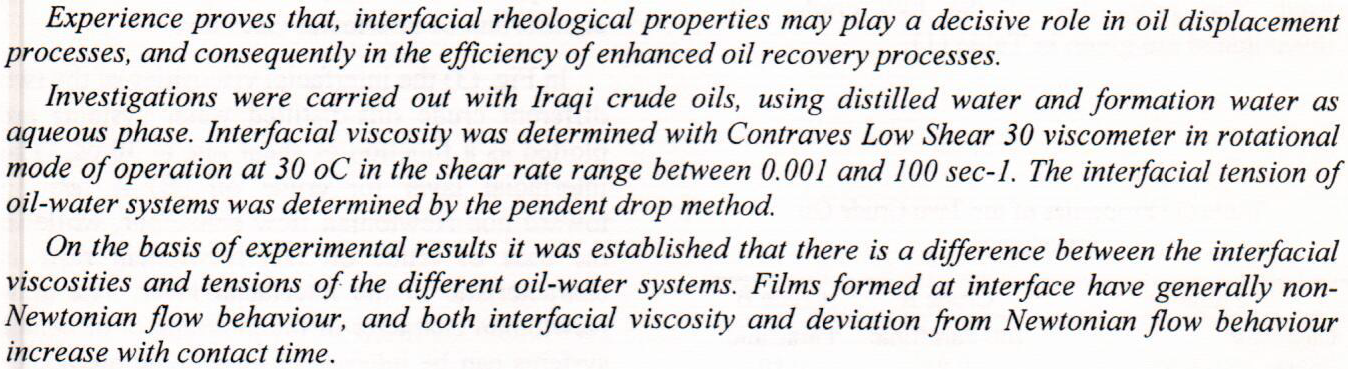
Interfacial Rheological Properties of Iraqi Crude Oils Water System

A simple , sensitive and accurate spectrophotometric method for the trace determination of bismuth (III) has been developed .This method is based on the reaction of bismuth (III) with arsenazo(III) in acid solution (pH=1.9) to form a blue water soluble complex which exhibits maximum absorption at 612nm .Beer's law is obeyed over the concentration range of 2-85 ?g bismuth (III) in a final volume of 20 mL( i.e. 0.1 – 4.25?g.mL-1) with a correlation coefficient of (0.9981) and molar absorptivity 1.9×10⁴ L.mol-1.cm-1 . The limit of detection (LOD) and the limit of quantification (LOQ) are 0.0633 and 0.0847 ?g.mL-1 , respectively . Under optimum conditions,the stoichiometry of the reaction between bismuth (III) and arsenazo(III) r
... Show More
Tigris River is one of the main important surface water resources in Iraq. This necessitates continuous study of its quality . The present study is concerned with the characteristics and quality of Tigris water passing through in Baghdad city. (eight) samples were collected from the river in the area Grea't City. The study periods were carried over four season, which has been sampled once represent the every season. First sampling 12-11-2012 represent the autumn season The second sampling 20-1-2013 to represent the winter season. The third in 25-3- 2013 to represent the Springer season. The fourth during 29-5-2013 to represent the summer spring season. In order to specify the water quality, a group of physical and chemical analyses have bee
... Show MoreNatural polymers are often non-toxic, biodegradable, biocompatible, and safe. A novel ligand was synthesized as a natural polymer using chitosan and oleander plant extract [(2R,3S,4R,5S)-5-(acetoxyamino)-4-hydroxy-3,6-dimethoxytetrahydro-2H-pyran-2-yl) methyl (16R)-3-(((2S,4S,5R)-4-methoxy-2,5-dimethyltetrahydro-2H-pyran-2-yl)oxy-10,13,16-trimethyl-17-(5-oxo-2,5-dihydrofuran-3-yl) hexadecahydro-14H-cyclopenta [a] phenanthren-14-yl) phthalate] (Chitosan-Ph-Oleander). This ligand and its complexes with several metals (Cr+3, Mn+2, Fe+3, Ni+2, Cu+2, Zn+2) were characterized using FTIR, UV-visible and 1H-NMR spectroscopy, as well as by molar conductivity, magnetic moment, and TGA analysis. The biological activity for the prepared polymer
... Show More (2)
(2)

Chlorine disinfection is a globally used method to ensure the safety of drinking water. However, it has not always been successful against viruses and, therefore, it is important to find new methods to disinfect water. Seventeen different coliphages were isolated from the treated municipal wastewater. These coliphages and MS2 were treated with different dosages of chlorine in drinking water, and a combined chlorine/ultraviolet irradiation treatment for the chlorine-resistant coliphages. Chlorine disinfection with 0.3–0.5 mg/L total chlorine (free Cl-dosage 0.12–0.21 mg/L) for 10 min achieved 2.5–5.7 Log10-reductions for 11 sensitive coliphages. The six most resistant coliphages showed no reduction with these chlorine concentra
... Show More
(36)
 (37)
(37)

This study examines experimentally the performance of a horizontal triple concentric tube heat exchanger TCTHE made of copper metal using water as cooling fluid and oil-40 as hot fluid. Hot fluid enters the inner annular tube of the TCTHE in a direction at a temperature of 50, 60 and 70 oC and a flow rate of 20 l/hr. On the other hand, the cooling fluid enters the inner tube and the outer annular tube in the reverse direction (counter current flow) at a temperature of 25 oC and flow rates of 10, 15, 20, 25, 30 and 35 l/hr. The TCTHE is composed of three copper tubes with outer diameters of 34.925 mm, 22.25 mm, and 9.525 mm, and thicknesses of 1.27 mm, 1.143 mm, and 0.762 mm, respectively. TCTHE tube's length was 670
... Show More
Thin films of Magnetite have been deposited on Galvanized Steel (G-S) alloy using RF-reactive magnetron sputtering technique and protection efficiency of the corrosion of G-S. A Three-Electrodes Cell was used in saline water (3.5 % NaCl) solution at different temperatures (298, 308, 318 & 328K) using potentiostatic techniques with. Electrochemical Impedance Spectroscopy (EIS) and fitting impedance data via Frequency Response Analysis (FRA) were applied to G-S alloy with Fe3O4 and tested in 3.5 % NaCl solution at 298K.Results taken from Nyquist and Bode plots were analyzed using software provided with the instrument. The results obtained show that the rate of corrosion of G.S alloy increased with increasing the temperatures from 298 t
... Show More
This study was carried out to study effect of magnetic water ( M0 and M) and different concentrations of coconut extract in Fragaria x ananassa (Duch) C.V Festival. The results showed significant differences in the plants treated with magnetic water ( 0.12 Tesla) and different concentrations of coconut extract C1 (0%), C2 (2.5%), C3 (5%), C4 (7.5%) and C5 (10%) in vegetative parameters as in leaf area and chlorophyll in treatment M0C3 was (53.72 Dcm2, 50.00), respectively, highest leaf number and plant dry weight in MC4 (12.77,14.22 gm), respectively. Results recorded significant differences in fruit parameters such as weight in MC1 (18.97 gm). The maximum fruit number was in MC3 (110), the greatest fruit size was in MC4 (15.78 cm3) and the
... Show More
(2)
(3)