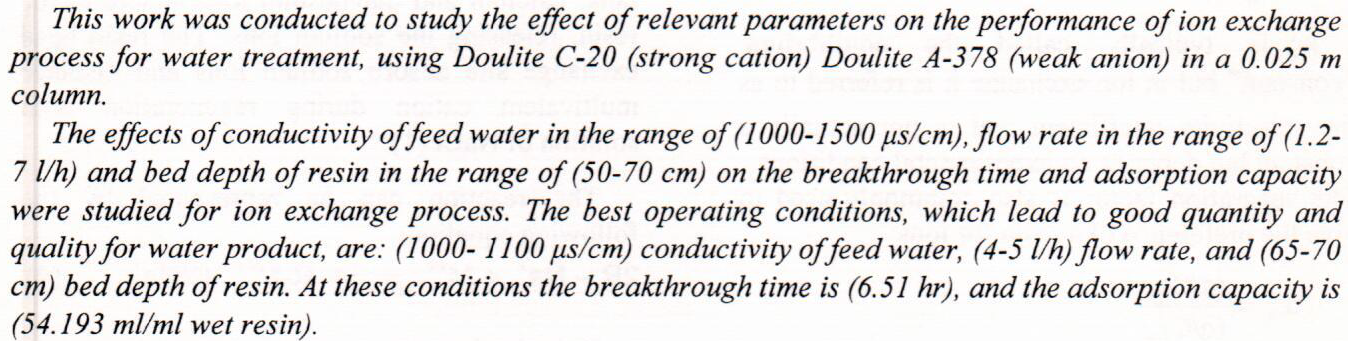
Water Treatment of Cooling Towers Blowdown by Ion Exchange

 (5)
(5)


This study revealed the efficiency of Bacillus subtilisin degrading two textile dyes (disperse red and disperse yellow), the rates of red dye removal when measured after 24, 48, 72 and 96 hours for the concentrations of 50 ppm were 51.67, 67.56, 84.67 and 95.33%, for the concentration 150 ppm were 41.67, 62.67, 80.67 and 89.67%, while for the concentration 300 ppm were 25.67, 42.67, 71.67 and 84.33%. The results of yellow dye removal showed that the concentration of 50 ppm were 49.67, 65.33, 83.33 and 92.67%, for the concentration of 150 ppm were 38.33, 60.33, 77.33 and 87.33%, and for the concentration, 300 ppm were 24, 36.67, 68.33 and 81.67%, when measured after 24, 48, 72 and 96 hours. Results recorded a slight decrease in pH valu
... Show MoreGrowth of Penicillium expansum, an ubiquitous mould found in stored fruit globallyt, was significantly restricted by exposure to 48 h cell-free supernatant of two strains of Lactobacillus plantarum (p < 0.001). In addition, the biotransformation of patulin, a toxic secondary metabolite formed by P. expansum, on exposure to L. plantarum cells and cell-free supernatant highlights the potential of this GRAS microbe as a biocontrol agent. Up to 80% of patulin was biotransformed following a 4 h incubation with 1010 cells ml−1 (37 °C) forming E- and Z-ascladiol. The formation of these products was more pronounced at elevated pH and cell density. Exposure to cell free supernatant or sonicated cells resulted in complete patulin biotransformation
... Show More
(81)
 (87)
(87)

The extraction of Basil oil from Iraqi Ocimum basillicum leaves using n-hexane and petroleum ether as organic solvents were studied and compared. The concentration of oil has been determined in a variety of extraction temperatures and agitation speed. The solvent to solid ratio effect has been studied in order to evaluate the concentration of Ocimum basillicum oil. The optimum experimental conditions for the oil extraction were established as follows: n-hexane as organic solvent, 60 °C extraction temperature, 300 rpm agitation speed and 40:1mL:g amount of solvent to solid ratio.
(11)
(9)
(2)
(3)
Background. Nanocoating of biomedical materials may be considered the most essential developing field recently, primarily directed at improving their tribological behaviors that enhance their performance and durability. In orthodontics, as in many medical fields, friction reduction (by nanocoatings) among different orthodontic components is considered a substantial milestone in the development of biomedical technology that reduces orthodontic treatment time. The objective of the current research was to explore the tribological behavior, namely, friction of nanocoated thin layer by tantalum (Ta), niobium (Nb), and vanadium (V) manufactured using plasma sputtering at 1, 2, and 3 hours on substrates made of 316L stainless steel (SS),
... Show More
(10)
(7)
In recent decades, global obesity has increased significantly, causing a major health problem with associated complications and major socioeconomic issues. The central nervous system (CNS), particularly the hypothalamus, regulates food intake through sensing the metabolic signals of peripheral organs and modulating feeding behaviors. The hypothalamus interacts with other brain regions such as the brain stem to perform these vital functions. The gut plays a crucial role in controlling food consumption and energy homeostasis. The gut releases orexigenic and anorexigenic hormones that interact directly with the CNS or indirectly through vagal afferent neurons. Gastrointestinal peptides (GIP) including cholecystokinin, peptide YY, Nesf
... Show More
(1)
(1)
(33)
(30)
A nano manganese dioxide (MnO2) was electrodeposited galvanostatically onto a carbon fiber (CF) surface using the simple method of anodic electrodeposition. The composite electrode was characterized by field emission scanning electron microscopy (FESEM), and X-ray diffraction (XRD). Very few studies investigated the efficiency of this electrode for heavy metals removal, especially chromium. The electrosorption properties of the nano MnO2/CF electrode were examined by removing Cr(VI) ions from aqueous solutions. NaCl concentration, pH, and cell voltage were studied and optimized using the Box-Behnken design (BDD) to investigate their effects and interactions on the electrosorption process. The results showed that the
... Show More
Single Walled Carbon nanotubes (SWCNTs), as nano-needle structures, are good candidates as nanocarrier delivery systems that carry drug to the site of action. They are good due to their unique pharmaceutical properties. Teniposide is an anticancer drug, which is widely used, but it has a problem of low solubility. In this study, to improve the properties of carbon nanotubes, pre-functionalization of carbon nanotubes via carboxylation with strong acids has been performed and then functionalized through attaching them to the polymer and copolymer. Concurrently, a proper polymer-copolymer combination has been selected by the UV-Visible spectrometer at 880nm. It is selected based on the qualitative dispersibility analysis, the visual observa
... Show More