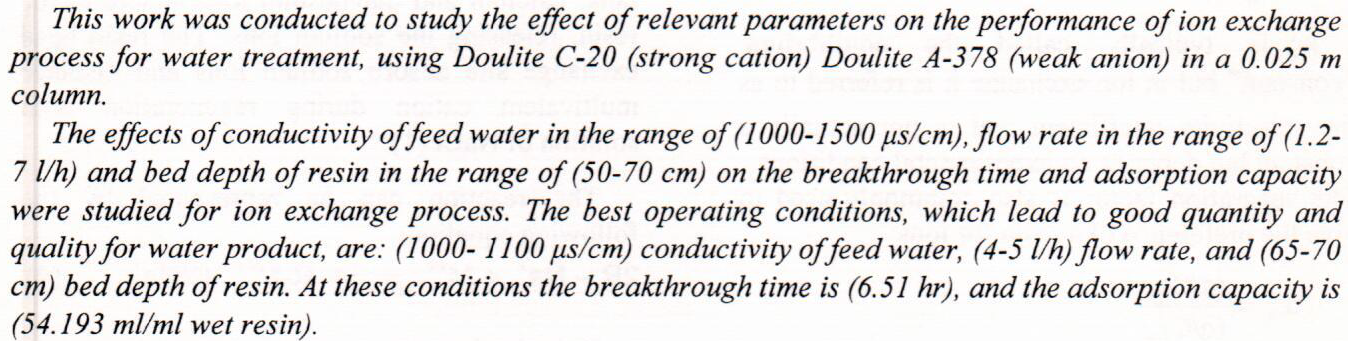
Water Treatment of Cooling Towers Blowdown by Ion Exchange

This research studied the effect of magnetized water in concrete preparation and its effect on the presenting of cement in concrete mixtures also to find the ability of reducing the amount of cement in preparing one cubic meter, this is not exceed than 10% in one mixture , The experiments showed the preparation of standard cubes from the concrete which was used two kind of water magnetized water which was prepared by passing the tap water through the systems of different magnetic strength in terms of (6000,9000) Gauss and the ordinary water . The velocity of water through the magnetic field, which gives us the highest value for the compressive strength, was up to 1m/sec. to determine the best magnetic intensity, we examined The comp
... Show More (1)
(1)

This study was conducted to study the cytogenetic effect of both alcoholic and water extracts of propolis on mice. Three different samples of propolis were collected from three different regions of Iraq (Najaf, Arbil and Baghdad) to be used in this study. The cytotoxic effect of two different doses of each extracted sample was measured by employing cytogenetic analysis which included (mitotic index (MI), chromosomal aberrations (CAs), micronucleus index (MN) and sperm abnormalities). Results showed that significant increase in MI and significant reduction in MN, CAs and sperm abnormalities percentage were seen after treatment with both alcoholic and water extract of the three samples when compared with negative control, and alcoholic extrac
... Show MoreExperimental measurements of viscosity and thermal conductivity of single layer of graphene . based DI-water nanofluid are performed as a function of concentrations (0.1-1wt%) and temperatures between (5 to 35ºC). The result reveals that the thermal conductivity of GNPs nanofluids was increased with increasing the nanoparticle weight fraction concentration and temperature, while the maximum enhancement was about 22% for concentration of 1 wt.% at
35ºC. These experimental results were compared with some theoretical models and a good agreement between Nan’s model and the experimental results was observed. The viscosity of the graphene nanofluid displays Newtonian and Non-Newtonian behaviors with respect to nanoparticles concen
Epoxy (EP) – Silica (SiO2) composites are well known composites used in microelectronic industry . So it is important to study their dielectric behavior under different conditions such as
the presence carbon black (UV absorber) and immersion in the water for 30 days .
Dielectric properties were calculated over the frequency range 102 – 106 Hz for epoxy composites with different weight % of micrometer 1.5μm SiO2 particles (60%, 65% and 70wt%) modified with 0.5wt% silane coupling agent to improve adhesion between EP and SiO2 phases .
 (5)
(5)

This study focuses on a comparison of the performance of two similar locally-fabricated solar water heaters. One of the collectors features a new design for accelerated absorber; its risers are made of converging ducts whose exit area is half that of the entrance. The other collector is a conventional absorber, with risers of the same cross sectional area along its length. Each collector is the primary part of an indirect thermosyphon circulation solar hot water system. Both collectors face south with a fixed tilt angle of 33.3
(11)
(3)
Abstract
In order to enhance the efficiency of flat plate solar water collectors without changing in its original shape and with low additional cost, twisted strips are inserted inside its riser pipes. Three flat plate collectors are used for test. Family of twisted strips are inserted inside each collector risers with different twisted ratios (TR=3,4,5). The collectors are connected in parallel mode (Z-Configuration) and are exposed to the same conditions (solar radiation and ambient temperature) .The experimental results show that, the highest heat transfer rate occurs at twisted ratio (3) .Consequently, for the same twisted ratio the daily efficiencies for the solar collector at d
... Show More
(1)
Air stripping for removal of Trichloroethylene (TCE), Chloroform (CF) and Dichloromethane (DCM) from water were studied in a bubble column (0.073 m inside dia. and 1.08 m height with several sampling ports). The contaminated water was prepared from deionized water and VOCs. The presence of VOCs in feed solution was single, binary or ternary components. They were diluted to the concentrations ranged between 50 mg/l to 250 mg/l. The experiments were carried out in batch experiments which regard the bubble column as stirred tank and only gas was bubbled through stationary liquid. In this case transient measurements of VOC concentration in the liquid phase and the measured concentra
... Show More
