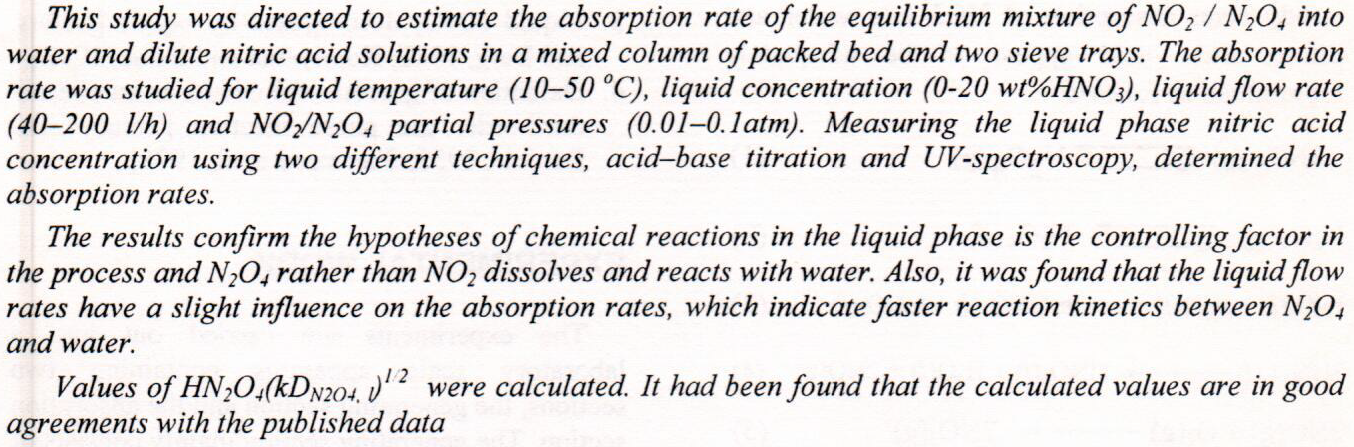
Absorption of NO2 into Water and Nitric Acid Solutions in a Fixed Column

The importance of the present work falls on the pitting corrosion behavior investigation of 304 SS and 316 SS alloys in 3.5 wt% of aqueous solution bearing with chloride and bromide anion at different solutions temperature range starting from (20-50)oC due to the pitting corrosion tremendous effect on the economic, safety and materials loss due to leakage. The impact of solution temperatures on the pitting corrosion resistance at 3.5wt% (NaCl and NaBr) solutions for the 304 SS and 316 SS has been investigated utilizing the cyclic polarization techniques at the potential range -400 to1000 mV vs. SCE at 40 mV/sec scan rate followed by the surface characterization employing Scanning Electron&nbs
... Show MoreBackground: The purpose of this study is to compare the color changes between the bonded middle third and the unbonded gingival and incisal thirds, fallowing fixed orthodontic treatment Material and method: The color parameter l, a, b has been recorded for each thirds in upper anterior teeth by mean of easy shad device. The has been calculated for gingival, middle and incisal thirds for the upper anterior teeth in 34 patient, 17 males and 17femals, those subject undergone fixed orthodontic treatment Results: The in middle bonded third is highly significant higher than that in incise and gingival thirds p<0.01 because the middle third isn’t expose to oral fluid and dental brushing since it covered by the bracket. Also there
... Show MoreThe present work aims to improve the flux of forward osmosis with the use of Thin Film Composite membrane by reducing the effect of polarization on draw solution (brine solution) side.This study was conducted in two parts. The first is under the effect of polarization in which the flux and the water permeability coefficient (A) were calculated. In the second part of the study the experiments were repeated using a circulating pump at various speeds to make turbulence and reduce the effect of polarization on the brine solution side.
A model capable of predicting water permeability coefficient has been derived, and this is given by the following equations:
Z=Z0 +C.R.T/9.8(d2/D2+1) [Exp. [-9.8(d
 (2)
(2)
 (2)
(2)



Nitrogen dioxide NO2 is one of the most dangerous contaminant in the air, its toxic gas that cause disturbing respiratory effects, most of it emitted from industrial sources especially from the stack of power plants and oil refineries. In this study Gaussian equations modelled by Matlab program to state the effect of pollutant NO2 gas on area around Durra refinery, this program also evaluate some elements such as wind and stability and its effect on stacks height. Data used in this study is the amount of fuel oil and fuel gas burn inside refinery at a year 2017. Hourly April month data chosen as a case study because it’s unsteady month. After evaluate emission rate of the all fuel and calculate exit velocity from
... Show More
(20)
(8)
In the cuurent article, the photophysical properties of 3,6-bis(5-bromothiophen-2-yl)-2,5-bis(2-ethylhexyl)-2,5-dihydropyrrolo[3,4-c]pyrrole-1,4-dione were investigated. The visible absorption bands at 527, 558 and 362 nm in propylene carbonate and the compound was found to be fluorescent in solution and in the plastic film with emission wavelengths between 550- 750 nm. The Stokes Shift of P.C., acetonitrile, diethyl ether, Tetrahydrofuran THF, cyclohexane, dibutyl ether, and dichloromethane DCM are 734, 836, 668, 601, 601, 719, and 804 cm-1 in respectively. The Stokes Shift Δ was less in THF and cyclohexane, than the solvents, which indicates that the energy loss is less between the excitation and fluorescence states. The
... Show More
The paper aims at initiating and exploring the concept of extended metric known as the Strong Altering JS-metric, a stronger version of the Altering JS-metric. The interrelation of Strong Altering JS-metric with the b-metric and dislocated metric has been analyzed and some examples have been provided. Certain theorems on fixed points for expansive self-mappings in the setting of complete Strong Altering JS-metric space have also been discussed.
(2)
(2)
Wastewater treatment plants operators prefer to make adjustments because they are more cost effective, to use the existing tank instead of building new ones. In this case an imported materials would be used as bio-loads to increase biomass and thus maintain efficiency as the next organic loading increases.In the present study, a local substance "pumice stone" was used as a biological carrier in the aeration tank, and the experiments were carried out in five stages: without biological carriers, filling ratio of 4%,10%,20%, and25% with pumice stone, the maximum organic loading at each stage (1.1884, 1.2144, 1.9432, 2.7768, 3.3141)g BOD /l.d respectively.Other experiments were carried out to determine the best filling ratio, the SS remova
... Show More
(4)
(7)
(4)
(26)